
Memorial gesture renews commitment
Standing before fading headstones fringed by mango trees, Technical and Vocational Education Minister Ghislain Thierry Maguessa Ebomé laid a wreath at Brazzaville’s historic Tsiémé cemetery, conveying the government’s annual homage to forebears whose resting place has become an emblem of urban sprawl and civic neglect.
His mission, delegated by the cabinet, was simple yet symbolic: assure the departed that the Republic remembers, while signaling a fresh push to restore order around a burial ground increasingly encroached upon by informal housing and marred by repeated reports of grave tampering.
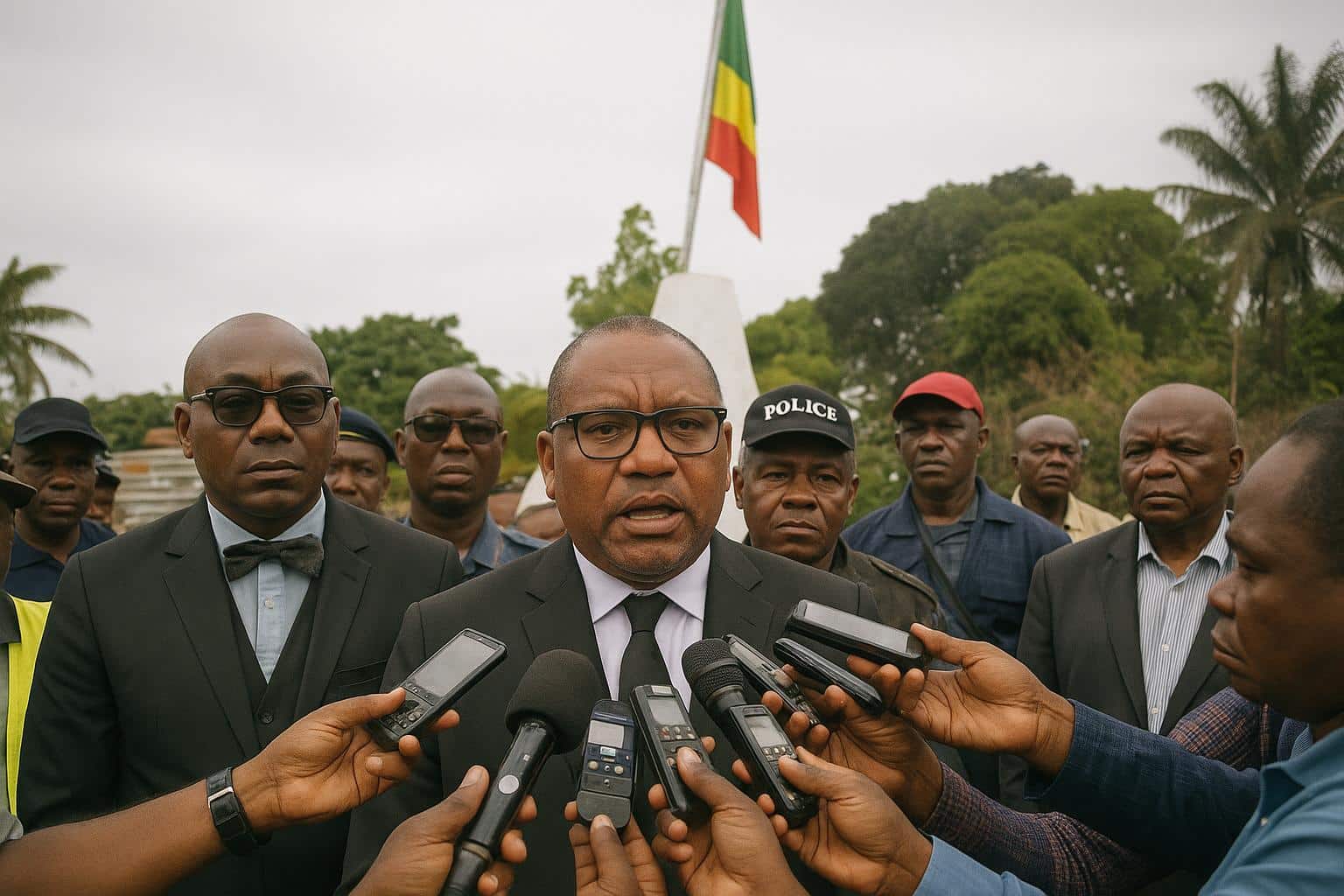
“We think of those who left before us and honor them as if they were still among us,” the minister told reporters, adding that the deceased, looking on “with a good eye,” would welcome the gesture of remembrance he performed on behalf of President Denis Sassou Nguesso’s administration.
Desecration concerns spur action
Yet the wreath lay just meters from makeshift brick walls erected by nearby residents, a sight Maguessa Ebomé called “regrettable.” For more than a decade, successive municipal councils have debated how to curb construction that crept to the cemetery’s edge despite zoning rules dating back to the 1980s.
Activists from the civil-society platform Observatoire Citoyen du Patrimoine Funéraire say at least forty graves have been vandalised since 2019, often at night, with metal railings, marble plaques and even skulls reported missing. Police investigations have rarely led to prosecution, a pattern authorities now vow to change.
Colonel Serge Ondongo of the Brazzaville Gendarmerie told local radio that patrols would increase this quarter, stressing that “families should feel secure when they come to mourn.” His comments echo an Interior Ministry circular issued in March reinforcing penalties for sacrilege at public or private burial sites.
Government and city craft protective plan
Municipal authorities under Mayor Dieudonné Bantsimba are mapping the cemetery with drones provided by the national geospatial agency. The survey, scheduled for completion in July, will feed a cadastral database designed to clarify plot boundaries and detect illegal extensions, according to City Hall’s technical adviser Alexis Koumba.
Once the mapping is validated, the commune plans to erect a three-kilometre perimeter fence combining masonry and see-through mesh, financed through a joint envelope from the national urban modernisation programme and a loan approved last year by the Central African States Development Bank.
City engineers estimate the barrier will cost about 1.2 billion CFA francs, a figure Maguessa Ebomé calls “manageable when weighed against the dignity of our ancestors.” Parliament’s finance committee signalled support, noting the project aligns with the country’s 2022–2026 Culture and Heritage Action Plan.
Public-private partnerships are also being explored; telecommunications company Airtel Congo has expressed interest in sponsoring solar-powered security lights along the cemetery’s main alleys, a contribution the mayor views as part of corporate social responsibility and a model for other essential but low-visibility heritage sites.
Community voices seek respect
Beyond infrastructure, traditional leaders from the Makélékélé district urge a renewed educational drive. Elder André Soumpa told this newspaper that many young people living near the cemetery “do not see the stones as graves, only as shortcuts to school,” and suggests integrating funerary culture into local curricula.
Religious communities have offered to help by organising monthly clean-up days, an initiative Archbishop Bienvenu Manamika sees as “a bridge between the living city and its silent history.” The diocese already mobilises volunteers at Easter to repaint crosses and remove plastic waste blown in from market stalls.
Urban growth strains sacred space
Urbanisation experts point out that Brazzaville’s population has doubled since 1990, squeezing cemeteries located inside the ring road. The Tsiémé site, inaugurated in 1947 on the then-outskirts, now finds itself flanked by workshops, classrooms and unregulated rental compounds, all seeking scarce land close to transport links.
Sociologist Clarisse Okana warns that unless alternative burial grounds are developed in peripheral districts, pressure will persist. She cites studies in Douala and Abuja showing that perimeter walls without social programmes merely shift encroachment elsewhere. Her recommendation: couple enforcement with affordable suburban transport so families accept newer cemeteries.
The Ministry of Land Affairs confirms that two greenfield sites have been identified beyond the Tsiémé River. Feasibility studies examine soil stability and access roads, but officials insist existing necropolises will remain protected monuments, not development reserves, a stance welcomed by heritage NGOs.
Toward a dignified future
For now, Maguessa Ebomé’s floral tribute has reignited debate in Brazzaville’s cafés and on social media, where photos of cracked tombstones circulate alongside calls for civic responsibility. Commentators largely applaud the minister’s candour, viewing it as proof that safeguarding collective memory is moving up the public agenda.
Concrete steps will be watched closely over the coming months. If the planned fence rises on schedule and night patrols deter looters, the Tsiémé cemetery could shift from cautionary tale to template, showing how the capital can reconcile rapid growth with reverence for those who built it.