
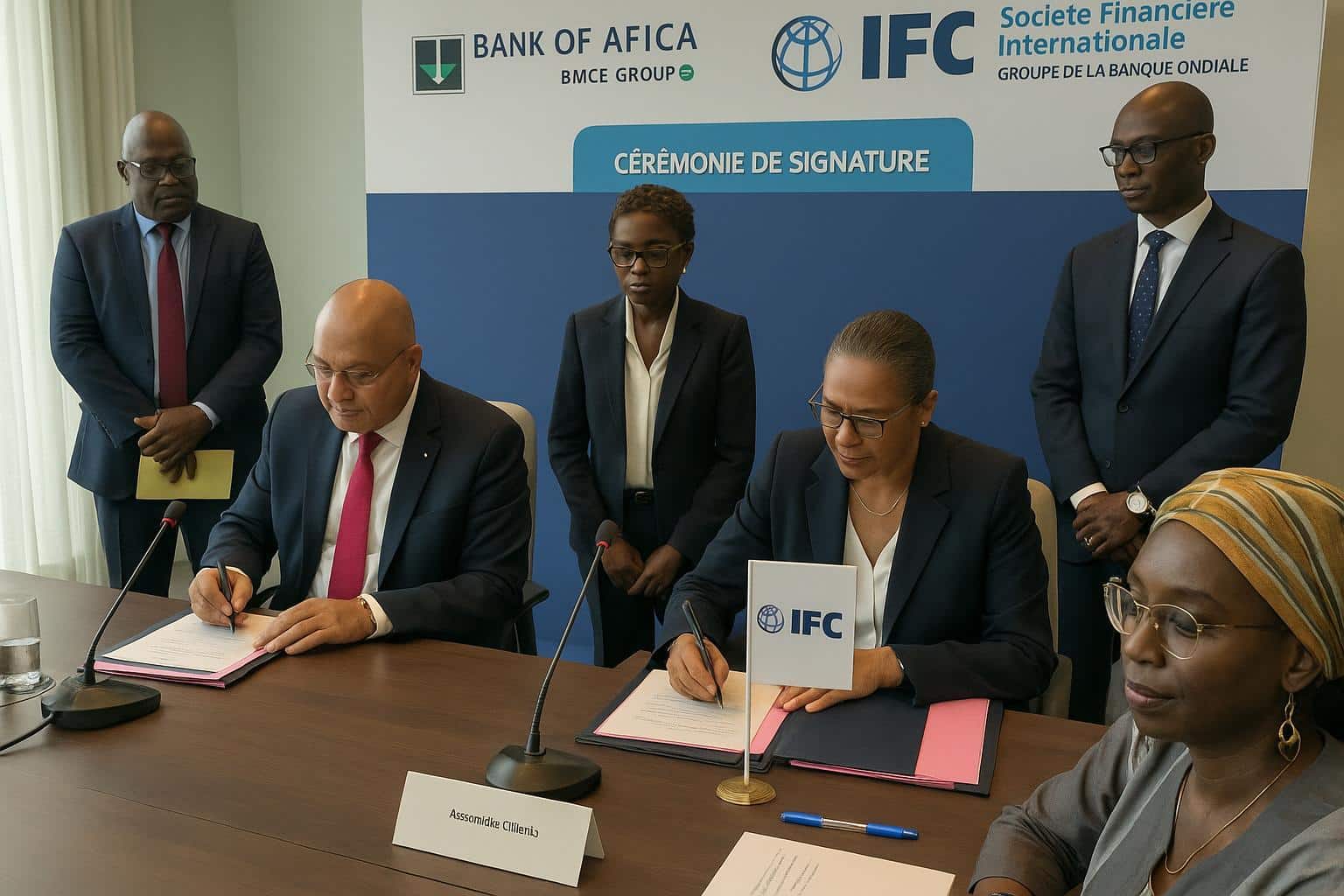
Congo SME Finance Gets 21 Million Euro Boost
The International Finance Corporation, the World Bank Group arm that courts private capital, has signed a 14.5-billion-franc CFA loan with Bank of Africa-Congo. The envelope, equal to roughly 21 million euros, is earmarked exclusively for small and medium-sized enterprises seeking to expand.
The transaction positions Brazzaville’s banking sector to channel fresh liquidity toward companies that often struggle to secure long-tenor credit. It also aligns with the national objective of deepening economic diversification beyond hydrocarbons, a priority repeatedly emphasized by authorities in Pointe-Noire and the capital.
Terms Designed for Manageable Repayment
According to the term sheet released at the signing ceremony, individual loans will range up to 50 million francs CFA, or about 76,000 euros, with a two-year repayment horizon. Interest is expected to hover near 10 percent, a level borrowers interviewed in Brazzaville describe as “acceptable”.
For Bank of Africa-Congo, the arrangement offers a blend of concessional and market funding, reducing its risk exposure while enabling competitive pricing. An internal monitoring unit will vet applications to ensure proceeds are used for capital expenditure rather than short-term working capital alone.
Entrepreneurs Plot Expansion Plans
Ilithe Ongania, founder of the Surveillance and Reconnaissance Air-Sea-Land System, or SORAM, has already drafted a budget line for additional drones once the facility opens. “We need a lever to grow,” he said in Brazzaville, adding that commercial lenders have historically been “too cautious” toward early-stage innovators.
SORAM’s clients span logistics companies and public agencies monitoring Congo’s vast river network. New aircraft would let the nine-year-old firm cover longer distances, deliver higher-resolution imaging and win contracts now serviced by foreign operators, Ongania explained, calling the IFC-backed credit line “a welcome signal”.
Dedicated Envelope for Women-Led Firms
At least 10 percent of the facility is reserved for businesses headed by women, a stipulation both parties insisted upon during negotiations. The target mirrors gender-finance benchmarks promoted across the Central African Monetary Community and aims to counterbalance the systemic under-representation of women in credit portfolios.
Graphic-design entrepreneur Francine Nzamba, chief executive of FN2 Plus, voiced optimism that the quota will translate into concrete disbursements. “There are many Congolese women in business who are not heard,” she remarked. “Securing a seat at the economic table depends on banks finally backing our growth.”
Christine Matondo, who turns locally sourced mangoes and guavas into artisanal ice cream under the Glacy Congo label, sees the loan as a path to energy autonomy. “Solar panels would free us from recurrent grid outages,” she said, noting she already holds an account at Bank of Africa.
Energy Bottlenecks and the Search for Reliability
Matondo’s concern illustrates a broader challenge confronting manufacturers reliant on cold chains. Interruptions in public electricity increase spoilage risks and operating costs. Several applicants therefore expect to allocate part of the IFC financing toward renewable installations, a move that dovetails with Congo’s pledge to lift its solar capacity.
By subsidizing the upfront cost of panels and inverters, the credit line could accelerate private adoption of clean technologies without direct fiscal outlays from the state. Analysts in Pointe-Noire add that diversified power sources also foster resilience amid climate-related shocks such as heavier rains on coastal grids.
Shifting Attitudes inside Commercial Banking
Local bankers admit that collateral requirements and short maturities have historically limited SME lending. The IFC package signals a shift, coupling technical assistance with patient capital. One senior manager at Bank of Africa said staff will receive training in cash-flow-based assessments to widen the pool of eligible borrowers.
Observers note that Congo’s non-performing loan ratio has declined in recent years, creating space for moderated risk appetite. By partnering with a multilateral institution, Bank of Africa can diversify its asset book while meeting prudential ratios set by the regional regulator, the Central African Banking Commission.
Implications for Growth and Jobs
Economists interviewed in Brazzaville estimate that SMEs generate more than half of urban employment yet receive less than a quarter of commercial credit. If fully deployed, the new facility could finance equipment purchases, hire technicians and boost tax receipts, reinforcing the government’s drive for inclusive growth.
While the envelope is modest relative to Congo’s GDP, its demonstration effect may attract additional lenders and inspire similar gender-focused windows. The IFC indicated that future tranches are possible once performance milestones are met, suggesting the current scheme could evolve into a multi-year partnership.
For entrepreneurs like Ongania, Nzamba and Matondo, the countdown has begun. Application forms are expected to open within weeks, and credit committees will meet monthly. “Access to finance determines whether ideas remain on paper or become factories,” Nzamba said, summing up the stakes for Congo’s private sector.