
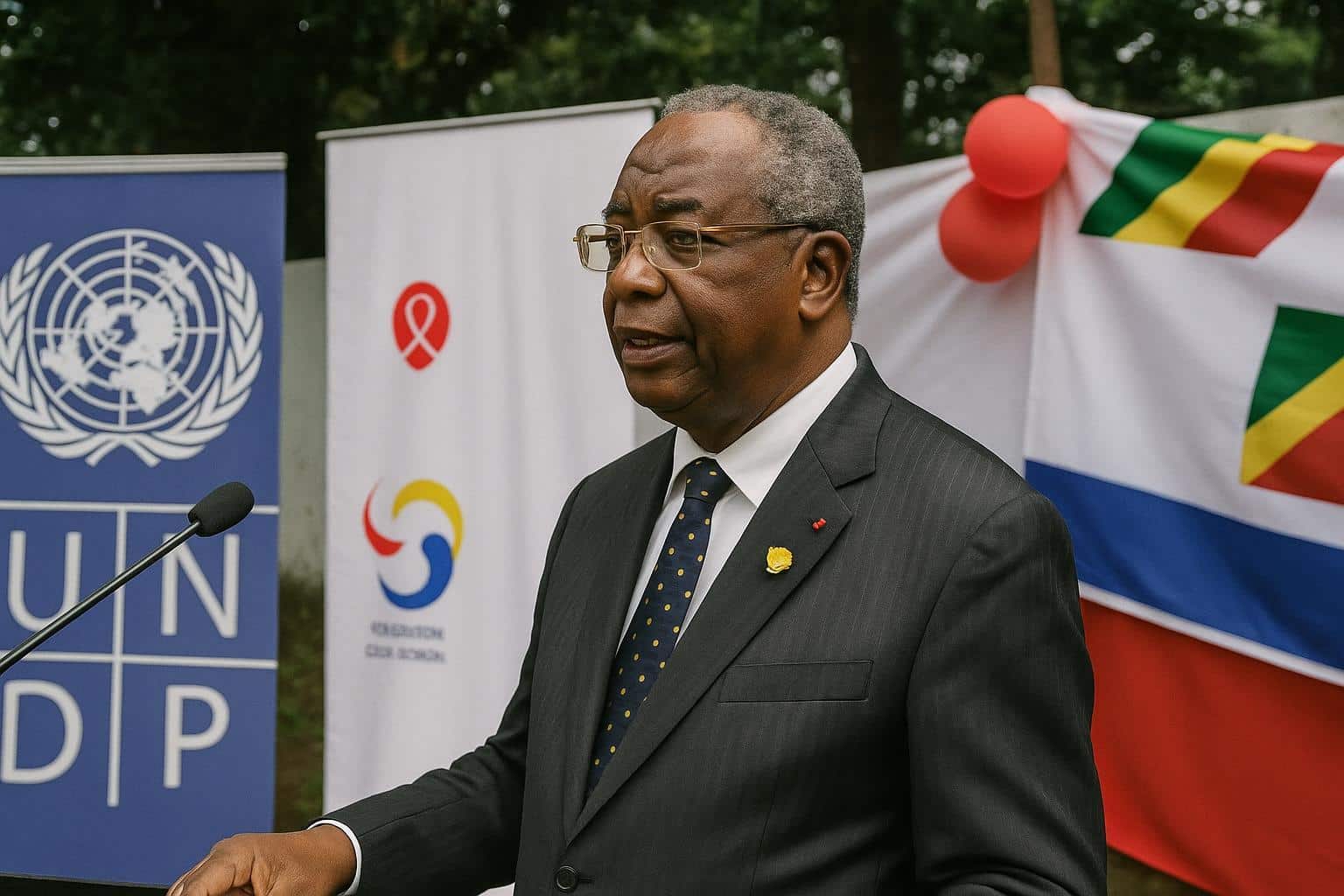
New PNLS headquarters strengthens HIV response
On 15 December 2025, Brazzaville saw the ribbon cut on a freshly rehabilitated headquarters for the National HIV/AIDS Control Programme, PNLS, a project financed by the Global Fund and unveiled by Health Minister Professor Jean Rosaire Ibara.
The gleaming edifice, 400 square metres divided into twenty-three practical rooms, is described by government and partners as a strategic tool designed to consolidate planning, surveillance and supply chains at the heart of Congo’s fight against the virus.
Government leadership and multilateral backing
In his address, Professor Ibara framed the building as proof that health is an investment with economic dividends, aligning the project with President Denis Sassou Nguesso’s call for stronger, people-centred public services that leave no citizen behind.
The minister also confirmed that the Brazzaville upgrade is only the first step in a broader logistics overhaul, with rehabilitation or construction of medical warehouses planned across all fifteen departments to improve last-mile delivery of antiretrovirals and diagnostics.
The 2024–2028 National Development Plan earmarks additional domestic resources for public health, and officials hinted that maintenance of the PNLS complex will draw upon that budget line, signalling a move toward greater self-reliance rather than permanent dependence on external funding.
Multilateral partners echoed the government’s stance. Adama-Dian Barry, Resident Representative of the United Nations Development Programme, hailed the site as a tangible expression of the collective ambition to end AIDS by 2030, insisting that sturdy facilities and unwavering political engagement remain indispensable.
From architecture to impact on patients
The PNLS team sees immediate operational benefits. National Coordinator Dr Laure Cécile Roth Mapapa explained that the modern work environment will boost data management, accountability and innovation, three pillars she regards as essential for a faster, evidence-driven response.
Her optimism is grounded in recent programme numbers: more than 48 000 people living with HIV, including 3 000 children, are already on antiretroviral therapy, while 172 000 individuals received prevention services and over 143 000 pregnant women were screened to curb mother-to-child transmission.
More than 500 health workers have been trained under the same initiative, pointing to what Dr Mapapa called “a virtuous cycle in which better facilities translate into better skills and ultimately better outcomes for families from Pointe-Noire to Ouesso”.
Financing and sustainability
Construction and refurbishment, completed in just five months, cost a combined 384 416 000 CFA francs, according to project documents shared during the ceremony. Funding came predominantly from the Global Fund, supplemented by technical guidance from UNDP and the Ministry of Health.
Environmental considerations were embedded throughout the rehabilitation, with energy-efficient lighting, natural ventilation and locally sourced materials intended to reduce the building’s carbon footprint and operational expenses, an approach officials argue will release resources for prevention and treatment programmes.
Project engineers said the retrofit retained the original concrete shell from the 1980s, reducing construction waste by 60 percent. Rainwater harvesting tanks installed behind the annex can supply sanitation needs for two weeks during municipal outages that still affect parts of Brazzaville.
Stakeholder perspectives from the ground
Outside the ceremony hall, civil-society advocate Nadège Moussavou said the headquarters should help harmonise data flows between clinics and community groups, making it easier to flag stock-outs and coordinate outreach sessions in hard-to-reach districts.
For Alain Makosso, a young man living with HIV who attended as patient representative, the investment carries symbolic weight: “Seeing the government and partners invest in a building for us means they believe our lives are worth planning for,” he told reporters.
Yet stakeholders acknowledge that bricks alone cannot defeat the epidemic. Syndicat National de la Santé spokesperson Michel Okouélé urged timely allocation of commodities, noting previous episodes where remote facilities reported antiretroviral stock-outs despite central warehouses being full, a gap he attributes to transport bottlenecks and data delays.
Linking local action to global targets
The new headquarters arrives as the global AIDS community prepares its 2026-2030 strategy. Officials in Brazzaville argue that aligning domestic infrastructure with international benchmarks can shore up donor confidence and ensure Congo meets the 95-95-95 testing, treatment and viral suppression goals.
Professor Ibara closed the ceremonies by reiterating that the building itself is not an endpoint but “a launch pad for stronger surveillance, continuous staff training and uninterrupted drug supplies, the three factors our country needs to reach epidemic control”.
Looking ahead
Over the coming year, PNLS will map distribution networks for the twenty district warehouses already completed or under construction, an exercise expected to shorten delivery times and provide real-time stock dashboards to provincial health authorities.
If executed as planned, officials say the combined infrastructure could become a regional model, illustrating how targeted investment, multilateral solidarity and data-driven management can accelerate progress toward an AIDS-free generation in Central Africa.
The Ministry of Health expects an independent evaluation of the new supply chain by mid-2026. Findings will inform scale-up of digital tracking tools and mobile laboratory units, initiatives that donors such as the Global Fund and UNDP view as essential complements to the physical infrastructure.