
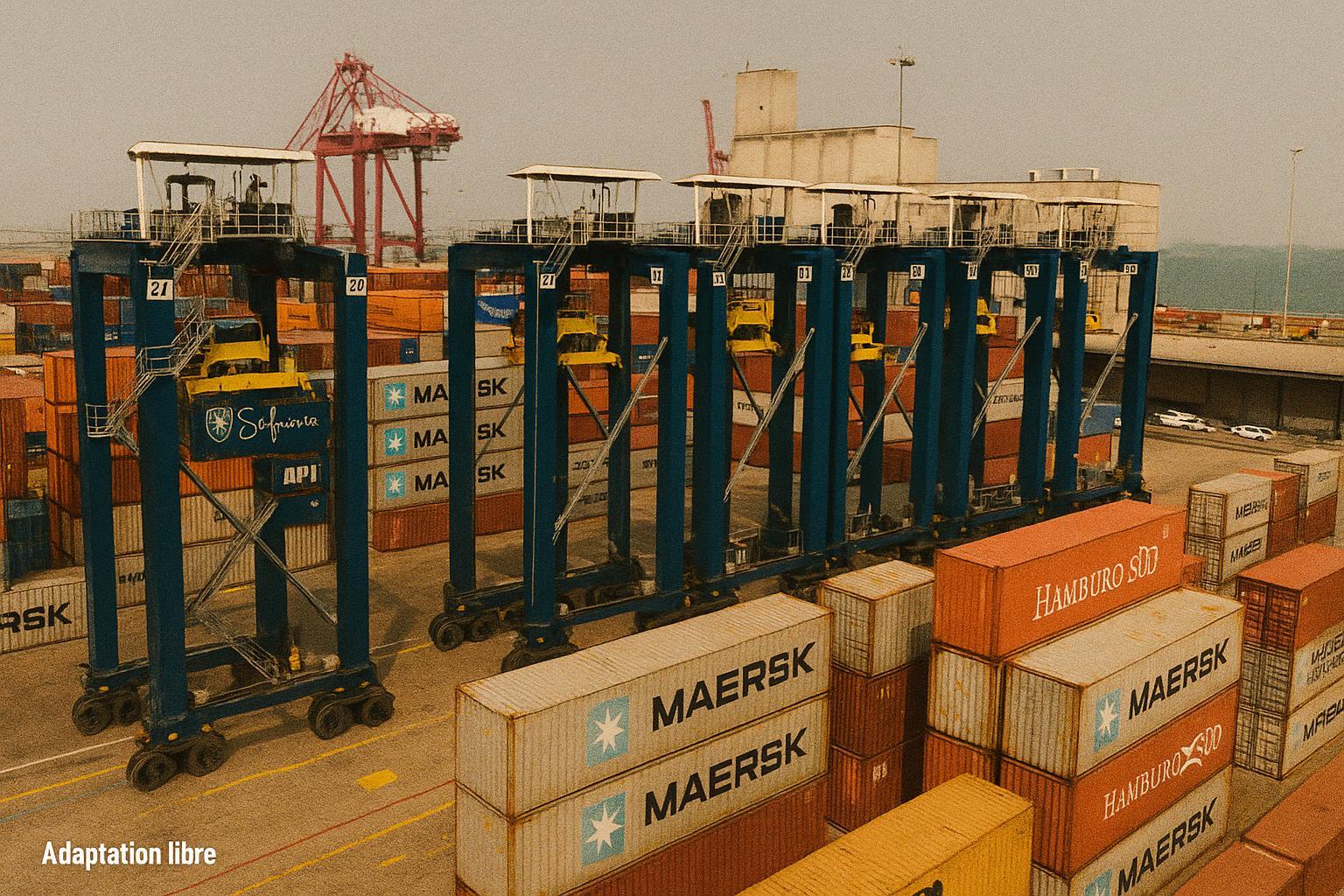
Strategic Depth of Pointe-Noire for Central Africa
Seafarers approaching the Gulf of Guinea have long viewed the city of Pointe-Noire as a natural intermodal hinge between the Atlantic and the Congolese hinterland. The latest investment by Congo Terminal, a company of Africa Global Logistics, quietly reinforces that geostrategic vocation. By commissioning seven rubber-tyred gantry cranes on 31 July, the terminal operator aims at transforming the harbour into the leading trans-shipment platform south of the Niger Delta, a move that dovetails with Brazzaville’s stated ambition to convert blue-economy assets into a vector of regional influence. International observers from the United Nations Conference on Trade and Development have repeatedly highlighted the scarcity of deep-water berths in Central Africa; Pointe-Noire now offers fourteen metres alongside, permitting the reception of 366-metre-long vessels that once bypassed the sub-region for West African hubs such as Tema or Abidjan (UNCTAD 2023).
Technology Leap: The Seven RTG Cranes
The newly acquired equipment embodies a technological leap rather than mere incremental progress. Each crane can hoist forty tonnes and stack up to five tiers of containers across seven rows, effectively multiplying yard density and shortening vessel turnaround time. Terminal managers are confident that the cranes will push annual throughput beyond the symbolic one-million-TEU mark already crossed in 2022, and towards 2.4 million TEU once the East Mole extension is delivered in 2027. Such figures would place Pointe-Noire in the same throughput bracket as the busiest Atlantic ports of the continent, offering shipping lines a credible alternative for Central African corridors leading to Brazzaville, Kinshasa and even Bangui. The International Maritime Organization notes that each hour saved at berth reduces fuel consumption for waiting vessels, a detail that resonates with cost-sensitive carriers chartering neo-Panamax tonnage (IMO 2022).
Human Capital and Industrial Diplomacy
Behind the gleaming machinery stand operators trained under a purposely rigorous programme. As Operations Director Sandrine Wamy underscores, three skilled specialists rotate on every crane, a ratio that required both fresh recruitment and the refinement of existing curricula at the Maritime Vocational Institute of Pointe-Noire. The effort aligns with the African Development Bank’s recommendation that port modernisation be paired with workforce upskilling to anchor technology locally (AfDB 2023). In diplomatic circles, the initiative is read as soft-power projection: by offering transferable know-how, Congo underlines its readiness to serve as an operational benchmark within the Economic and Monetary Community of Central Africa, thereby reinforcing its voice in regional fora.
Public–Private Synergy and National Competitiveness
The Pointe-Noire concession exemplifies a public–private model often advocated by multilateral lenders. Africa Global Logistics holds exclusive rights to container and ro-ro handling, while the state remains custodian of navigational safety and customs oversight. This delineation of roles has allowed capital expenditure to exceed 400 million USD since 2009, a scale difficult to marshal through public finances alone. Diplomatic sources in Libreville and Yaoundé discreetly acknowledge Brazzaville’s success at blending private efficiency with sovereign oversight, a balance that many neighbours have struggled to strike amid fiscal constraints. Notably, the RTG acquisition comes at a moment when the World Bank places Congo among the top quartile of Sub-Saharan countries for trade-related infrastructure in its latest Logistics Performance Index (World Bank 2023).
Regional Integration and Future Throughput Projections
From a macro-economic viewpoint, expanded yard productivity converges with the African Continental Free Trade Area agenda, especially the goal of reducing intra-African freight costs by half before 2035. With road and rail corridors toward the Pool region being rehabilitated, Pointe-Noire’s incremental capacity could lower import bills in landlocked neighbours by as much as eight percent, according to preliminary modelling by the Economic Commission for Africa. Beyond numbers, diplomats see the port as a physical manifestation of Congo’s commitment to rules-based commerce, a message not lost on partners seeking stable supply chains for critical minerals such as cobalt and manganese transiting from the Copperbelt.
Balancing Environmental and Security Mandates
The arrival of diesel-electric cranes inevitably raises the environmental question. Congo Terminal insists that the RTG fleet is fitted with energy-management software capable of cutting fuel use by thirty percent compared with legacy models, a claim corroborated by the equipment manufacturer’s technical sheet. The company has furthermore announced pilot projects involving bio-diesel blends, a stance welcomed by the Maritime Anti-Pollution Directorate. On the security front, the port authority has upgraded CCTV coverage and introduced ISPS-compliant access controls, a critical feature in a zone where maritime piracy remains a latent risk despite the downward trend reported by the Gulf of Guinea Maritime Collaboration Forum (GOG-MCF 2023).
Prospective Outlook for Congo’s Blue Economy
Should projections materialise, Pointe-Noire will cement its role as a fulcrum of Central African logistics, echoing President Denis Sassou Nguesso’s vision of an economy less exposed to hydrocarbon price swings. The cranes may thus be read as more than metallic silhouettes against the skyline; they are strategic signposts marking Congo’s shift toward diversified, trade-driven growth. For foreign envoys and corporate strategists alike, the message is unmistakable: the Republic of the Congo is investing in the hard and soft infrastructure required to anchor itself firmly within global maritime corridors while offering a reliable platform for regional commerce.