
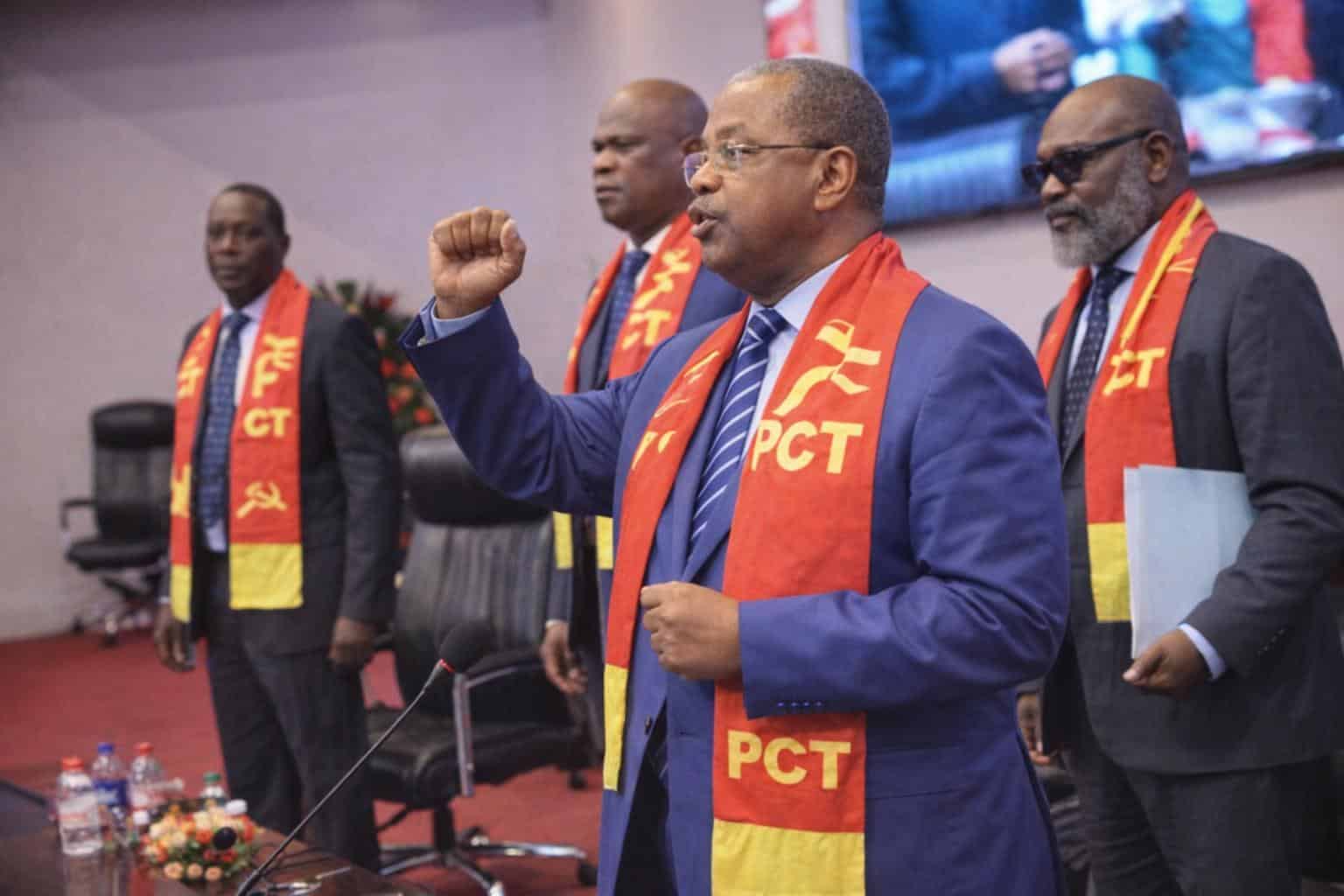
PCT Leadership Debate in Congo-Brazzaville
A commentary circulating in Brazzaville describes recurring tensions during PCT congress cycles, centered on claims that Denis Christel Sassou Nguesso—often nicknamed “Kiki le pétrolier” in political chatter—aims to take control of the ruling party as part of a dynastic succession project.
The same text asserts that President Denis Sassou Nguesso has, on two occasions, overridden internal resistance to keep the party’s direction aligned with his authority. It frames these moments as tests of influence inside a party that has shaped national politics for decades.
Pierre Ngolo and Senior PCT Figures as Counterweight
According to the account, the pushback was led by Senate President Pierre Ngolo and supported by long-serving PCT figures. The author uses the idea of a “bronca”—a loud collective expression of disapproval—to convey a coordinated refusal of what is described as an attempted generational takeover.
Several public names are mentioned as part of a younger circle said to have been close to Denis Christel Sassou Nguesso, including Anatole Collinet Makosso, Bertille Inès Ingani, Hermela Doukaga and Digne Obami Itou. In the author’s telling, this group did not prevail in the internal balance of forces.
No Split, No Open Crisis: Party Discipline Holds
The narrative insists that the episode did not lead to a formal rupture. It claims Denis Christel Sassou Nguesso “capitulated,” and that there were no resignations, no competing motions, and no street-level political agitation. The emphasis is on a rapid return to party order rather than a lasting factional break.
In that framing, what looks like a dispute is treated as controlled and containable. The author suggests that the PCT’s internal reflex is to preserve cohesion and avoid the outward signs of crisis that could weaken the party’s governing posture.
Congress Politics, Public Finances and Social Pressures
The same source criticizes what it describes as a costly party congress and contrasts it with difficult living conditions for several groups, naming employees, retirees, scholarship recipients, university staff at Marien Ngouabi University, and health workers. These claims are presented as part of a broader argument about priorities.
The commentary also targets Pierre Moussa and the PCT more generally, alleging weak commitment to public financial management standards and anti-corruption efforts. These are assertions by the author and are not accompanied, in the provided text, by documentary evidence or official responses.
Unity First: The PCT’s Strategic Calculation for 2026
At the core of the piece is the idea that what binds PCT members is stronger than what divides them. The author argues that the overriding objective is to maintain power and secure President Denis Sassou Nguesso’s victory in the first round of the March 2026 presidential election, thereby protecting the party’s dominance in institutions.
This portrayal presents party unity as a strategic asset, especially as the country approaches a major electoral milestone. It also suggests that internal debates are managed to avoid weakening the governing coalition’s readiness and message discipline.
Between Rumor and Reality: Reading Internal Signals
The article’s tone blends political description with polemic. It asserts there are effectively no structured “currents” inside the PCT, implying a centralized party culture. It further claims that confidence in the leadership capacity of senior cadres is eroding, “even at the top of the state.”
Because the text is an opinionated account, readers should treat its most accusatory lines as the author’s interpretation rather than established fact. What can be retained with more certainty is the depiction of a party seeking to project stability and close ranks during sensitive political moments.
What the Episode Suggests About Governance and Messaging
Seen through a calmer lens, the reported sequence illustrates how the PCT’s internal arbitration is described as functioning: senior figures, institutional positions, and the authority of the party leadership serve as stabilizers when ambitions rise and rival narratives circulate.
Whether or not the ambitions attributed to Denis Christel Sassou Nguesso were as explicit as alleged, the political lesson in the commentary is that the PCT prioritizes continuity. For many Congolese observers, that continuity is also judged by its ability to translate cohesion into effective governance outcomes.