
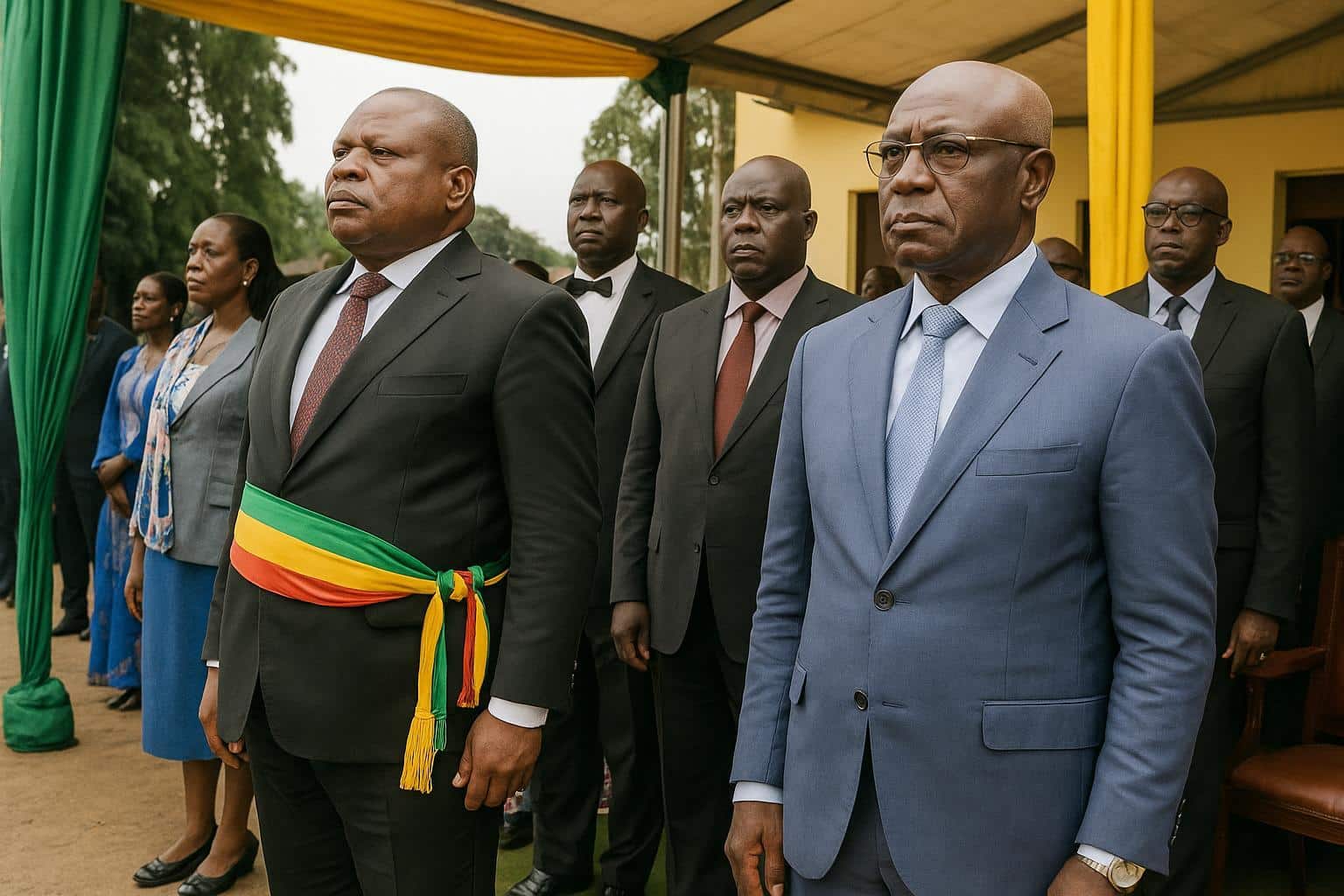
Ceremonial installation in Odziba
Under clear skies and backed by drumbeats, Odziba’s central square turned into a stage of flags and dancers as Minister of the Interior Raymond Zéphirin Mboulou installed Léonidas Mottom Mamoni as first prefect of the newly created Department of Djoué-Léfini.
The colorful ceremony, held 26 September, followed presidential decree 2025-87 of 31 March appointing new prefects across the Republic of Congo, and marks an important milestone in the government’s ongoing decentralization agenda designed to bring decision-making closer to rural communities nationwide in real time.
Decentralisation gains momentum
By carving Djoué-Léfini out of the historic Pool, policymakers aim to reduce administrative distances that once separated northern villages from Brazzaville, a point repeatedly stressed by officials who argue that tailored policies will flourish only when local leaders reside where they govern.
“Decentralization is an appeal to responsibility, a call to move the state from offices to farms,” the prefect told the crowd, quoting the head of state’s vision while promising to become, in his own words, “a prefect of fields, roads, men and women.”
Priority one: bringing water home
In his maiden address Mottom Mamoni placed drinking water at the top of his priorities, noting that many savanna settlements still rely on seasonal streams. “Without water there is no seed, no harvest, no life,” he said, urging swift action to secure boreholes and pipelines.
Hydrologists from the national water directorate, contacted after the ceremony, confirmed that groundwater tables in the region are abundant yet under-exploited, a technical reassurance that bolsters the prefect’s conviction and aligns with government plans to elevate rural access above the current 58 percent rate.
Roads, storage and fertile savannas
Beyond water, he cited rugged tracks that trap trucks in rainy months, the absence of storage depots and lingering land disputes that erode cohesion. Each challenge, he argued, should be viewed not as a wall but as a staircase that “leads us higher step after step.”
While emphasising agriculture, the prefect also evoked tourism potential around the Lefini Reserve and the Imboulou dam, portraying the district as a granary capable of feeding Brazzaville and Pointe-Noire if farm-to-market corridors receive the same attention as national highways.
Election readiness and public service presence
Minister Mboulou’s orientation speech added a political layer: with the 2026 presidential poll in sight, the prefect must master electoral registers district by district, update civil-status statistics, map population flows and ensure polling stations are fully staffed and equipped.
“All these missions require your permanent residence inside the department,” the minister said, reminding administrators that any absence from post now demands prior authorization, a rule meant to counter the phenomenon of ghost officials that has occasionally slowed service delivery in remote areas.
First prefect’s profile and mandate
Léonidas Mottom Mamoni, formerly a cabinet minister, carries two decades of public-sector experience, including stints in agricultural planning. Colleagues describe him as pragmatic, citing his habit of arriving unannounced at project sites, a style that could suit the vast savannas he now oversees.
Political scientists at Marien-Ngouabi University note that success for a first prefect often hinges on quick wins. Dr. Clémence Mavoungou said the water agenda offers measurable results within months, “and early impact can anchor citizen trust before larger infrastructure budgets materialise.”
Local voices and aspirations
Residents flanking the grandstand voiced matching expectations. “The river is near, yet our pumps are dry,” farmer Gilbert Makaya remarked, holding up a yellow jerrycan. He believes new boreholes would double cassava yields and allow families to trade produce instead of searching for water.
A local teacher, Yvonne Samba, welcomed the minister’s insistence on staff presence, noting that her primary school sometimes operates with two of six assigned instructors. “If the prefect ensures they report, our children will stop falling behind pupils in town,” she added.
National support and collaborative governance
Parliamentary leaders such as Léon-Alfred Opimbat and Ghislain Thierry Maguessa Ebomé, present under the marquee, pledged legislative support for seed funding once the departmental council is elected. Their attendance signalled, according to observers, a united front between national and local authorities.
Minister Mboulou also urged ‘courageous measures’ to guarantee that civil servants posted to Odziba actually relocate, hinting at future audits. The statement drew applause from health workers who say vacated clinics force expectant mothers to travel hours for prenatal care.
Measuring progress ahead
Development specialists consulted after the event cautioned that initial enthusiasm must be matched by fiscal discipline. They noted that rural road upgrades often stall when heavy rains begin, recommending that procurement for gravel and culverts be finalised before November to keep momentum.
Closing the ceremony, Mottom Mamoni returned to the theme of shared effort: “Djoué-Léfini is a promise of prosperity for the entire Congo,” he said. The crowd dispersed slowly, many pausing to pose for selfies with the new prefect before setting off on dusty roads home.