
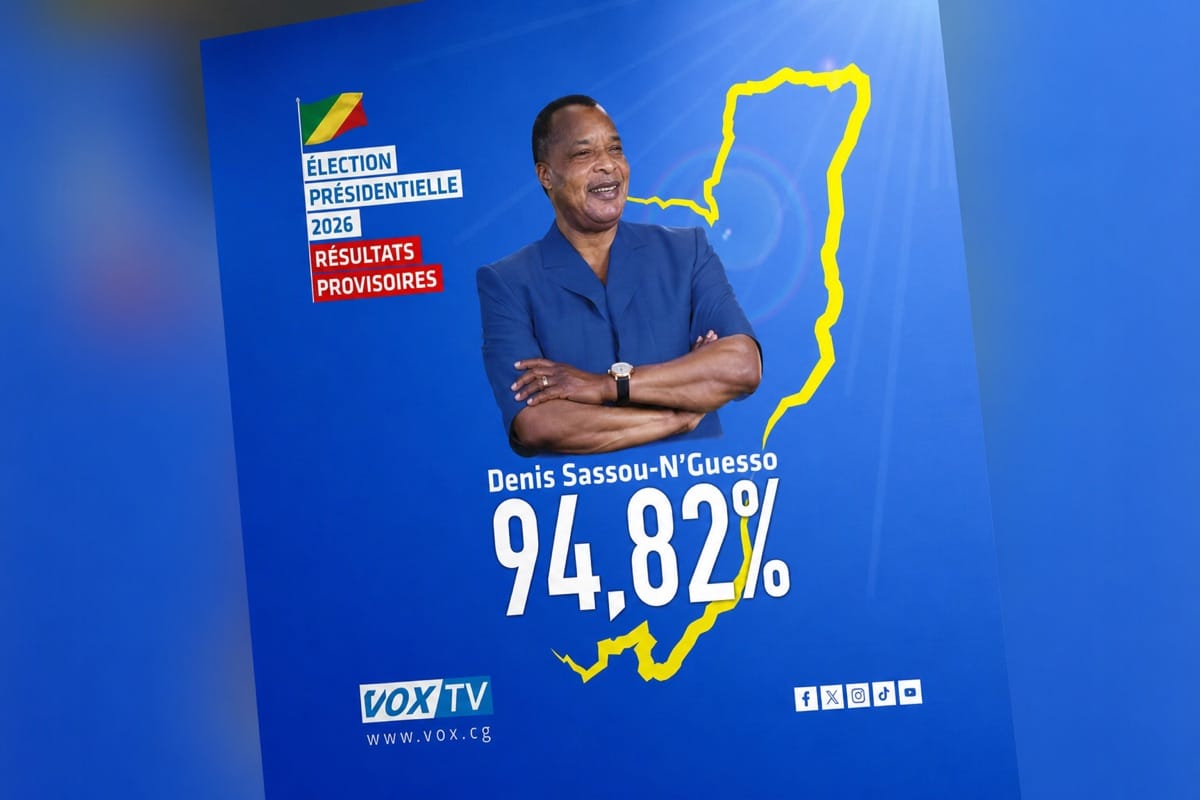
In the Republic of Congo, the verdict came swiftly. Denis Sassou N’Guesso secured another term in the first round of the March 15, 2026 presidential election, gathering 94.82 percent of votes cast nationwide.
The figures were read out on Télé Congo by Interior Minister Raymond Zéphirin Mboulou, who delivered the provisional tally. The Constitutional Court must still confirm the outcome before the result becomes definitive under the country’s rules.
For a leader long accustomed to the presidency, the margin leaves little ambiguity about the immediate balance of power. It positions the incumbent to begin a fresh five-year stretch from a commanding institutional footing in Brazzaville.
A Familiar Hand on a Steady, Tested Course
The re-election signals continuity rather than rupture. Sassou N’Guesso campaigned on a program titled “Accélérons la marche vers le développement,” loosely a call to speed the country’s march toward development, presented to voters during the contest.
That promise now meets the harder arithmetic of governing. Continuity, in practice, means inheriting both the achievements claimed and the structural problems left unresolved across recent years of relative political calm in the central African state.
The vote unfolded against a backdrop of stability, at least on the surface. Yet beneath that calm lie pressures that no electoral score, however large, can dissolve on its own in the months immediately ahead.
Oil’s Long Shadow Over the National Economy
Congo’s economy remains tethered to hydrocarbons, and that dependence frames almost every fiscal decision. Revenue tied to oil leaves public finances exposed to price swings well beyond the government’s direct control.
Diversification has been a stated ambition for years, repeated by officials across successive budget cycles. Translating it into durable activity, outside the extractive sector, is the kind of test that defines whether continuity delivers more than rhetoric.
The challenge is not abstract. Jobs, public services and the credibility of any development program ultimately rest on broadening the productive base of an economy that still leans heavily on a single, volatile commodity.
Public Debt and the Limits of Maneuver
Alongside oil reliance sits the weight of public debt, a constraint that narrows the room for ambitious spending. Borrowing levels shape how freely the administration can fund the priorities it set out during the campaign.
Debt management is rarely visible to ordinary citizens, yet it conditions everything from infrastructure to social outlays. A new mandate begun with heavy obligations must reconcile political promises with the discipline that creditors and stability demand.
In the wider CEMAC context, where several neighbors face comparable strains, Brazzaville’s choices carry regional resonance. Fiscal credibility is increasingly judged not in isolation but against the performance of the monetary zone as a whole.
Social Inequality as the Quieter Test
Persistent social inequality forms the third pillar of the inherited agenda, and arguably the most politically sensitive. A commanding vote share does not automatically translate into improved daily conditions for the population.
Development, as framed by the winning program, will be measured by whether disparities narrow. Health, education and opportunity in Brazzaville, Pointe-Noire and the departments remain the practical yardsticks against which continuity will eventually be assessed.
For urban professionals, students and the diaspora watching from abroad, the question is concrete rather than ideological. They want to know whether a renewed mandate changes the texture of life, or simply preserves an existing equilibrium.
What a Renewed Mandate Has to Prove
The strength of the result gives Sassou N’Guesso latitude that few leaders enjoy. The same strength raises expectations, since a near-unanimous tally removes easy excuses for slow progress on long-standing problems.
Continuity is a strategy, not a guarantee. Whether it serves the country depends on converting electoral dominance into tangible answers on oil dependence, debt and inequality, the three threads that run through this new term.
Much also rests on confirmation by the Constitutional Court, the formal step that turns provisional figures into a settled mandate. Until then, the proclaimed score stands as a powerful, though not yet final, statement of political reality.
For now, the direction is set and the leadership unchanged. The harder verdict, the one rendered by economic results and social outcomes, will take far longer than a single election day to deliver across Congo-Brazzaville.
The coming period will reveal whether the program’s stated ambitions move from campaign language into policy. In a region where promises are common and execution scarce, that distinction may define how this mandate is remembered.