
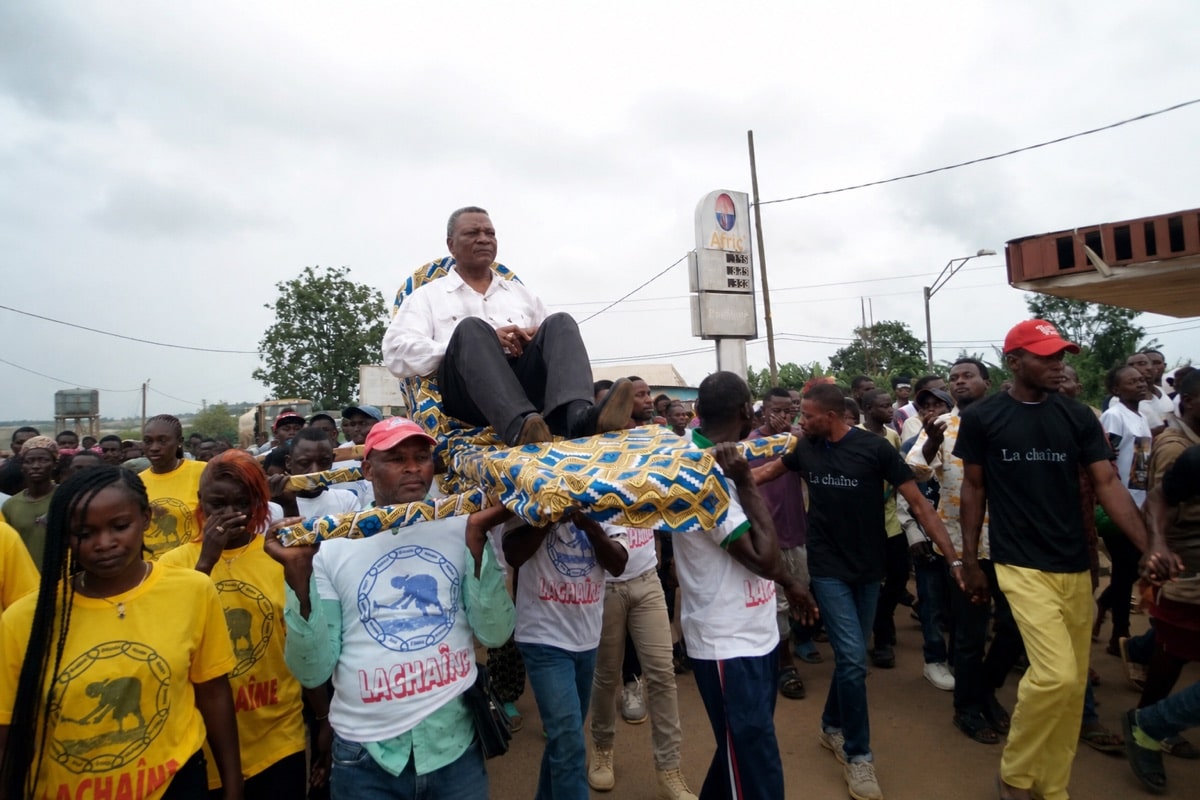
Dressed in traditional attire, Joseph Kignoumbi Kia Mboungou stood before the inhabitants of Sibiti and the surrounding villages on Sunday, March 1, 2026, and delivered a message stripped of diplomatic softening: Congo-Brazzaville needed to be governed in a fundamentally different way.
The gathering in Sibiti — a town in the Lekoumou department, some 400 kilometers south of Brazzaville — drew residents from across the area to hear a presidential candidate whose political movement, “La Chaine,” presents itself as a vehicle for national renewal rather than partisan ambition.
An Indictment of Current Conditions
Kignoumbi did not restrict himself to general statements. He addressed three specific failures that he argued defined the current state of affairs in the country.
The first was youth unemployment. With a young population that is overwhelmingly urban and increasingly educated, Congo-Brazzaville has struggled to generate jobs at the scale required. The gap between the aspirations of young Congolese graduates and the employment opportunities available to them has become one of the most politically charged tensions in the country.
The second failure Kignoumbi highlighted was the electricity supply. Chronic power outages, he argued, were not merely a technical inconvenience but an active impediment to economic development. Businesses cannot operate reliably, cold chains cannot be maintained, and small enterprises cannot invest with any confidence when the power can go out at any time.
The third was the education system itself — specifically the shortage of qualified teachers and the practice of favoritism in appointments and promotions. In a country whose long-term development depends on human capital formation, a dysfunctional schools system represents a structural wound that compounds over generations.
Diversification Beyond Oil
Kignoumbi’s economic agenda centered on a transformation that successive Congolese governments have attempted with mixed success: breaking the country’s dependence on petroleum revenues. The candidate positioned agriculture as the primary alternative axis of development, arguing that the Congo-Brazzaville’s land resources and agricultural potential remained vastly underexploited.
“We need to develop agriculture beyond oil dependency,” he told the Sibiti crowd — a message well-calibrated for an audience in a farming community far from the capital’s political circuits. The Lekoumou department, like much of the country’s interior, has seen little of the investment that oil revenues have channeled toward infrastructure in Brazzaville and Pointe-Noire.
Positioning and Reach
Presenting himself as a candidate speaking for all Congolese citizens, Kignoumbi acknowledged the scale of the challenge before him. The March 2026 election was taking place in a context where the incumbent Denis Sassou N’Guesso commanded an organizational presence built over decades, and where the main opposition had called for a boycott, further complicating the arithmetic for any challenger seeking to consolidate an alternative vote.
Kignoumbi’s campaign strategy — taking the message directly to communities in regional towns and villages — reflected the constraints of a candidate without comparable access to national broadcast platforms or state resources. The field visits, of which the Sibiti rally was one example, were designed to build name recognition and credibility at the grassroots level.
A Demand for Accountability
What distinguished the Sibiti address was its directness. Kignoumbi did not frame the country’s problems as abstract policy failures. He named them, described their effects on ordinary people, and committed — by implication — to treating the resolution of those failures as a governing priority.
Whether that directness translated into votes on election day would depend on factors well beyond any single rally. But the gathering in Sibiti on March 1 offered a glimpse of the candidate’s conviction that change in Congo-Brazzaville begins with naming, plainly and publicly, what is not working.