
A continental mandate under Brazzaville’s stewardship
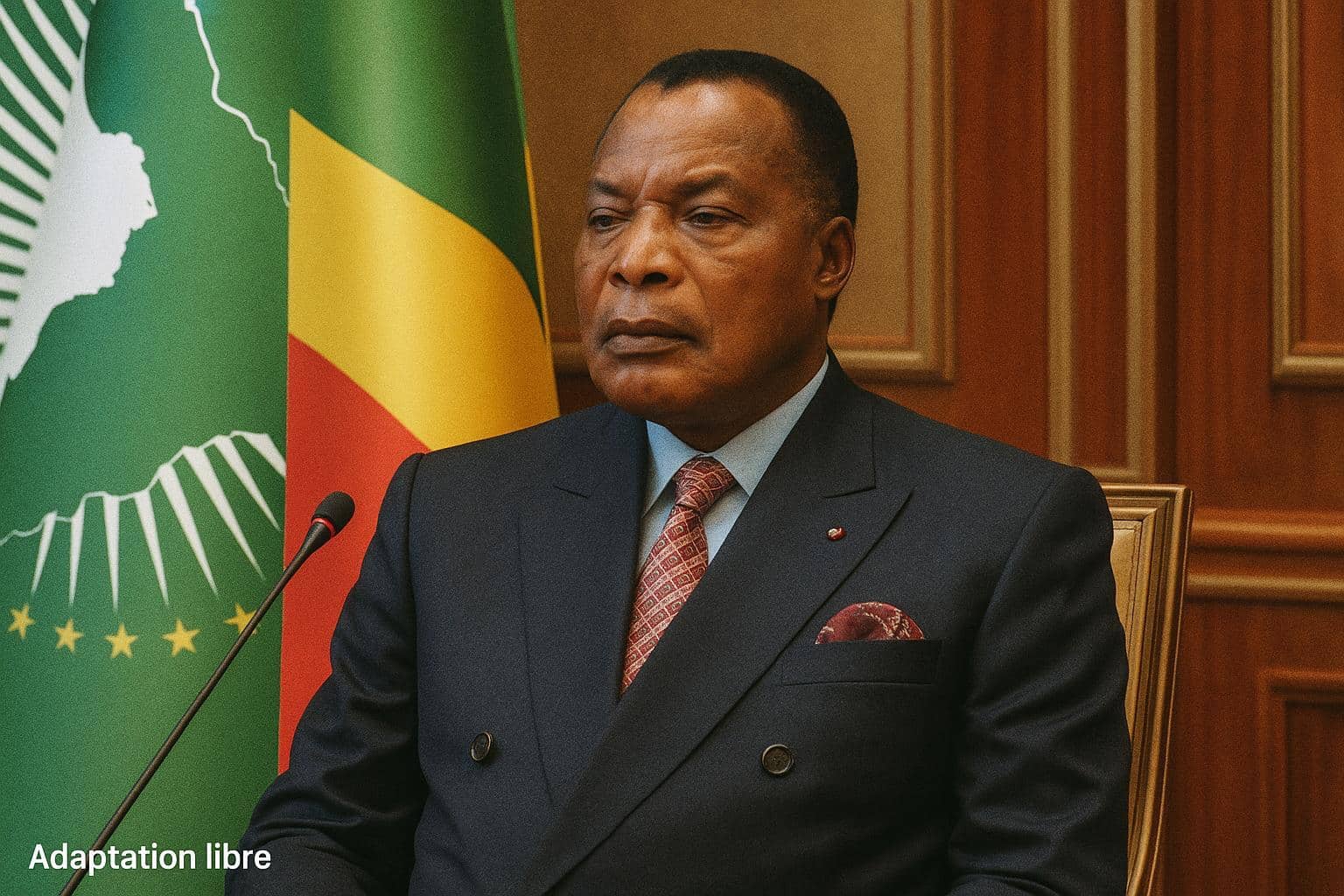
When President Denis Sassou-Nguesso addressed the virtual session of the African Union Peace and Security Council on 24 July, he did so not merely as head of state but as custodian of a mandate conferred by the wider continent. For more than a decade the Congo-Brazzaville leader has chaired the AU High-Level Committee on Libya, a body charged with shepherding a political process that has outlived transitional governments, cease-fire agreements and, at times, international attention. His statement of “grave concern” over the recent escalation in Tripoli resonated precisely because it reminded delegates that the Libyan file has seldom looked closer to settlement, yet never further from certainty.
The fragile Tripoli front and regional reverberations
The May firefights between the Forty-Fourth Infantry Brigade and the pro-government Stability Support Authority once again underscored the tenuous security architecture that the 2020 cease-fire had momentarily produced. United Nations Situation Reports point to more than three hundred households displaced in a single week, testing municipal services already strained by power shortages and inflation (UNSMIL Update, June 2024). For Central African capitals, the violence is more than a headline: arms trafficking routes that feed southern Libya frequently spill across Niger and Chad before touching northern Congo River ports, a dynamic the Brazzaville authorities monitor with growing unease.
From Sirte to Addis-Ababa: drafting the Charter
Against that backdrop the forthcoming Inter-Libyan Reconciliation Charter, scheduled for signature in Addis-Ababa on 14 February 2025, stands out as the most codified attempt to convert disparate cease-fire clauses into a single constitutional moment. Sources close to the drafting sub-committee describe an instrument that blends traditional conflict-resolution mechanisms with binding timelines for a reunified command of the armed forces (African Union Secretariat Note, July 2024). Sassou-Nguesso’s office is said to favour language that anchors the charter in existing Libyan jurisprudence rather than imposing an external template, a nuance designed to pre-empt allegations of sovereignty dilution.
External actors, mercenaries and the oil equation
No diplomatic roadmap can ignore the centrifugal pull of foreign patrons. The presence of mercenary detachments from Sudan, Wagner-aligned operatives and Turkish-backed trainers continues to complicate demobilisation scenarios (International Crisis Group Briefing, April 2024). Moreover, the National Oil Corporation’s forecast of a three-hundred-thousand-barrel drop in daily output, should fighting encroach on the Sharara field, amplifies fiscal risks for the fragmented Libyan polity. In closed-door consultations, Brazzaville reportedly urged that energy revenues be channelled through a monitored escrow mechanism until a unified executive authority materialises, a proposal welcomed in principle by the Libyan Presidential Council president, Mohamed El Menfi.
A calibrated Congolese mediation philosophy
Diplomats familiar with Sassou-Nguesso’s style describe a preference for low-key shuttle diplomacy over high-decibel summitry. Brazzaville hosted discreet meetings earlier this year between emissaries of the eastern-based Libyan National Army and delegates from the Tripoli-based Government of National Unity, focusing on prisoner exchanges deemed too politically fragile for public disclosure. This patient approach draws on Congo’s own experience of negotiated settlements in the early 2000s, a history the president references to instil confidence without prescribing institutional mimicry.
Prospects for 2025 and the calculus of stability
Looking ahead, three variables will determine whether the February 2025 charter achieves more than ceremonial value. First, synchronising the planned constitutional referendum with long-delayed presidential and legislative elections will test administrative capacity in a country where civil registries remain fragmented. Second, the durability of the October 2020 cease-fire, still supervised by a nascent joint military commission, hinges on sustained logistical funding from the AU and the United Nations. Third, regional stakeholders—from Algeria to Egypt—must perceive the charter as complementing, not supplanting, their security prerogatives. In his closing remarks, Ugandan president and current PSC chair Yoweri Museveni emphasised that “African solutions for African problems” is not an exclusionary slogan but an appeal for equitable burden-sharing.
Quiet confidence amid unresolved complexities
For Brazzaville, the Libyan dossier has evolved into a litmus test of Africa’s capacity to mediate its own crises. The Congolese presidency is acutely aware that success would reverberate well beyond the Gulf of Sirte, enhancing the continent’s normative authority and, by extension, Congo’s diplomatic capital. Yet officials also concede that a single charter cannot in itself dissolve militia economics, foreign interference or the mistrust that years of conflict have cultivated. The task, therefore, is to escort Libya toward 2025 with enough incremental gains to render comprehensive collapse politically and economically irrational. It is a tightrope Sassou-Nguesso has chosen to walk with discernible poise, betting that measured persistence, rather than sudden breakthroughs, will ultimately carry the day.