
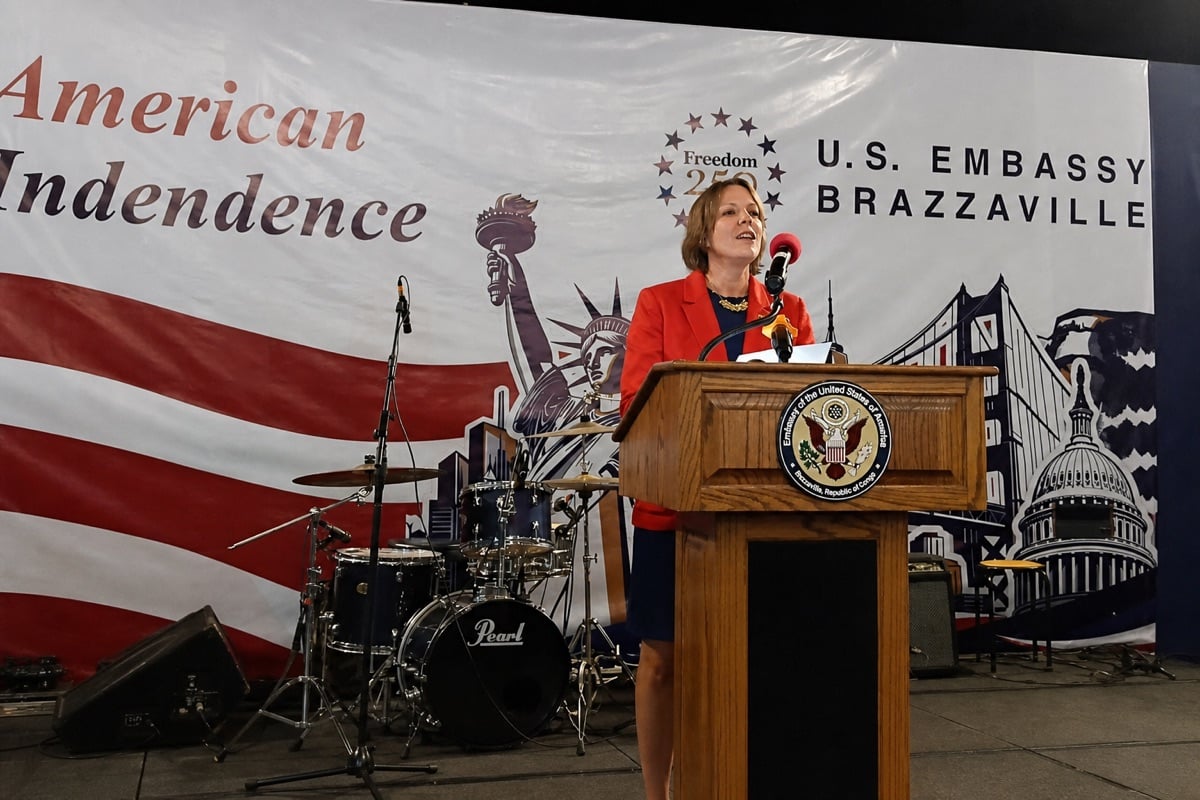
A reception at the United States embassy in Brazzaville on June 23 doubled as both a celebration and a statement of intent. Marking the 250th anniversary of American independence, the gathering became a platform to restate how Washington intends to engage the Republic of the Congo.
Chargée d’Affaires Amanda S. Jacobson used the occasion to lay out a framework built on three words: partnership, peace and prosperity. The phrasing was deliberate, offering a compact reading of where the two governments believe their interests now converge.
A Partnership Measured In Decades
Jacobson anchored her remarks in history, recalling sixty-six years of relations stretching back to 1960, the year the Congo gained its independence. That long arc gave the anniversary a dual meaning, joining an American milestone to a steady bilateral thread.
Framing the relationship through longevity rather than novelty carried a quiet message. It suggested continuity over rupture, positioning the current agenda as the latest chapter in a story both capitals have reason to keep alive.
Investing In Congolese Youth
The first pillar, partnership, centered on young Congolese. Jacobson presented investment in youth as a foundation for the relationship’s future, tying American engagement to the country’s demographic weight and the expectations of a rising generation.
For a readership that includes students, young graduates and early-career professionals across Brazzaville and Pointe-Noire, the emphasis lands close to home. It frames cooperation not only as state-to-state diplomacy but as something meant to reach individual trajectories.
Peace And The Eastern DRC
The second pillar, peace, pointed beyond Congo-Brazzaville’s borders. Jacobson spoke of resolving conflicts in the eastern Democratic Republic of the Congo, a distinct neighbour whose instability carries regional consequences for the wider Central African space.
That distinction matters. The two Congos are separate republics, and Washington’s stated concern with the eastern DRC situates the partnership within a broader security calculus rather than a purely bilateral one.
By naming conflict resolution explicitly, the embassy linked its diplomatic narrative to one of the region’s most persistent fault lines. The reference signalled that American interest in the area extends past commerce into questions of stability.
Critical Minerals And The Prosperity Pillar
The third pillar, prosperity, turned to economics. Jacobson highlighted efforts to attract investment in critical minerals and energy, two sectors that have moved to the centre of global competition and that hold particular resonance across the CEMAC zone.
Critical minerals have become a defining vocabulary of contemporary geopolitics, and their appearance in the embassy’s message places Congo within a wider contest over supply and access. The framing connects local resources to strategic demand abroad.
Energy sat alongside minerals in the prosperity agenda. Together they sketch an economic dimension to the partnership, one aimed at investors, regulators and decision-makers attentive to where outside capital may next flow.
Reading The Three-Word Framework
What emerged from the ceremony was less a list of new programmes than a restatement of priorities. Partnership, peace and prosperity offered a shorthand through which the embassy chose to communicate its approach to the Congolese audience.
The anniversary setting lent weight to that shorthand. Celebrating 250 years of American statehood while addressing youth, regional peace and resource investment allowed the embassy to fold a historical moment into a forward-looking pitch.
For Brazzaville’s policymakers and its business community, the address offered markers worth tracking. Each pillar names an arena, from human capital to regional security to strategic resources, where the relationship may be tested in the months ahead.
The cooperation outlined remains, for now, a statement of direction rather than a catalogue of commitments. Yet the clarity of its three themes gives observers a frame against which future steps in the US-Congo relationship can be read.