
France is keeping its hand in Congo-Brazzaville’s water sector, sustaining two major infrastructure programmes that touch daily life in the country’s two largest cities. The commitment was reaffirmed during a working meeting in Brazzaville, where the agenda turned squarely to drinking water and sanitation.
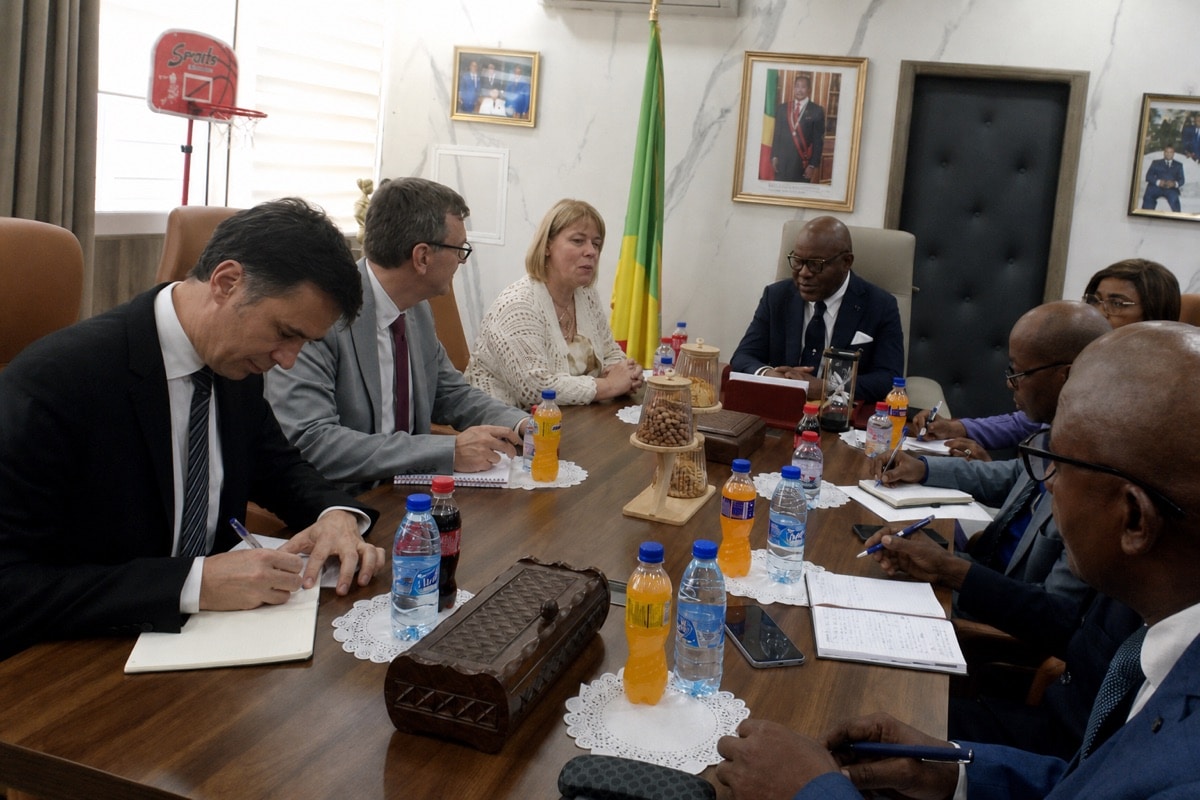
French Ambassador Claire Bodonyi was received on 25 June by Bruno Jean Richard Itoua, Minister of Energy and Hydraulics. According to the ambassador, Paris intends to see both projects through, signalling continuity rather than a fresh announcement, and underscoring a partnership that has shaped urban services for years.
Steady Support For Drinking Water Access
The cooperation rests on the Agence française de développement (AFD), which is steering the financing and overall direction of the work. The agency’s involvement places these projects within a broader pattern of development lending, where water provision is treated as a foundation for public health and urban stability.
In Pointe-Noire, the economic capital on the Atlantic coast, the effort centres on strengthening the systems that distribute drinking water. The stated aim is straightforward: widen and improve residents’ access to a resource that remains uneven across many neighbourhoods.
That framing matters in a port city whose population has grown quickly, often outpacing the networks built to serve it. Reliable distribution is less a convenience than a precondition for households, small businesses, and the services that depend on a steady supply.
Brazzaville Sanitation And Flood Defence
In the capital, the priorities shift toward sanitation and the management of waterways. The works include canalisation projects designed to ease the flooding risk that recurs in several districts, a concern familiar to anyone who has watched Brazzaville’s streets during the rainy season.
The ambassador pointed to clear progress on the Tsiemé river, where the channelling of waterways is under way. She compared the approach to earlier interventions in Makélékélé, drawing a line between past work and the methods now being applied across the city.
The logic is preventive. By guiding water along engineered channels, the projects seek to blunt the effects of runoff during heavy rains, when downpours can overwhelm low-lying areas and disrupt entire neighbourhoods within hours.
A Familiar Partnership Under The Spotlight
The meeting fits a long arc of Franco-Congolese cooperation on infrastructure, in which the AFD has been a recurring partner. Reaffirming existing projects, rather than unveiling new ones, suggests a phase of execution where delivery is the measure that counts.
For the ministry, the exchange offered a moment to take stock. Hosting the ambassador allowed officials to review where the works stand and to restate shared objectives, an exercise as much about confidence as about technical detail.
What gives the projects their weight is their reach. Drinking water in Pointe-Noire and flood mitigation in Brazzaville address two pressures felt by ordinary residents, linking foreign financing to outcomes visible on the ground rather than confined to formal communiqués.
What Residents Can Expect Next
According to the information shared, both projects are expected to reach completion in the coming months. That timeline frames the current period as decisive, the stretch in which planning gives way to finished works and the promised benefits begin to materialise.
If the schedule holds, the payoff would be twofold. Improved access to drinking water could ease a daily strain for many households, while better-managed waterways could reduce the disruption that flooding imposes on affected districts each rainy season.
Caution is warranted on the details, since the available account stops short of precise figures on cost, coverage, or the exact number of people served. What is clear is the direction of travel: continuity of funding and a focus on completing what has already begun.
Reading The Bigger Picture
Beneath the technical vocabulary lies a question of governance. Water and sanitation are among the most tangible tests of how a city is run, and progress on them tends to register quickly with residents who experience the difference at the tap or on the street.
The reaffirmation also speaks to the texture of the relationship between Brazzaville and Paris. Development cooperation of this kind blends diplomacy with delivery, and its credibility ultimately rests on whether the works are finished as described and to the standard pledged.
For now, the message from the meeting is one of steadiness. France has confirmed it will continue, the AFD remains at the helm, and the coming months will reveal whether the Tsiemé works and the Pointe-Noire networks translate ambition into lasting improvement for the cities they serve.