
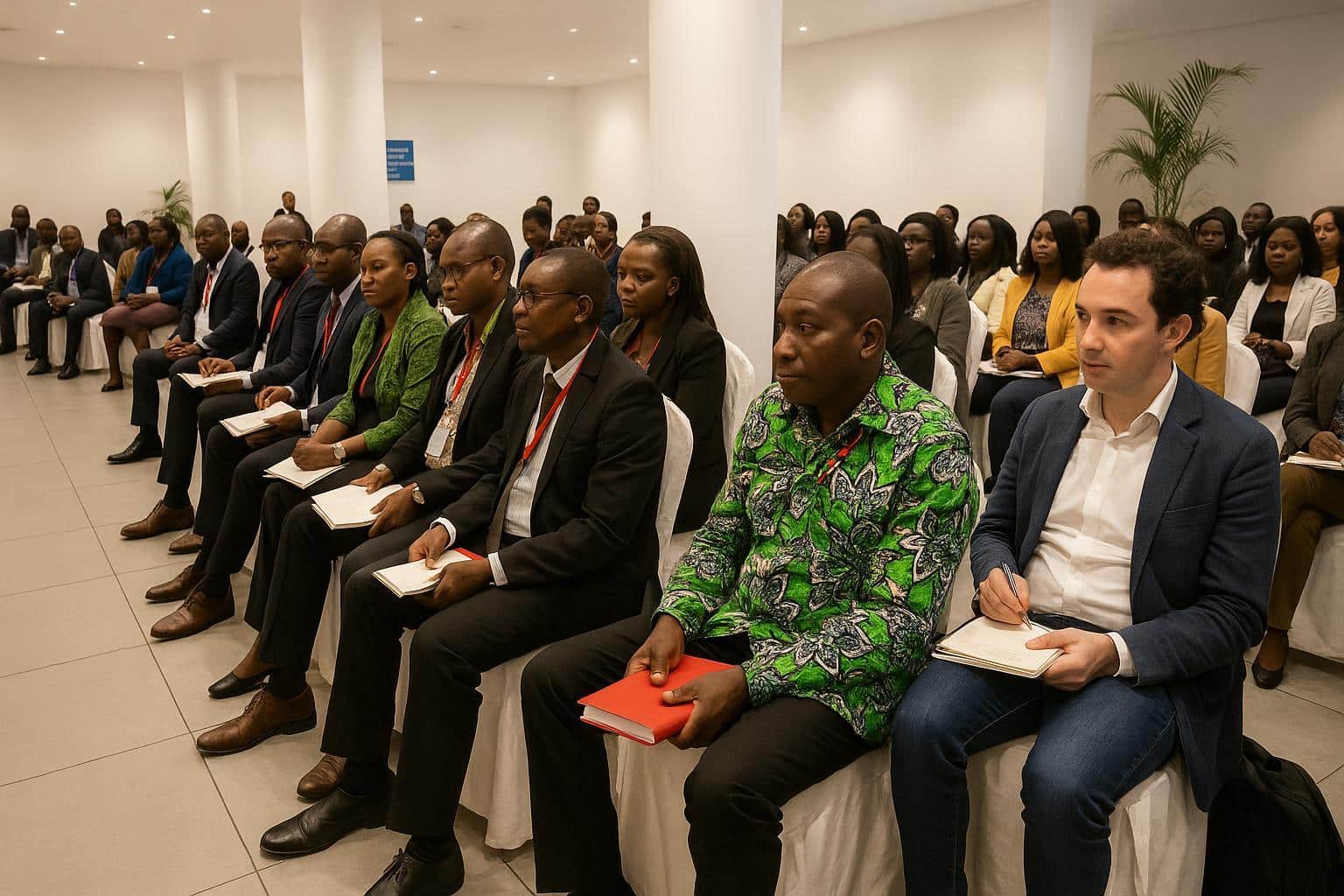
Brazzaville forum spotlights SDG urgency
The marble hall of an uptown Brazzaville hotel hummed on 26 September as executives, diplomats and students streamed in for the second Doing Good in Africa Forum, a space curated by the consultancy Afrique RSE Congo to dissect how business can accelerate national progress toward the Sustainable Development Goals.
Billed under the banner “Impact Enterprises: Congolese Corporate Contribution to SDGs – focus on Goals 3, 7 and 13,” the one-day meeting came five years before the 2030 United Nations deadline, a temporal marker repeatedly invoked by moderators to stress what they called “the urgency of now.”
Private sector momentum on CSR law
Bel Lauretta Tene née Pambou Dinana, managing partner of Afrique RSE Congo, opened with a stark data point: the Republic of Congo scores 52.8 out of 100 on the 2023 UN SDG Index, ranking 154th globally, “a position that should alert, not discourage,” she asserted.
Speaking to reporters afterwards, she underlined that the country already possesses a Corporate Social Responsibility law adopted in 2019, “yet without its enforcement decree the text remains dormant; our collective task is to breathe life into it.” Her comments drew nods from officials in the front row.
Participants agreed that clarity on the law could set a common vocabulary for boardrooms and ministries. Training modules for accountants, regulators and civil-society monitors are being mapped by Afrique RSE Congo in partnership with the National School of Administration, according to organisers.
Health and wellbeing goals under review
Goal 3—ensuring healthy lives and promoting well-being—dominated early panels. Physicians from the Faculty of Health Sciences highlighted that non-communicable diseases now represent one third of hospital admissions nationwide, a trend the private sector can counter through workplace screening programmes and subsidised insurance.
Telecommunications firm Airtel Congo shared its pilot where text-message reminders boosted prenatal visit compliance in Oyo District by 17 percent within six months, a result the Health Ministry representative called “a low-cost intervention worth replicating.” Such cases illustrated the multiplier effect of business technology on public services.
Clean energy transition gains relevance
Energy experts then pivoted to Goal 7. Congolaise de l’Énergie Renouvelable, a Pointe-Noire startup, unveiled a solar micro-grid financed through a blended capital model mixing bank loans and carbon credits. Chief executive Prisca Mboumba forecasted that replicating the scheme across 100 villages would save 34 000 tonnes of CO₂ annually.
Delegates heard that the national electrification rate stands at 54 percent, citing World Bank statistics, meaning opportunities abound for local firms to capture off-grid markets while reducing diesel dependence. Banker Hervé Okemba argued that tax incentives for renewable importers could unlock “hundreds of green jobs before 2025.”
Combatting emissions through innovation
Goal 13—climate action—wove through every debate. From shipping to forestry, speakers detailed how extreme weather already strains balance sheets. The Chamber of Commerce presented survey results showing that 62 percent of Congolese SMEs experienced supply disruptions after the 2022 floods, reinforcing the case for climate-resilient infrastructure investments.
Government advisor Christelle Oba insisted that aligning corporate climate strategies with the country’s Nationally Determined Contribution “will safeguard competitiveness when carbon border taxes arise on export markets.” Her remark underscored the forum’s pragmatic tone: sustainability framed less as philanthropy, more as risk management.
Training drives shared SDG vision
At midday, organisers paused for a compact training session on ESG reporting, walking managers through indicators accepted by the Global Reporting Initiative. Participants practised tracing a simple emissions baseline, an exercise Bel Tene said would “demystify jargon that often deters smaller companies from disclosing.”
Recognition awards bolster engagement
The afternoon shifted to recognition. The Forum Award for Social Impact went to Société de Transport du Congo for introducing electric minibuses on the Brazzaville airport route, cutting noise and particulate pollution. Accepting the prize, director Arnaud Mayota pledged to double the fleet by next year.
Observers from the United Nations Development Programme and the French Embassy welcomed the awards as tools that create positive peer pressure. “Shining light on front-runners inspires imitators,” UNDP resident representative Siaka Coulibaly remarked, adding that forums of this kind complement official bilateral financing envelopes.
Online amplification and provincial outreach
Though the audience numbered barely 200, the event’s social-media reach climbed as attendees live-tweeted insights under the hashtag #DGIA2023. Organisers reported 1.2 million impressions within 24 hours, a reminder of how digital conversation can amplify technical discussions beyond conference walls.
Looking ahead, Afrique RSE Congo plans a roadshow in Pointe-Noire and Dolisie to translate lessons into provincial contexts where mining and timber operations shape livelihoods. “We cannot let SDG dialogue stay in the capital,” Bel Tene said, announcing scholarships for local journalists to track implementation.
Pathways toward 2030 milestone
Closing the forum, Director-General of Economy and Planning Jean-Baptiste Ondongo reaffirmed the government’s support: “The private sector is an indispensable ally on our path to 2030. Together we will unlock the health, energy and climate dividends our citizens expect.” With that, delegates dispersed, pledging follow-up action rather than mere rhetoric.