
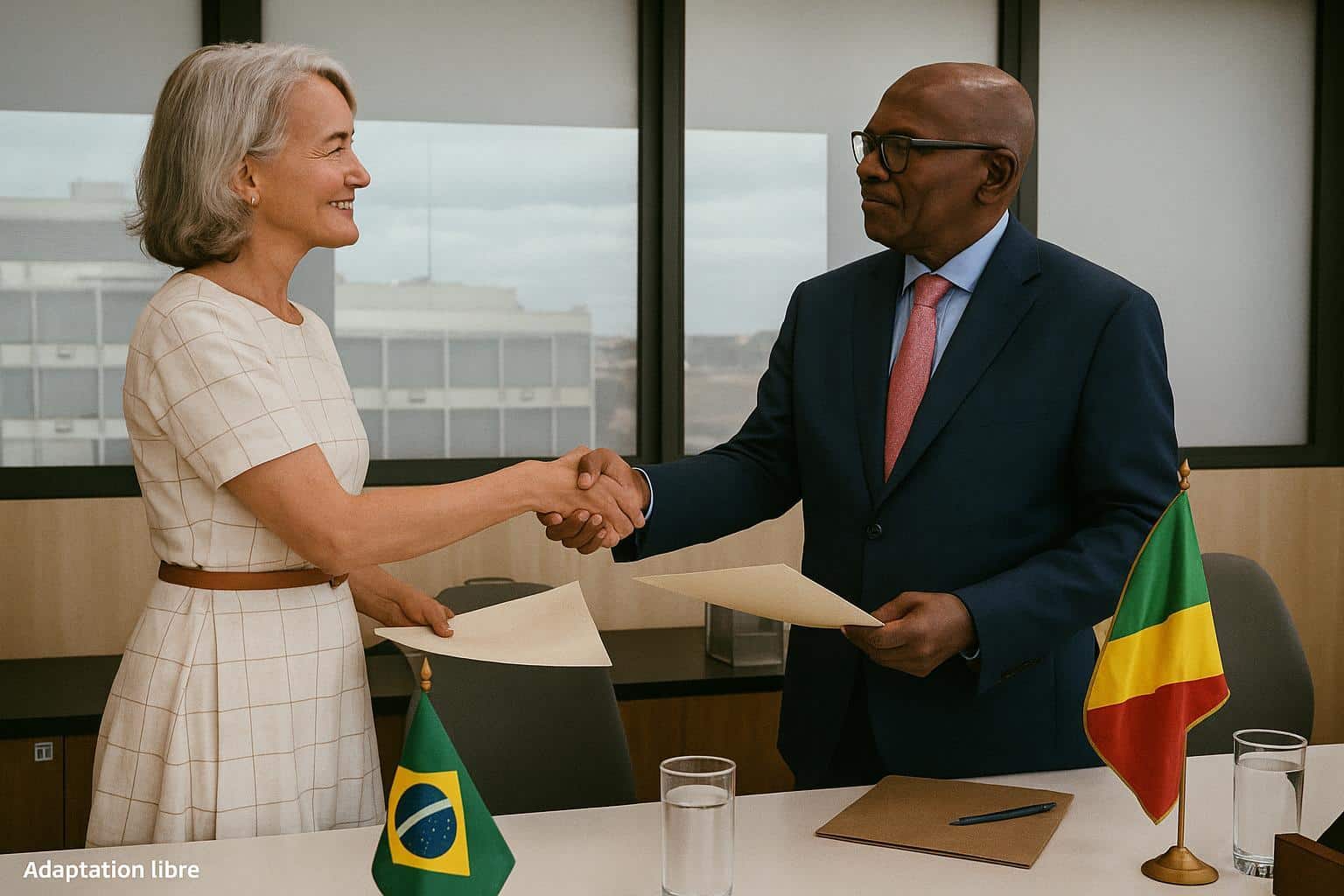
Debt Diplomacy in Focus
The discreet signing on 22 July at the Brazilian Ministry of Finance marked more than a technical revision of spreadsheets. By initialling the first amendment to their 2014 Debt Rescheduling Agreements, Procuradora Sônia de Almendra F. Portella Nunes and Ambassador Louis Sylvain-Goma re-anchored a partnership that had weathered a half-decade of commodity shocks and pandemic-induced fiscal stress. Brasília’s marble halls, usually dominated by domestic tax debates, provided an unlikely stage for a reminder that South-South solidarity can be as much about bond prospectuses as about rhetoric. Both the Brazilian Senate and the Congolese Parliament gave prior authorisation, underscoring the political salience that the two capitals now attach to financial housekeeping.
Navigating the Post-Libor Landscape
The core of the amendment is the replacement of London’s defunct Libor benchmark with Term SOFR, calculated from overnight secured transactions in United States Treasury repos and disseminated by Bloomberg. For Congo-Brazzaville, whose public debt reached an estimated 88 percent of GDP in 2022 (IMF 2023), the shift limits exposure to opaque interbank fixes and aligns repayment profiles with a more transparent, less volatile yardstick. Brazilian officials quietly note that the adjustment dovetails with the country’s broader migration to SOFR across its export-credit portfolio. Market practitioners in São Paulo observe that SOFR’s collateralised basis may shave several basis points off the effective coupon, a marginal but symbolically important relief for Brazzaville as it consolidates the fiscal reforms agreed with international partners.
Historical Convergence of Brazzaville and Brasília
Diplomatic ties formally date back to 4 March 1980, the height of what scholars describe as Brazil’s “Responsibility to the South” doctrine. An umbrella Cooperation Agreement signed in 1981 created a Joint Commission that still meets, albeit irregularly, to steer projects in agriculture, health and education. President Denis Sassou Nguesso’s visits in 1982, 2005 and during the 2023 Amazon Cooperation Treaty summit, alongside President Luiz Inácio Lula da Silva’s landmark trip to Brazzaville in 2007, have layered personal rapport atop institutional mechanisms. Those encounters produced memoranda on ethanol technology, professional training and upstream oil services—sectors that now stand to benefit from the renewed momentum signalled by the debt accord.
Economic Realities and Converging Interests
Congo-Brazzaville emerged from the 2015-2020 oil slump with arrears to multiple bilateral creditors, prompting a 2019 Extended Credit Facility with the IMF that hinges on debt sustainability. Brazil, for its part, has recalibrated its foreign-economic policy to re-engage Africa after a period of relative retrenchment. The debt amendment therefore serves dual objectives: it helps Brazzaville clear a path toward ratings improvement while allowing Brasília to safeguard its National Treasury’s claims and reopen commercial channels for Brazilian engineering and agribusiness firms. Analysts at the Getulio Vargas Foundation describe the pact as “de-risking avant la lettre,” a necessary precondition for the revival of trade that peaked at 500 million dollars in 2013 before falling below 100 million in 2021 (UN Comtrade 2023).
Prospects for a Greener Bilateral Agenda
Beyond the spreadsheets, both governments sense diplomatic capital in aligning the Congo Basin and the Amazon Basin—two of the planet’s foremost carbon sinks—in global climate negotiations. Congo’s National Development Plan 2022-2026 identifies forestry value chains and renewable energy as pillars of diversification, while Brazil’s Ministry of Foreign Affairs has quietly floated a trilateral rainforest fund with Indonesia. By reaffirming financial cooperation, the debt accord provides credibility that could facilitate blended-finance vehicles or green bonds anchored in Term SOFR benchmarks, a point recently highlighted by the African Development Bank’s regional economist for Central Africa. Such instruments would allow Brazzaville to leverage concessional rates while enabling Brasília to showcase its environmental diplomacy ahead of the 2025 UNFCCC summit it is slated to host.
Inside Voices on the Accord
In a rare on-record comment, Ambassador Sylvain-Goma called the amendment “a pragmatic step that reflects our shared confidence in the resilience of Congolese reforms.” Deputy Finance Secretary António Freitas echoed the sentiment, emphasising “Brazil’s commitment to ensuring that debt does not become a barrier to sustainable growth in partner countries.” Independent observers are cautiously optimistic. A senior analyst at Moody’s in London remarked that the SOFR switch is “a governance signal perhaps more than a material cash-flow shift,” but added that “signals matter for investors scouring frontier markets.” Civil-society actors in Brazzaville, while supportive, underline the importance of complementing debt relief with social-sector spending, a priority the government has reiterated in its 2024 budget circular.
Charting the Next Chapter
A second amendment—now before the Brazilian Senate—would compress the overall debt-service profile through reduced spreads and an elongated grace period. If ratified, it could unlock additional fiscal space for Brazzaville’s infrastructure pipeline, including the much-discussed deep-water port at Pointe-Noire. The broader narrative, however, transcends amortisation tables. It is about repositioning a South Atlantic axis that pairs Brazil’s industrial scale with Congo’s strategic geography at a moment when global supply chains seek alternative routes. In that sense, the 22 July signature functions less as an epilogue to past arrears and more as a prologue to diversified, climate-conscious and mutually beneficial engagement.