
Government sets the sanitation tempo
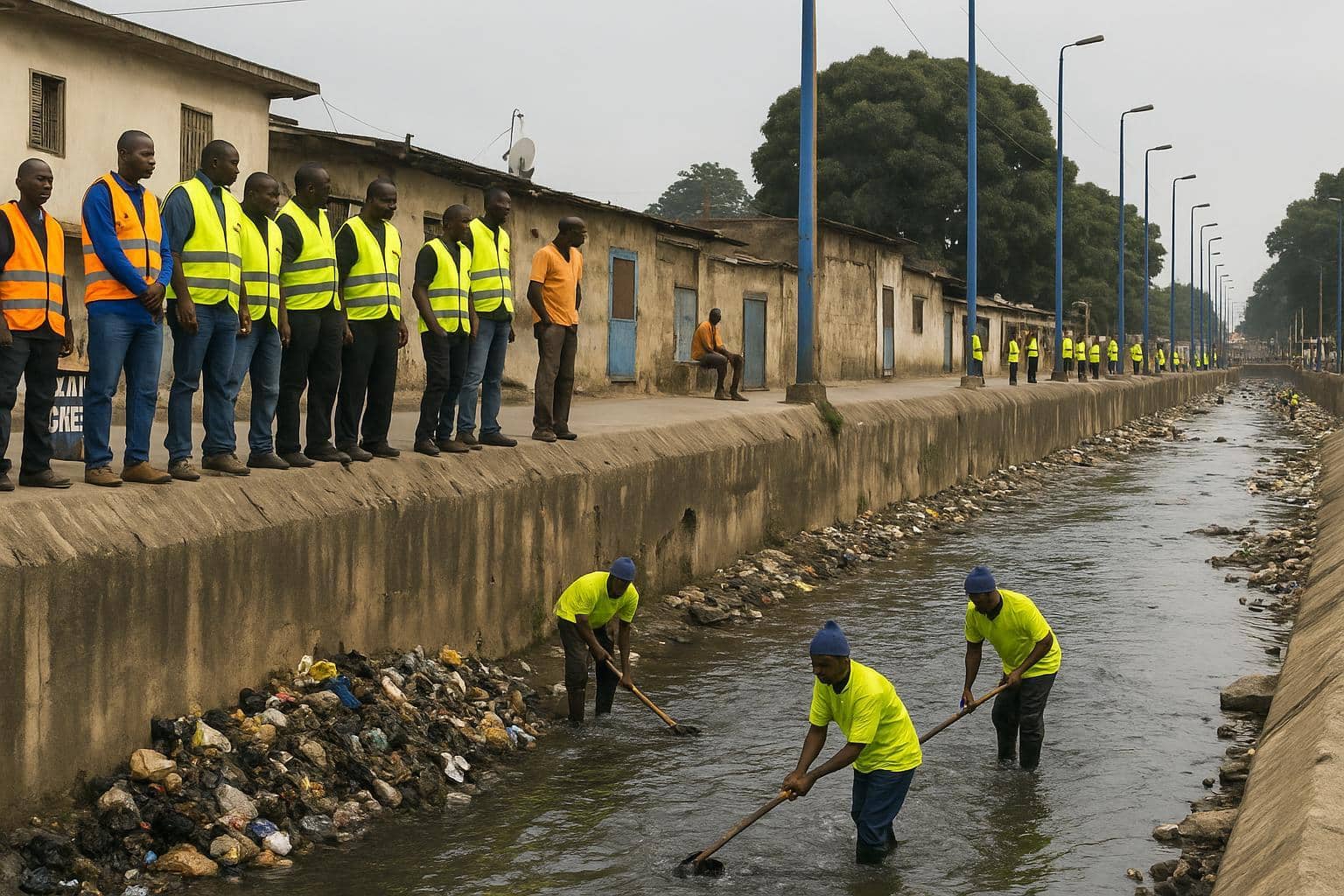
Long before sunrise on 1 September 2025, hydraulic shovels from the Ministry of Urban Sanitation rumbled back into the Maduku Tsékélé canal. The operation is the second phase of a nationwide programme announced in a June circular that prioritises drainage before peak rains, officials confirmed.
Deputy minister Juste Désiré Mondelé reiterated that clearing collectors and sweeping arterial roads remain “a strategic public-health duty”. He told Municipal Radio the government had allocated additional fuel and overtime for crews so that “no neighbourhood feels forgotten”.
Grass-roots energy on the riverbanks
Community groups amplified the state’s resources along the Mfoa and its tributaries. Members of Salubrité Sans Frontière and Congo Propre formed human chains to remove decades-old silt between Rue Mbochi and Avenue de France, cheered by pedestrians who briefly joined the line, eyewitnesses reported.
Further south, Association des Jeunes Éveillés targeted the clogged gutters linking Avenue des Trois Martyrs to Rue Lénine in Moungali. Their president, Brice Ngatse, said the combined presence of youth and ministry technicians “proves civic duty and public service can pull in the same direction.”
Faith organisations sweep in
In Ouenzé’s Fifth Arrondissement, congregants from the Liloba Church arrived after morning prayers wearing reflective vests emblazoned with the verse “Blessed are the clean in heart”. They spent hours ferrying debris from Avenue de la Tsiémé to collection points designated by city engineers.
The sight of hymn singers washing down sidewalks attracted onlookers who, according to local councillor Francine Mavoumba, “realised keeping streets immaculate is as spiritual as it is practical”.
Private-public logistics keep the pace
Turkish-Congolese operator Albayrak, holder of the city’s solid-waste concession, dispatched compactors to follow each volunteer segment. Company supervisor Mehmet Karaca said trucks completed six rotations before noon, cutting travel time because piles were pre-sorted by volunteers.
The Direction Générale de l’Assainissement confirmed that aligning NGO schedules with truck circuits saved an estimated 30 percent on fuel, freeing resources for additional sites later in the month.
Clear rules, firm enforcement
Marie-Claire Bouanga, chief of Quartier 42, patrolled the Mfoa footbridge reminding pre-collectors that dumping is punishable by fines. “Sanctions will be severe because repetition drains public funds,” she announced through a megaphone, citing legal provisions posted on new metal placards.
Officials say the placards, installed during Minister Mondelé’s July field tour, have already curbed habitual tipping. Residents interviewed near the guardrails confirmed fewer nighttime deposits, attributing the change to the threat of immediate confiscation of pushcarts.
Training the informal sector
More than four hundred micro-collectors have attended workshops explaining where to deposit household refuse for Albayrak haulage, counsellor Roger Christian Itoua told this newspaper. “Education precedes repression,” he stressed, noting refresher sessions will rotate through all nine arrondissements before year’s end.
Participants receive laminated maps marking transfer stations and storm-water inlets. According to Itoua, the approach aims to professionalise an informal economy that already employs thousands while protecting drainage infrastructure.
Health and climate stakes
Epidemiologist Dr Josiane Koumba of the Congolese Institute of Public Health said stagnant water breeds malaria vectors and heightens cholera risk once rains intensify. “Removing organic sludge is as important as spraying insecticide,” she added, referencing 2023 surveillance data.
Meteorologists predict heavier-than-average precipitation from October to December. Clearing culverts now, they argue, could cut urban flood incidents by up to 40 percent, figures echoed in a recent African Development Bank briefing.
Voices from the street
Motorcycle-taxi rider Armel Mabiala paused by the Maduku site to observe excavators at work. “Last year my engine failed after floodwater entered the carburetor,” he said, expressing hope the clean-up will spare him costly repairs.
Vendor Clarisse Ndinga, who sells produce near Rue Lénine, noted a rise in customers since drains stopped overflowing. “People walk more comfortably; my tomatoes stay dry,” she laughed, crediting the youth volunteers.
Economic ripple effects
Urban economist Alain Boukaka believes improved sanitation can lift retail turnover by reducing closure days linked to flooding. He estimated temporary stalls lose up to 15 percent of monthly revenue each time water covers pavements, a finding drawn from 2024 chamber-of-commerce surveys.
Bankers say cleaner surroundings also boost Brazzaville’s attractiveness to investors assessing logistics costs. A senior analyst at a regional brokerage, requesting anonymity, said persistent sanitation drives signal “predictable municipal management”, a consideration in city bond ratings.
Civic education gains momentum
City schools have integrated waste-sorting lessons into science classes this term. Teacher Mireille Tsalissan at Lycée de la Révolution assigned students to chart family habits. “They realise throwing plastic in drains means wading through that same plastic later,” she reported.
Local radio hosts echo the message daily, reinforcing simple directives: bag waste, respect schedules, steer clear of gutters. Communication experts argue repetition across channels cements behavioural change better than sporadic enforcement alone.
Digital monitoring enters the scene
The ministry’s pilot mobile app, MonCaniveau, now lets residents geotag blocked grates. Data analyst Fabrice Kiala said 630 alerts were filed in August, guiding crews to hidden trouble spots within 48 hours. “Crowdsourcing speeds diagnosis,” he declared.
Authorities plan to link the platform to Albayrak’s dispatch software, creating a closed loop from complaint to removal and verification.
Funding and sustainability
Financing comes from the national budget line on resilient infrastructure, complemented by a modest environmental levy on construction permits. Treasury officials confirm disbursements are executed through the Single Treasury Account to strengthen transparency.
Environmental lawyer Léon Ndinga applauds the mechanism, arguing predictable funding avoids cycles of emergency spending that historically strained public coffers.
Regional resonance
Neighboring Pointe-Noire has requested technical notes on Brazzaville’s campaign, according to an internal letter reviewed by this newsroom. Urban planners there face similar silted waterways and see promise in coordinating timelines with the northern capital.
The Central African Economic and Monetary Community has also highlighted the initiative in a recent newsletter showcasing best urban-resilience practices.
Challenges still ahead
Despite progress, some backstreets remain obstructed by abandoned vehicles and informal kiosks. Municipal police say negotiations continue to relocate traders without disrupting livelihoods. Observers caution that maintaining momentum after media attention fades will test institutional endurance.
Seasonal labour demand could pose another hurdle as agricultural planting coincides with peak clean-up needs, potentially thinning volunteer ranks.
Looking toward the rainy season
With September half over, excavators are scheduled to move into Bacongo’s riverfront catchments. Officials aim to finish primary collectors by mid-October, then shift to secondary drains. Engineer Pauline Massengo expressed confidence schedules will hold barring extreme weather shocks.
She emphasised that citizen vigilance remains the linchpin: “A single bag tossed into a gutter can undo days of machine time.”
A shared responsibility
As twilight settled on Avenue de France, volunteers posed for photos beside freshly scrubbed walls, their gloves caked with mud yet faces bright. The moment captured a rare civic convergence where ministries, churches, youth and firms saw their interests aligned.
Whether that spirit endures may determine if Brazzaville greets the coming rains with dry feet and renewed confidence in collective action.