
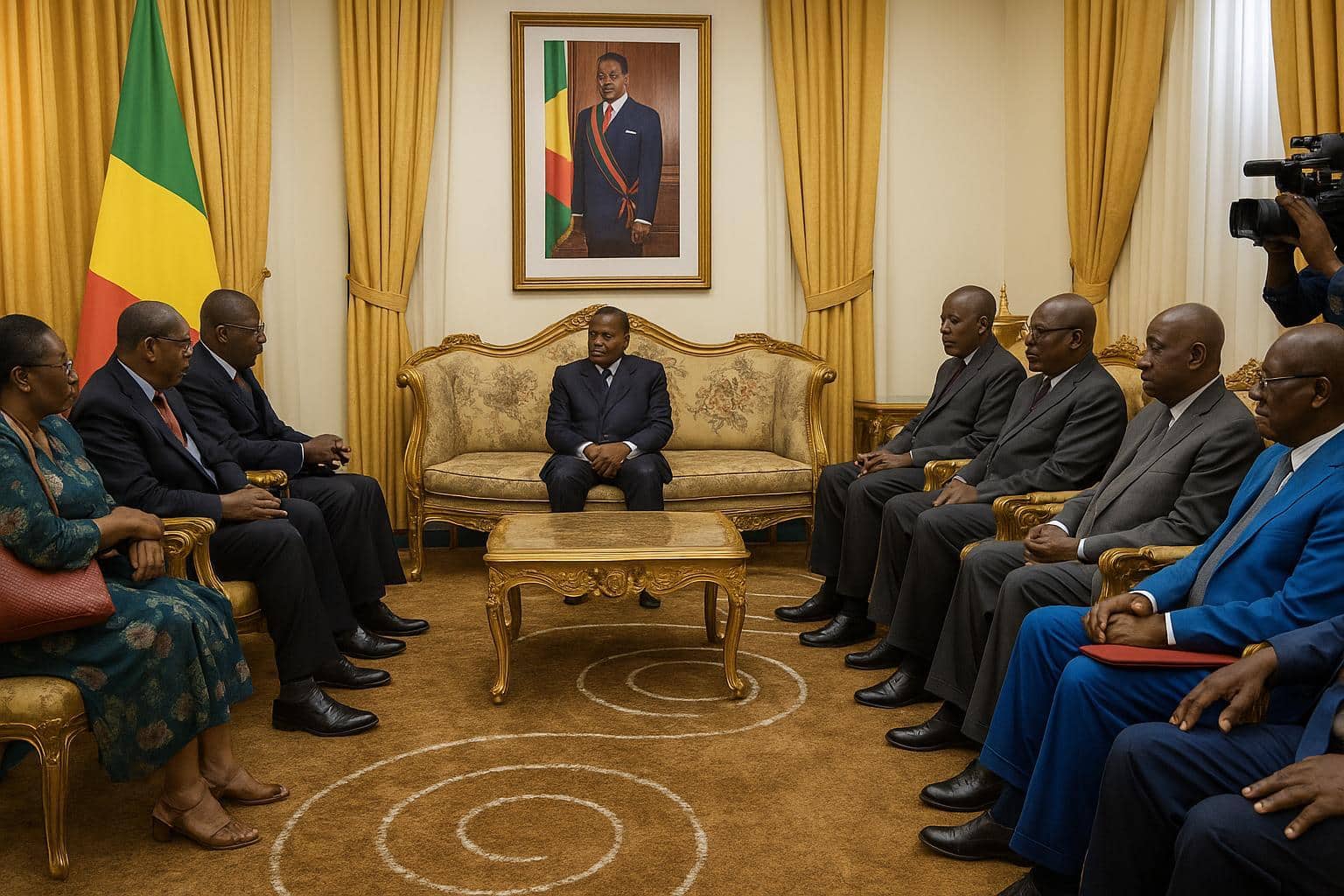
Diplomatic signals from Brazzaville
South Africa’s new ambassador to the Republic of Congo, Uppigton Mziwamadoda Kaloko, used one of his very first meetings in Brazzaville to call for a refreshed partnership between the two national legislatures.
On 11 November he sat down with Senate president Pierre Ngolo in the red-brick parliament building overlooking the Congo River, pledging to share experience, training modules and procedural know-how that could make debates more efficient and oversight more rigorous in both capitals.
The encounter, though protocolary, signaled Pretoria’s intention to weave closer institutional links with a country it already regards as an exemplar of stability inside the Central African Economic and Monetary Community, according to the envoy’s remarks after the meeting.
Shared lessons for stronger legislatures
Kaloko told reporters that the two parliaments could benefit from comparing committee structures, budget scrutiny techniques and public outreach practices, areas where each chamber has developed distinct expertise over time.
Senator Ngolo welcomed the suggestion, underlining that the Congolese Senate, renewed last year, is seeking fresh approaches to engage citizens and to accompany government programmes more effectively while respecting the balance of powers defined in the 2015 Constitution.
Observers noted that such cooperation could eventually include staff exchanges, joint seminars or digital platforms for document management, initiatives that do not require heavy budgets yet often deliver tangible institutional gains.
Economic dimension enters the conversation
Beyond the legislative arena, Ambassador Kaloko used the audience to float a broader agenda centred on economic self-reliance.
He argued that African economies, blessed with minerals, timber and arable land, should aim to limit imports and process raw materials at home so that value and jobs remain on the continent.
Congo’s role as an oil producer and emerging hub for wood transformation makes it a natural partner in that conversation, the diplomat said, suggesting future discussions with sectoral ministries once his accreditation is formally completed.
Why Pretoria sees Brazzaville as a model
Kaloko praised Congo as an example within the African Union for its steady political climate and its constructive stance in multilateral forums.
Such diplomatic language echoes previous statements from South African officials who view institutional continuity in Brazzaville as helpful to regional projects ranging from infrastructure corridors to health-security cooperation.
By anchoring the new ambassador’s mission in parliamentary matters, Pretoria also signals respect for processes that underpin governance, a point likely to resonate within Congo, where lawmakers often underscore their constitutional mandate during debates.
Calendar and immediate priorities
Kaloko’s credentials are expected to be presented to President Denis Sassou Nguesso in the coming days, opening the way for a more detailed roadmap with the Ministry of Foreign Affairs and the two chambers of parliament.
Sources close to the Senate bureau say a first concrete step could be the drafting of a memorandum of understanding that outlines focal points, timelines and evaluation mechanisms for the cooperation programme.
Both sides are also considering scheduling virtual meetings between committee chairs before arranging in-person visits, a cost-effective formula that proved useful during recent health restrictions, according to parliamentary aides.
Statements underline shared ambitions
“We envisage an exchange of experience, in view of reinforcing the capacities of our two institutions,” Kaloko said, stressing that the initiative will be mutually beneficial. He framed the plan as a pragmatic continuation of South Africa’s diplomacy of solidarity with the continent’s future in mind.
Ngolo, for his part, noted that Congo’s Senate welcomes comparative insights, saying the chamber is continuously refining its internal rules to reflect emerging challenges in governance, technology and public finance.
He highlighted recent reforms that opened committee hearings to television broadcasts, a move he believes complements the transparency ethos championed by regional partners such as South Africa.
Government advisers present at the meeting described the atmosphere as warm and forward-looking, emphasizing that legislative cooperation can function independently of fluctuating commodity prices or global shocks that sometimes slow other bilateral initiatives.
A senior official later remarked that success will ultimately be measured by practical outcomes such as co-drafted guidelines or harmonised induction manuals for new lawmakers, tools that would leave a concrete legacy beyond the customary photographs.
Potential ripple effects for the region
Analysts in Brazzaville note that deeper Congo–South Africa ties could inspire similar bilateral tracks among other CEMAC and SADC members, gradually stitching together a pan-African network of legislatures sharing best practices.
For now, the focus remains on turning a cordial handshake into working agendas, but the symbolism of two historically influential states choosing to invest in institutional learning has already drawn cautious optimism from civil society groups tracking governance reforms.
Regional parliamentarians following the meeting on social networks applauded the announcement, with a Cameroonian deputy tweeting that systematic peer-to-peer learning is the “missing link” in Africa’s integration agenda; a Gabonese senator echoed the sentiment, saying shared legislative standards could ease cross-border business procedures while warning that political will remains crucial.