
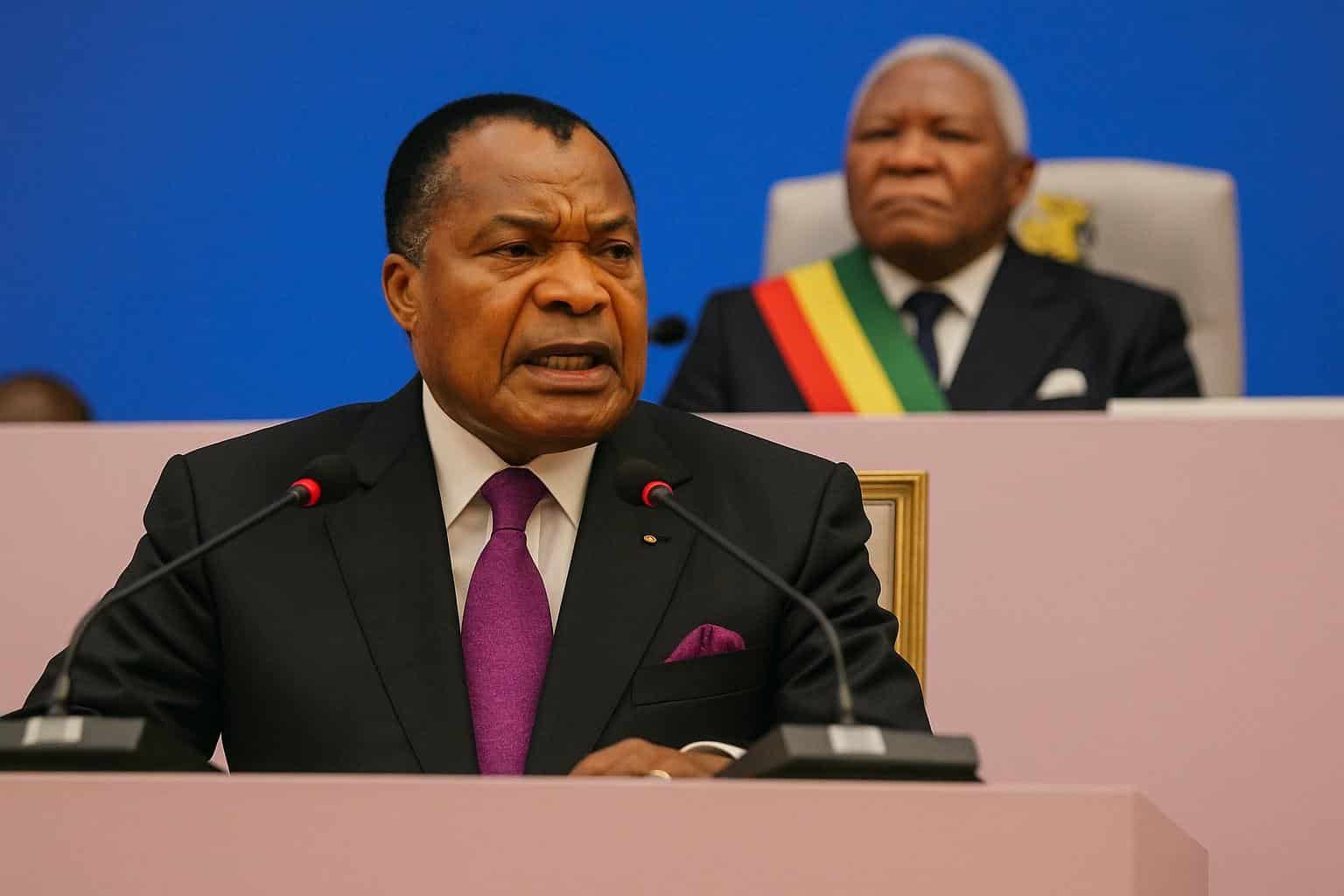
Ceremony in Pointe-Noire and address to Parliament
Pointe-Noire’s Avenue de la République felt both festive and introspective on 28 November as the Republic of Congo celebrated the 67th anniversary of its proclamation. President Denis Sassou-Nguesso seized the moment to deliver his constitutionally mandated message on the state of the nation before a joint session of parliament.
Flanked by Prime Minister Anatole Collinet Makosso, senior judges and foreign diplomats, the Head of State opened his speech with a sober reminder that national progress has often advanced amid turbulence. “History handed us trials; unity turned them into lessons,” he noted, echoing earlier independence-day addresses.
The assembled lawmakers, led by National Assembly speaker Isidore Mvouba, responded with measured applause, aware that the annual ritual doubles as a barometer of government priorities for the coming year.
Call for moral renewal and civic ethics
Sassou-Nguesso devoted early passages to what he called “the battle for conscience”. He urged citizens to abandon corrosive rivalries, warning that unresolved grievances could re-emerge in new forms. Without a collective change of mentality, he said, “the problems we denounce today may revisit us tomorrow”.
Political scientist Alphonse Ndinga Oba, contacted by phone, views the emphasis on ethics as “a subtle acknowledgement that social cohesion cannot be legislated; it must be lived.” He contrasts the appeal with post-conflict reconciliation campaigns in Sierra Leone and Rwanda, where truth-telling commissions formalised forgiveness.
Peace and security priorities
Turning to safety, the president declared an “unrelenting offensive” against organised crime. Latest police statistics, cited in the speech, record a 12 percent decline in armed robberies over ten months, yet high-profile incidents in Brazzaville suburbs have amplified public anxiety.
Sassou-Nguesso’s warning was unequivocal: “I shall be uncompromising, and that must be understood as such.” Interior Ministry sources say night patrol budgets have already been increased, while Chinese-made surveillance cameras are being tested near the capital’s Talangaï interchange.
Opposition MPs cautiously welcomed the security drive yet asked for parallel investment in youth centres to deter delinquency. Government spokesperson Thierry Lézin Moungalla promised consultations, insisting that peace extends beyond the absence of gunfire to “the removal of every threat to citizens’ tranquillity”.
2024 declared National Year of Youth
With one eye on demographic trends—two-thirds of Congolese are under 30—the head of state proclaimed 2024 the Year of the Youth. The initiative, he clarified, is less a panacea than a platform to rally ministries, donors and private firms around education, entrepreneurship and civic engagement.
Groundbreaking ceremonies for two public universities, one in Loango and another in Oyo, are slated for the first semester, according to Higher Education Minister Delphine Edith Emmanuel. Architectural plans, reviewed by our newsroom, show lecture halls powered by hybrid solar-grid systems to mitigate erratic electricity supply.
Youth activist Grace Makaba, co-founder of the Pointe-Noire coding lab Tekili, says expectations are high. “Classrooms help, but we also need seed capital so graduates can launch startups instead of queuing for public jobs,” she told this paper.
Infrastructure bottlenecks in power and water
Infrastructure remained a recurrent theme. Sassou-Nguesso admitted that unreliable electricity distribution risks choking industrial ambitions, citing ageing substations in Brazzaville and accelerated urban sprawl. Pointe-Noire’s demand now surpasses 220 megawatts, double the capacity installed a decade ago, according to the Energy Regulation Authority.
To address the gap, the government plans to commission the 33-kV northern ring by September 2026 and accelerate interconnection with the Inga-Congo supply line from neighbouring Democratic Republic of Congo. African Development Bank documents show financing talks have progressed to term-sheet stage.
Water shortages were also acknowledged. The president cited corrosion at the Djoué treatment plant and unmetered consumption as simultaneous culprits. Earlier this month, the French Development Agency allocated €40 million for network rehabilitation—funds that public works officers say will prioritise secondary cities where disruptions spark seasonal protests.
Political undertones ahead of 2026 poll
Back in the hemicycle, Speaker Mvouba hailed the speech as “an appeal to truth, hope and confidence”, then issued a pointed invitation: he asked the president to heed popular calls to seek another mandate at the March 2026 presidential election.
Observers noted the choreography. While Sassou-Nguesso refrained from declaring intentions, the request, delivered on national television, effectively set the political tone for the months ahead. Analyst Ndinga Oba predicts that “infrastructure delivery during the Youth Year will shape the narrative for any future campaign”.
For now, the administration appears intent on consolidating the day’s central message: nation-building flourishes in unity, not division. Whether fighting crime, wiring classrooms or stabilising the grid, executives insist the projects unveiled this Republic Day will translate lofty words into tangible progress.
Economic resilience amid global headwinds
The address also cited a forecast of 4 percent growth next year, driven by steady oil flows and pilot exports of potash from the Mayoko basin.
Finance Minister Rigobert Andely told reporters that cautious debt policy leaves headroom for projects, while IMF staff still warn of vulnerability to commodity swings and shocks.