
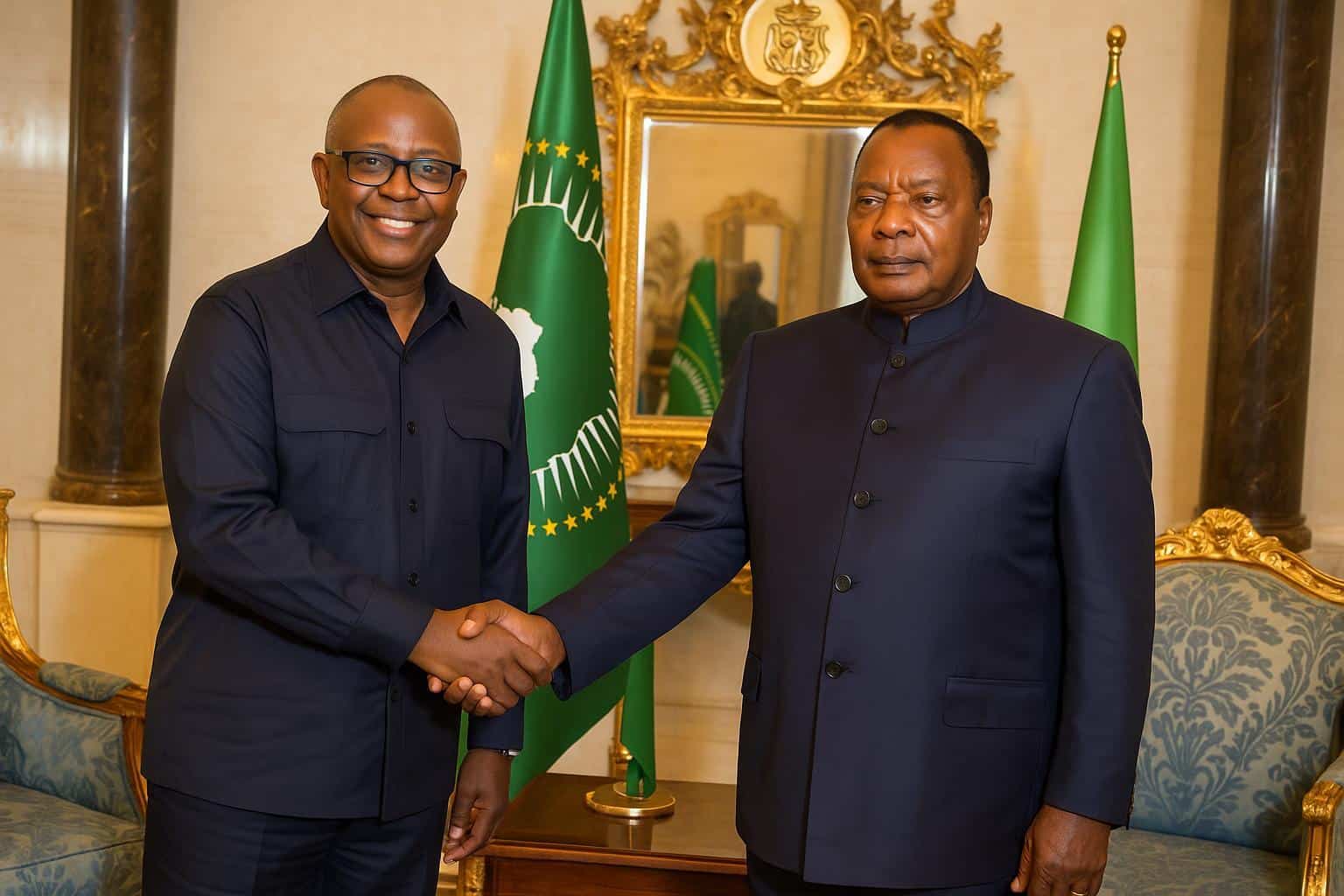
Brazzaville summit sets diplomatic momentum
The marble halls of the Palais du Peuple in Brazzaville echoed on 15 October as President Denis Sassou Nguesso welcomed his Bissau-Guinean counterpart, Umaro Sissoco Embaló. Their one-hour tête-à-tête, held away from cameras, set the tone for a renewed partnership between the two Atlantic neighbours.
According to a joint communiqué issued after the meeting, both leaders agreed to install dedicated working groups that will examine concrete projects in trade, energy, agriculture and security. The groups are tasked to deliver an initial roadmap before the end of the first quarter of 2024.
Visa-free travel deepens political trust
Officials emphasised that the current cooperation rests on the January 2022 framework agreement signed in Bissau, which lifted visa requirements for holders of diplomatic and service passports. For many analysts, that gesture eased official mobility and signalled the political confidence now being translated into sectoral programmes.
Speaking to reporters, Congo’s Foreign Affairs Minister Jean-Claude Gakosso described the visa waiver as “a bridge facilitating faster consultations,” while Guinea-Bissau’s chief diplomat, Carlos Pinto Pereira, called it a “first brick in a broader edifice” aimed at linking Lusophone and Francophone West-Central Africa.
Trade and investment priorities expand
Bilateral trade remains modest, barely surpassing 18 million dollars in 2022, according to figures from Congo’s Trade Promotion Agency. Both governments believe untapped forestry resources, fishery products and light manufactured goods could quickly double that volume once logistics corridors and customs procedures are streamlined.
The idea of a joint business forum, to be convened in Pointe-Noire early next year, emerged during the Brazzaville exchanges. Organisers intend to match Congolese timber processors with Bissau-Guinean cashew exporters and to showcase opportunities in port services, digital payments and professional training.
Economist Hervé Nzouzi, interviewed by public broadcaster Télé Congo, argued that complementarity is real. “Congo has deep-water facilities and surplus power; Bissau has agricultural niches and ocean access to the northern Atlantic routes. Together they can build regional value chains,” he said.
Energy and mining cooperation ambitions
Hydrocarbons dominated the closed-door segment of the talks. Congo, now producing around 267,000 barrels a day, wants to attract Bissau-Guinean investment funds into its upcoming offshore licensing round, while offering expertise from state firm SNPC to help Guinea-Bissau audit its own nascent oil potential.
Both presidents instructed their energy ministers to revive a 2015 memorandum on shared geological data. Analysts say such cooperation could facilitate joint bids for seismic surveys, reducing exploration costs at a time when African producers seek to balance energy security with climate commitments.
Mining also featured high. Congo’s Zanaga iron-ore project and Guinea-Bissau’s untapped bauxite reserves present scope for technical exchanges on rail evacuations and community engagement. Sources close to the delegation hinted at a possible study for a maritime shuttle linking Pointe-Noire to Bissau for bulk minerals.
Agriculture and food security partnership
Agriculture, long considered Guinea-Bissau’s backbone, is gaining attention in Congo, where food imports top 700 million dollars annually. Brazzaville outlined incentives for Bissau-Guinean agro-industrial entrepreneurs willing to cultivate rice and cassava in the Niari Valley, offering land leases, tax holidays and access to the railway corridor.
In exchange, Guinea-Bissau expressed interest in adopting Congo’s recently launched e-subsidy platform that delivers farm input vouchers via mobile phones. “Digitalisation can reduce leakages and empower smallholders,” noted Agriculture Commissioner Maria Odete Semedo, applauding Congo’s experience with the African Development Bank’s farm lab.
Working groups chart implementation
To steer all these ambitions, five thematic working groups—diplomacy, trade, energy, agriculture and culture—will convene alternately in Brazzaville and Bissau. Each will include officials, private-sector representatives and academics, reflecting Sassou Nguesso’s stated preference for an “inclusive mechanism that blends policy and expertise.”
A coordination secretariat hosted by Congo’s Ministry of International Cooperation will track progress and publish quarterly dashboards. Observers note that transparent metrics could reassure investors after earlier continental initiatives, such as the 2014 Praia-Brazzaville maritime service, stalled due to unclear mandates.
Regional and international outlook
Regionally, both states frame their rapprochement as consistent with the African Continental Free Trade Area. By linking CEMAC and ECOWAS maritime lanes, they hope to shorten shipping times between Central Africa and the mid-Atlantic, relieving pressure on congested West European trans-shipment hubs.
International partners are taking note. The Portuguese development bank, AFD, and the Saudi Fund for Development have separately expressed readiness to co-finance feasibility studies, diplomatic sources said. Their interest aligns with global efforts to diversify supply chains for critical minerals and agricultural commodities.
Civil society and next milestones
Civil society voices urge realistic timelines. “Past memoranda sometimes faded after the headlines. This time, the publication of monitoring tables is encouraging,” remarked Carine Diawara, researcher at the University of Brazzaville. Government advisers insist momentum will be sustained, citing the presidents’ “personal commitment to follow-up.”
Focus now shifts to March 2024, when Sassou Nguesso will visit Bissau for the inaugural joint commission. Draft records already list forty-two cooperation accords, highlighting the urgency both capitals attach to turning pledges into projects.