
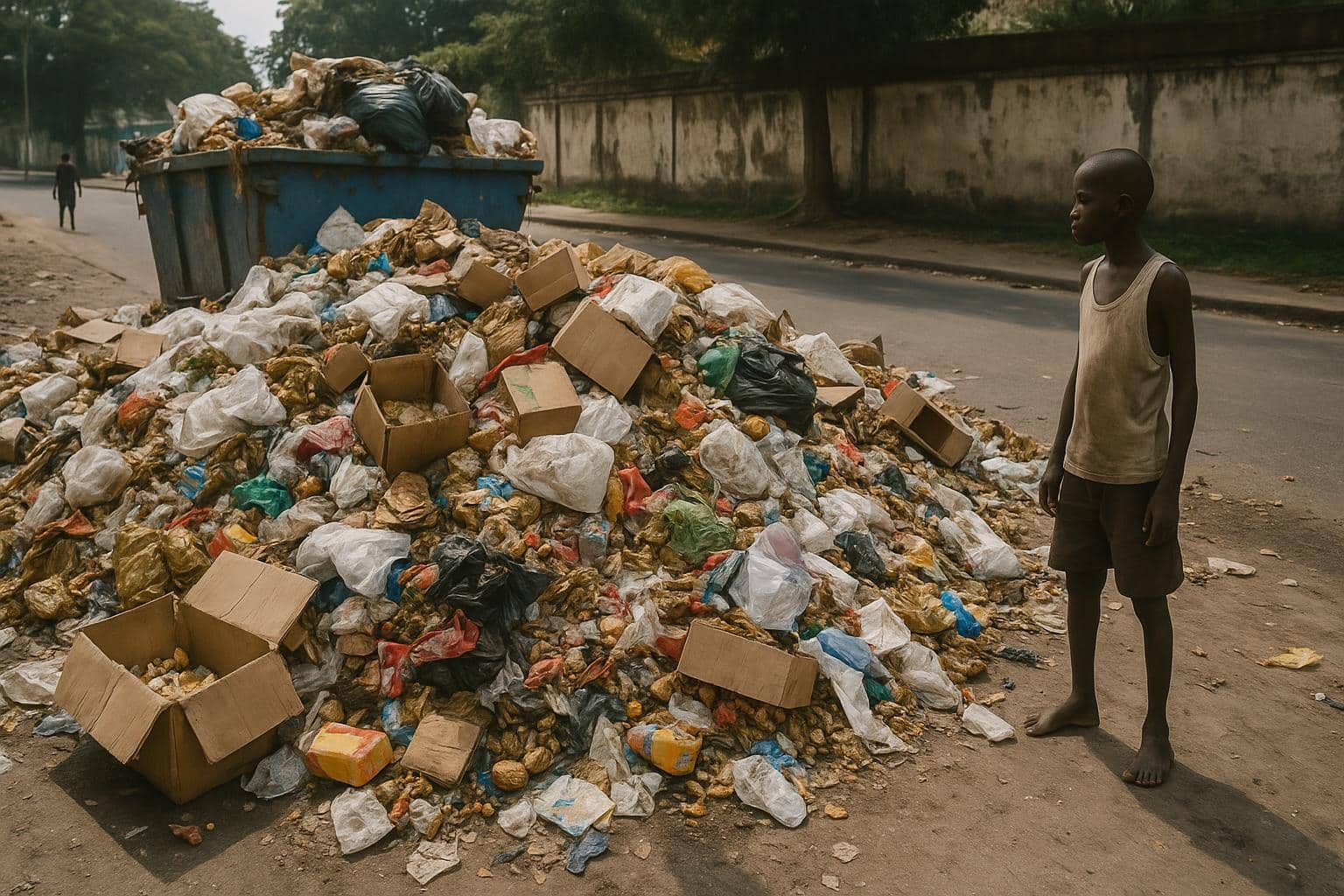
Daily Reality of Overflowing Bins
At dawn on Moungali’s Avenue Marien-Ngouabi, municipal bins overflow, plastic sachets flutter across the tarmac and vendors step around discarded mango peels. The scene, common in almost every arrondissement, underscores the scale of Brazzaville’s urban waste puzzle and the urgency citizens now feel.
Les Dépêches de Brazzaville reports that more than 600 informal dumpsites dot the capital, despite the entry in 2021 of the Turkish-owned Albayrak Waste Management Company under a multiyear public-private partnership aimed at modernising collection routes and reducing landfill volumes.
Albayrak’s Mandate and Operating Model
Albayrak’s contract, validated by the Ministry of Environment and the Municipality of Brazzaville, covers sweeping, door-to-door pick-ups and treatment at the Mpila landfill. The operator deploys compactors, skip loaders and street sweepers imported from Istanbul, working in shifts designed to match the city’s 24-hour rhythm.
Company managers insist progress is measurable. “We evacuated 35,000 tonnes during the last rainy season alone,” notes operations head Mehmet Cengiz, citing internal logs shared with the press. Still, he concedes that access roads, fuel costs and sporadic payment of service fees slow daily rotations.
Municipal Actions Backed by Central Government
The government has signalled reinforced support. In March, Prime Minister Anatole Collinet Makosso launched the Ville Propre programme, allocating an additional two billion CFA francs to sanitation in Brazzaville and Pointe-Noire, according to the budget annex published in the Official Gazette.
Municipal councillors say the fresh envelope will refurbish transfer stations, rehabilitate drainage channels that trap waste and finance public campaigns. “Cooperation with Albayrak and smaller Congolese firms remains our preferred path,” stresses city services director Thérèse Okemba, pointing to ongoing coordination meetings every fortnight.
Finance and Logistics Challenges
Logistics, however, remain complex. Brazzaville produces an estimated 1,000 tonnes of household refuse daily, but fleet capacity barely reaches 700 tonnes, according to a 2022 municipal audit. Frequent traffic jams on Avenue de la Corniche and fuel supply disruptions add several unplanned hours to each tour.
Revenue collection presents a second hurdle. Waste fees are bundled into electricity bills for households connected to the national grid, while markets pay flat rates. Payment compliance hovers around 60 percent, creating cash-flow gaps that delay maintenance of trucks and procurement of protective gear.
Community Engagement and Behaviour Change
Officials repeatedly emphasise that behavioural change is as critical as trucks. Many residents still deposit rubbish after collection rounds or burn plastics in yards, a practice highlighted in a recent rapport by the Congolese Observatory for Sustainable Development, which calls for stronger school curricula on waste sorting.
Grass-roots initiatives are multiplying. In Talangaï, the youth association Espace Vert recruits volunteers each Saturday to clear drains, while neighbourhood chiefs broadcast reminders over community radios. Albayrak now offers free pickups for groups organising clean-up days, an incentive praised by civil society organisation Eco-Congo.
Emerging Tech Solutions on the Table
Digital tools are also entering the scene. The start-up Mboka Clean has piloted a mobile app that geotags overflowing bins and alerts the closest truck base. Funded through the National Innovation Fund, the platform processed 4,200 reports during its first quarter, municipal data indicate.
The Ministry of Scientific Research is examining waste-to-energy prototypes capable of transforming organic matter into biogas for canteens. A feasibility study, co-financed by the African Development Bank, evaluates whether heat from a future unit near Djiri could power street lighting along adjoining corridors.
Experts Advocate Circular Economy Moves
Environmental economist Marina Bikindou argues that long-term success lies in a circular economy model. She recommends separating organics for composting that could enrich peri-urban cassava fields, and selling recovered plastics to Pointe-Noire packaging plants, a scheme trialled in neighbouring Cameroon with encouraging margins.
Public health specialists concur. “Reducing open dumping cuts malaria and cholera vectors,” explains Dr. Raphaël Obambé of the University of Brazzaville. He notes that hospital admissions rise sharply in rainy months when gutters clog. Better waste management, he says, constitutes preventive healthcare in disguise.
Outlook for a Cleaner, Greener Capital
Regional partners express readiness to accompany the effort. The Economic and Monetary Community of Central Africa has listed urban sanitation among priorities for its 2024-2026 plan, opening access to concessional loans for equipment and training. Discussions with the Community Development Fund are reportedly advanced.
For now, Brazzaville residents navigate between optimism and frustration. Visible progress along central boulevards contrasts with persistent piles in dense outskirts. City hall asserts that a fully synchronised system will emerge within two years. Success, observers agree, will hinge on steady funding and shared civic responsibility.