
Regulatory overhaul under way
Five years after Congo-Brazzaville adopted the landmark Forest Code, technicians from the Ministry of Forest Economy are polishing the secondary regulations expected to guide every future community concession. The process, officials stress, is designed to translate legal principles into practices that benefit both people and ecosystems.
Drafts circulated this month outline how villages may apply for a plot, manage timber sales and share revenue. Yet the texts remain provisional. Before they reach the Council of Ministers, civil society voices are invited to pinpoint gaps, flag conflicts and propose safeguards that ensure inclusivity.
Civil society workshop in Brazzaville
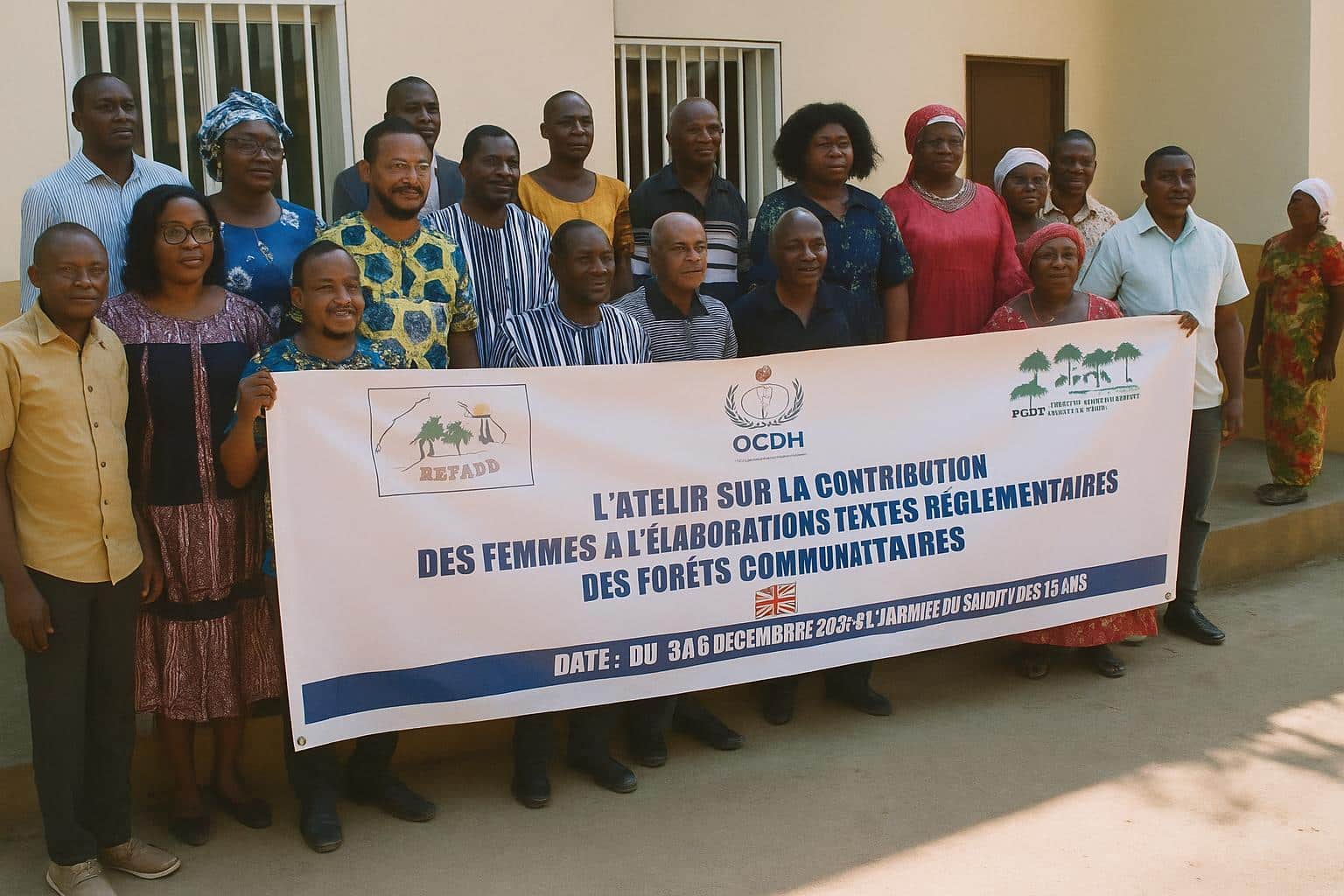
Responding to that call, the African Women’s Network for Sustainable Development, known as Refadd, teamed up with the Platform for Sustainable Forest Management and the Congolese Observatory of Human Rights to organise a three-day Brazzaville workshop held 3-5 December 2025.
The opening and closing remarks came from Refadd’s national coordinator, Marie Julienne Longo Bendo, who underlined women’s responsibility in forest governance. Alongside her stood PGDF coordinator Alfred Nkodia and OCDH executive director Nina Cynthia Kiyindou Yombo, signalling a unified civil-society front across gender and thematic lines.
More than twenty participants dissected preliminary decrees prepared by consultancy Terea. Their mission was twofold: gauge how far gender language already penetrates the drafts and craft concrete wording that secures women’s voting rights on forest committees, equal access to proceeds and targeted support for female-led green enterprises.
Why gender matters in forest governance
Speaking during the plenary, Longo Bendo argued that a rulebook ignoring half the population would undermine the Forest Code’s intent. She reminded delegates that in many villages women collect non-timber products, nurse seedlings and keep household accounts, positioning them as day-to-day custodians of forest value.
Invited resource person Maixent Fortunin Agnimbat Emeka, president of the Forum for Human Rights Governance, broadened the argument. ‘Community forestry is designed to combat rural poverty while conserving biodiversity,’ he said. ‘If women are sidelined, we jeopardise economic, social and ecological objectives in a single stroke.’ The hall nodded in firm agreement.
Key proposals on the table
The draft decree creating a National Committee on Genetic Resources was one focal point. Delegates recommended reserving at least thirty per cent of seats for women and requiring gender-balanced technical subgroups. They also called for a publicly accessible roster listing each committee member’s community endorsement and conflict-of-interest statement.
Another suggestion targets revenue flows. Workshop notes propose that no less than forty per cent of community-forest profits be reinvested in social projects selected through a vote in which women hold equal quorum. Eligible projects include health centres, preschool classrooms and micro-credit schemes for smallholder agroforestry ventures.
Finally, participants urged drafters to mention women’s land-use knowledge in the preamble, arguing that such recognition helps traditional chiefs embrace female participation. ‘Symbolic wording matters in our culture,’ said Nkodia. ‘Once the decree cites women, local negotiators follow its example.’
Balancing triple benefits of forests
Agnimbat Emeka recapped the three functions of community forests: generate income, uplift living conditions and safeguard biodiversity. In his view, devolving certain powers to grassroots groups answers persistent rural poverty. But he cautioned that empowerment without clear checks could expose forests to elite capture or speculative logging.
Workshop rapporteurs therefore recommended periodic audits by the National Committee, coupled with simplified reporting templates so even remote villages can comply. They insisted that transparency, not bureaucracy, remain the guiding principle. Forests, they noted, are long-term assets whose dividends only accrue if management survives electoral and market cycles.
Next steps before adoption
The refined recommendations will feed into a multi-stakeholder working group convened by the Ministry. According to officials familiar with the timeline, the group intends to finalise a consolidated text early next year, paving the way for review by the Council of Ministers and, subsequently, presidential promulgation.
Refadd and its allies plan follow-up field missions in Cuvette, Niari and Kouilou to brief rural women on their prospective rights. ‘Participation does not end in the capital,’ Kiyindou Yombo said. ‘We will travel, translate and train so that new rules live beyond the Gazette.’
For government advisers, the initiative aligns with commitments under the African Forest Landscape Restoration Initiative and global biodiversity frameworks. They view the gender lens as complementary, not adversarial. ‘Our goal is a coherent policy set that honours international pledges while respecting Congolese realities,’ one senior official explained.
Should the decrees pass largely in their current form, Congo-Brazzaville would position itself among regional pioneers of gender-responsive community forestry. For the women who filled the Brazzaville hall, that prospect already feels tangible. As Longo Bendo told reporters, ‘This forest reform will carry our voices into the canopy.’
Neighbouring Cameroon, Central African Republic and Gabon are also revising community-forest rules, often watching Brazzaville’s experimentation. Diplomats in the CEMAC secretariat hint that harmonised standards could ease cross-border timber certification and unlock climate finance earmarked for gender-inclusive landscape programmes in future.