
A Northern Diocese at the Centre of National Attention
Few provincial ceremonies in the Republic of Congo attract the confluence of ecclesiastical, diplomatic and governmental actors witnessed on 19 July 2025 in Ouesso. Once famed for its cacao warehouses and river trade, the Sangha prefectural capital became the liturgical epicentre of the nation when Bishop Brice-Armand Ibombo, long-serving secretary-general of the Episcopal Conference, received episcopal ordination before a congregation estimated at six thousand. According to clerical sources consulted in Brazzaville and Vatican News reports, the Holy See had formalised the nomination on 28 May, prompting a meticulous mobilisation of dioceses from Pointe-Noire to Impfondo.
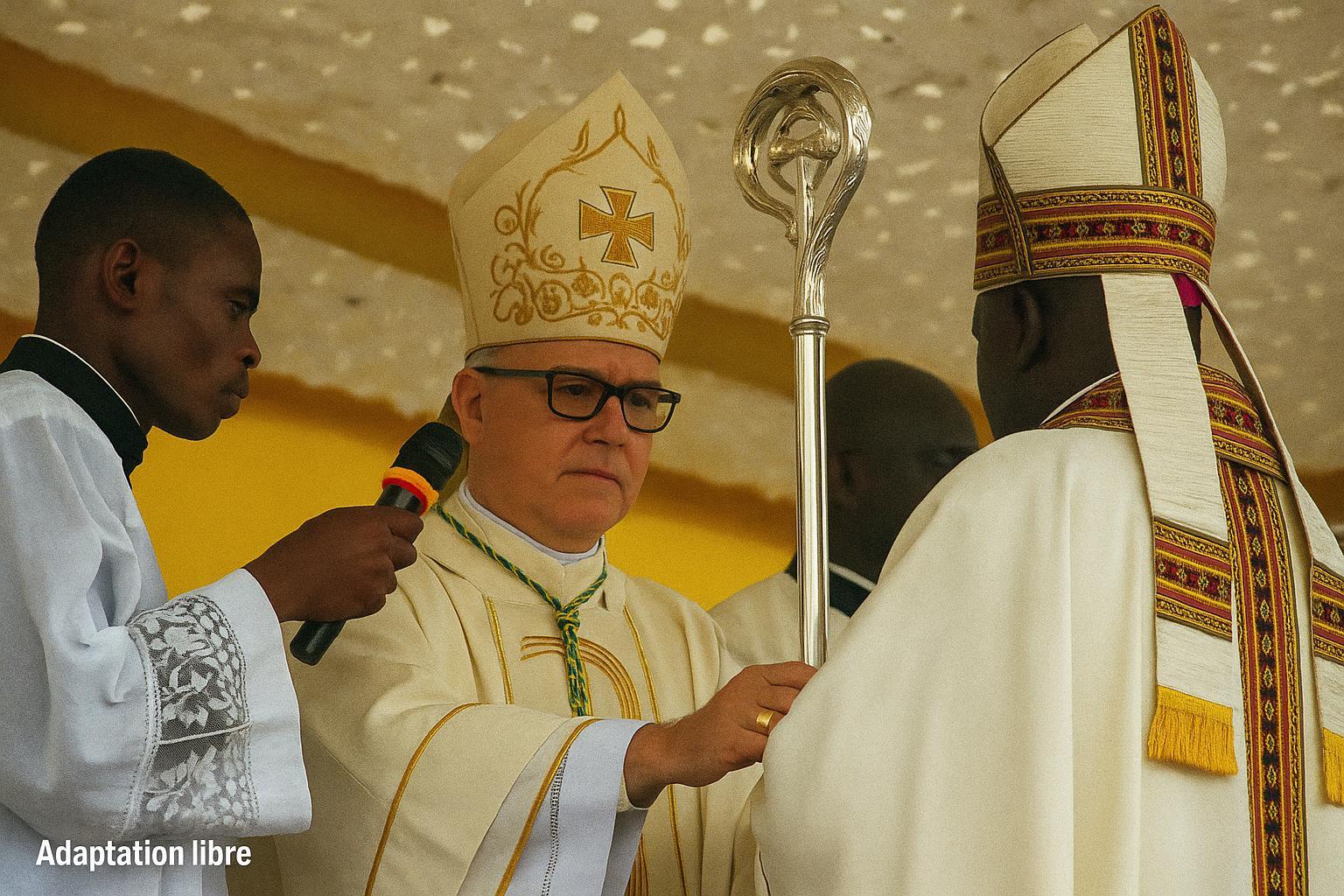
The rite unfolded under the tropical afternoon sun on the forecourt of Saint Peter Claver Cathedral, a strategic architectural landmark whose façade still bears colonial-era masonry. Apostolic Nuncio Javier Herrera Corona, principal consecrator, framed the appointment as “a tangible sign of papal solicitude toward the peripheries”, reminding the faithful that episcopal ministry is intrinsically linked to local development agendas.
State Protocol and Ecclesial Ceremony in Subtle Concert
The Congolese Government’s presence, represented by Minister-Delegate Ghislain Thierry Maguessa Ebomé and Sangha Prefect Denis Okouya, underscored a climate of constructive Church–State collaboration. In a brief intervention the minister stressed that the executive had “supported this celebration of republican conviviality”, a formulation that echoes President Denis Sassou Nguesso’s recurrent calls for social cohesion. Observers from the national daily Les Dépêches de Brazzaville noted that logistical assistance—ranging from security escorts for prelates to road maintenance on the often-challenging RN2—was expressly authorised by the presidency.
Such protocol did not eclipse liturgical solemnity. During the four-hour Mass, the papal bull of appointment, read by Bishop-emeritus Louis Portella Mbuyu, elicited visible emotion among clergy who had worked alongside Ibombo during his decade at the helm of the Conference secretariat. The new bishop knelt as the nuncio and twelve Congolese bishops imposed hands, an act that visually articulated collegiality as much as hierarchy.
Voices from the Nave: Expectations and Commitments
Testimonials gathered by Agence Congolaise d’Information conveyed a pervasive optimism. Bishop Bienvenu Manamika Bafouakouahou praised “a man chosen to guide, teach and sanctify”, while visiting Gabonese cleric Father Michel-Ange Bengene spoke of leaving “with joyful hearts”. The local laity, travelling from riverine parishes by pirogue, expressed more pragmatic hopes: improved catechetical programmes, rehabilitated schools and a diocesan micro-credit fund for cocoa cooperatives.
In his inaugural homily the following morning, Bishop Ibombo addressed those aspirations directly, advocating unity, solidarity and disciplined labour as prerequisites for sustainable progress. He announced forthcoming norms on financial transparency and pastoral attendance, signalling an administration both pastoral and managerial. Analysts interpret these priorities as consonant with Brazzaville’s national development plan, which foregrounds agricultural revitalisation and youth employment.
Regional Diplomacy Woven into Ecclesial Networks
The episcopal seating drew delegations from Italy, Cameroon and the Democratic Republic of Congo, transforming Ouesso into a micro-hub of Central African soft diplomacy. Conversations on the cathedral esplanade revealed shared concerns over cross-border forestry management and the humanitarian corridor toward Sangha-Mbaéré. Clerics privately acknowledged that the Church’s transnational networks often facilitate dialogue where formal diplomatic tracks stall.
Bishop Ibombo’s tenure as secretary-general afforded him fluency in this discreet diplomacy. Analysts at the Institut des Études Stratégiques de Brazzaville suggest that his appointment may invigorate ecclesial cooperation agreements, including a pending memorandum on health-sector partnerships supported by the Prime Minister’s Office. The presence of senior state officials at the consecration thus served a double purpose: paying homage to a spiritual figure and signalling governmental readiness to leverage ecclesiastical channels for regional stability.
A Forward Glance toward Governance and Development
While the ceremony’s harmony was momentarily shadowed by the sudden passing of Mme Cécile Badila, mother of a young deacon, the overall narrative remained forward-looking. The bishop closed proceedings by inviting continuous prayer and civic engagement, affirming that evangelisation and socio-economic advancement are mutually reinforcing. Government interlocutors echoed that sentiment, with the prefect pledging infrastructural upgrades to secondary roads leading to mission stations.
Measured against the broader tapestry of Congolese public life, the Ouesso consecration offers an instructive vignette of institutional synergy. It demonstrates how ceremonial rites can foster civic momentum, nurturing both spiritual capital and developmental resolve. As pilgrims dispersed along the Sangha River and the episcopal motorcade headed south, the prevailing assessment among diplomats present was succinct: an event orchestrated with dignity, emblematic of a polity where religious vitality and state vision can, at their best, converge for the common good.