
New equipment strengthens urban sanitation
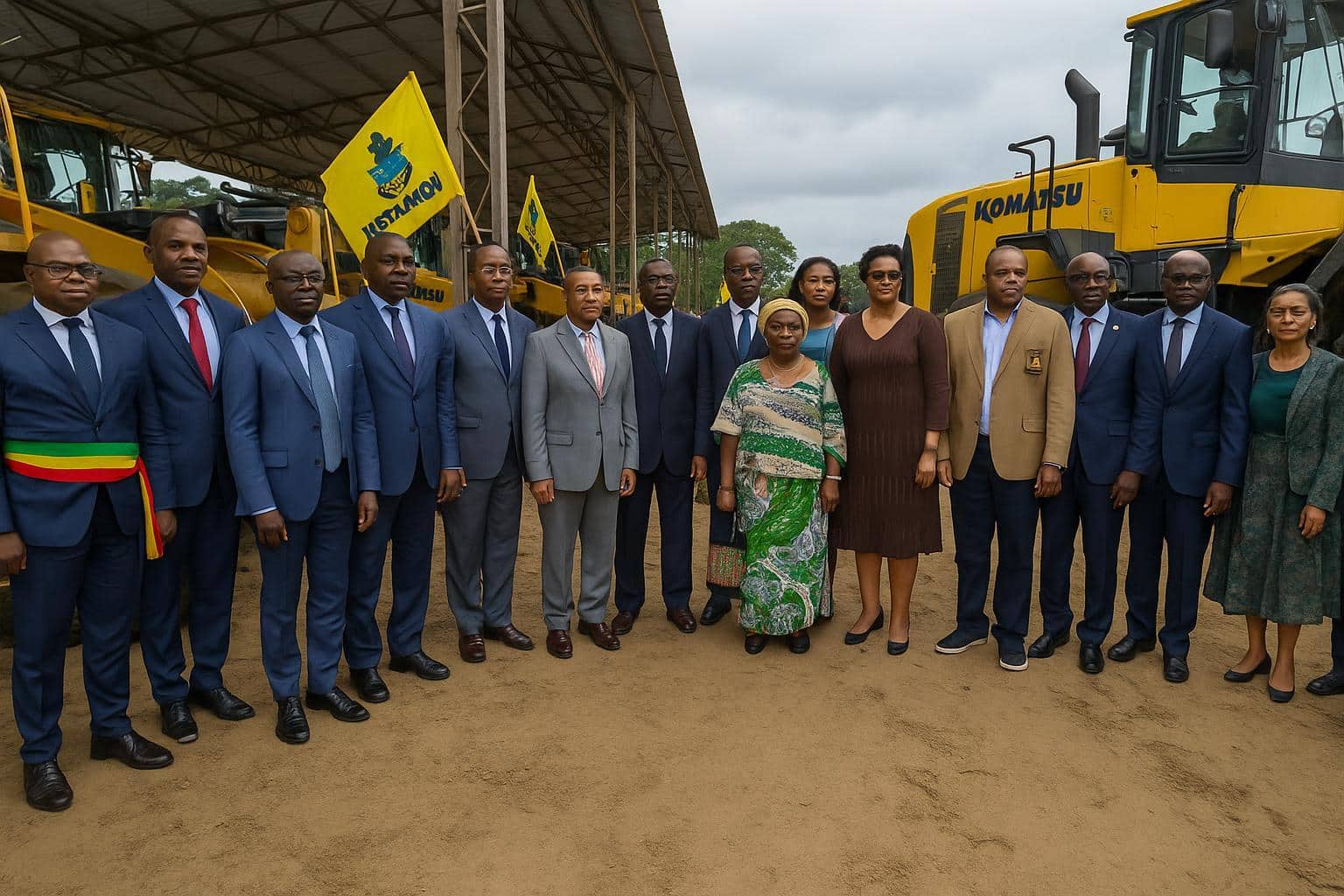
A convoy of freshly painted bulldozers and compactors rolled onto the esplanade of the Pointe-Noire town hall on 12 December, marking the visible start of a 180-million-yen donation from the government of Japan aimed at revamping the port city’s battered streets.
The package, converted to just over 80 million CFA francs, includes Caterpillar bulldozers delivering roughly 200 horsepower and compactors from Komatsu and Sakai, equipment city engineers say is rarely available in municipal garages after decades of wear and constrained budgets.
Diplomatic ceremony highlights shared priorities
Speaking on behalf of the Japanese embassy, Deputy Head of Mission Maekawa Hidenobu expressed the wish that every machine be operated rigorously and serviced on schedule, warning that heavy gear can quickly deteriorate in a coastal climate if grease points and filters are ignored.
Maekawa reminded officials that reliable roads reinforce economic integration, social cohesion and emergency response, adding that the gradual degradation of Pointe-Noire’s arteries had become a visible challenge for residents and investors who depend on timely delivery of fuel, fish, timber and containerized cargo.
Government pledges strict stewardship
The hand-over was presided by Minister of Urban Sanitation, Local Development and Road Maintenance Juste Désiré Mondélé, representing Prime Minister Anatole Collinet Makosso. He urged municipal brigades to treat the equipment as a public asset, not a decorative line-up or a side business for private rentals.
You have a kit for road and street upkeep, he said. The machines must generate smoother traffic, cleaner drainage and safer pedestrian zones, because urban sanitation is not only about garbage pickup but also about pavement quality and commuter comfort, Mondélé declared to applause from technicians.
Echoing the call, Council President Evelyne Tchitchielle promised rigorous tracking of fuel logs, operating hours and maintenance sheets. The city’s finance committee, she noted, will table a quarterly report to reassure both Brazzaville and Tokyo that the gift is translating into measurable kilometres of rehabilitated roadway.
TICAD agreement frames Japanese support
The donation stems from a 2022 technical cooperation agreement signed in Brazzaville by Minister of International Cooperation Denis Christel Sassou Nguesso and the then Japanese ambassador. The deal aligns with priorities outlined by the Tokyo International Conference on African Development, better known as TICAD.
Under that framework, Japanese aid targets human security by improving access to infrastructure, health and education. Pointe-Noire, a hub for oil production and maritime trade, was identified as a strategic pilot city where road reliability could quickly enhance livelihoods and regional supply chains.
Technical gains expected on the ground
Engineers from the municipal service say the Caterpillar D6 units can clear eroded shoulders and level pothole-ridden lanes in hours instead of days. Komatsu and Sakai compactors, meanwhile, promise denser asphalt layers that resist the tropical downpours blamed for premature cracking.
Yet officials concede that hardware alone will not keep roads drivable. Timely budgeting for diesel, spare parts and operator training remains crucial. Pointe-Noire’s mechanical workshop has therefore been instructed to submit an inventory plan within 30 days, according to an internal note seen after the ceremony.
Residents voice measured optimism
Residents who gathered behind police barriers offered mixed reactions. “If they grade the sand piles near Loandjili market, taxis will stop breaking axles every week,” said stonemason Florent Mabika. Vendor Clarisse Bibila was more cautious, recalling previous donations that disappeared from depots without visible impact.
Minister Mondélé acknowledged that concern, announcing that GPS beacons will be fitted to each machine and that the National Office of Road Maintenance will publish monthly deployment maps on its website. Transparency, he argued, is part of the patriotism required to turn Pointe-Noire back into ‘Ponton-la-Belle’.
Economic stakes for both partners
For Japanese diplomats, the gesture also serves public diplomacy. Congo hosts a growing number of Japanese companies in telecommunications and energy services, and safe streets can lower logistics costs. “Better roads help everybody, including firms from our country,” Maekawa observed, hinting at win-win economics without overstating commercial motives.
The equipment will now be dispatched to three primary clusters: downtown avenues feeding the port, industrial roads near Zian-boulou plant and residential links in Tié-Tié district. Municipal engineers expect the first resurfaced segments to appear early next year, pending dry weather windows.
Scaling lessons to other cities
Observers note that Pointe-Noire’s rehabilitation model could inform other départements. Owando, Dolisie and Oyo share identical maintenance challenges, and the Ministry says lessons learned on preventive servicing, procurement and citizen feedback will be compiled for nationwide replication under the 2024-2028 municipal road strategy.
For now, residents will be watching the odometers and fuel gauges as closely as the fresh asphalt. Success, local pundits say, will be measured less by inaugural photographs than by the number of rainy seasons the resurfaced lanes survive without crumbling into familiar potholes.
Time savings become the real metric
City planners estimate that each rehabilitated kilometre reduces average travel time by seven minutes, a saving that compounds across freight and public transport.