
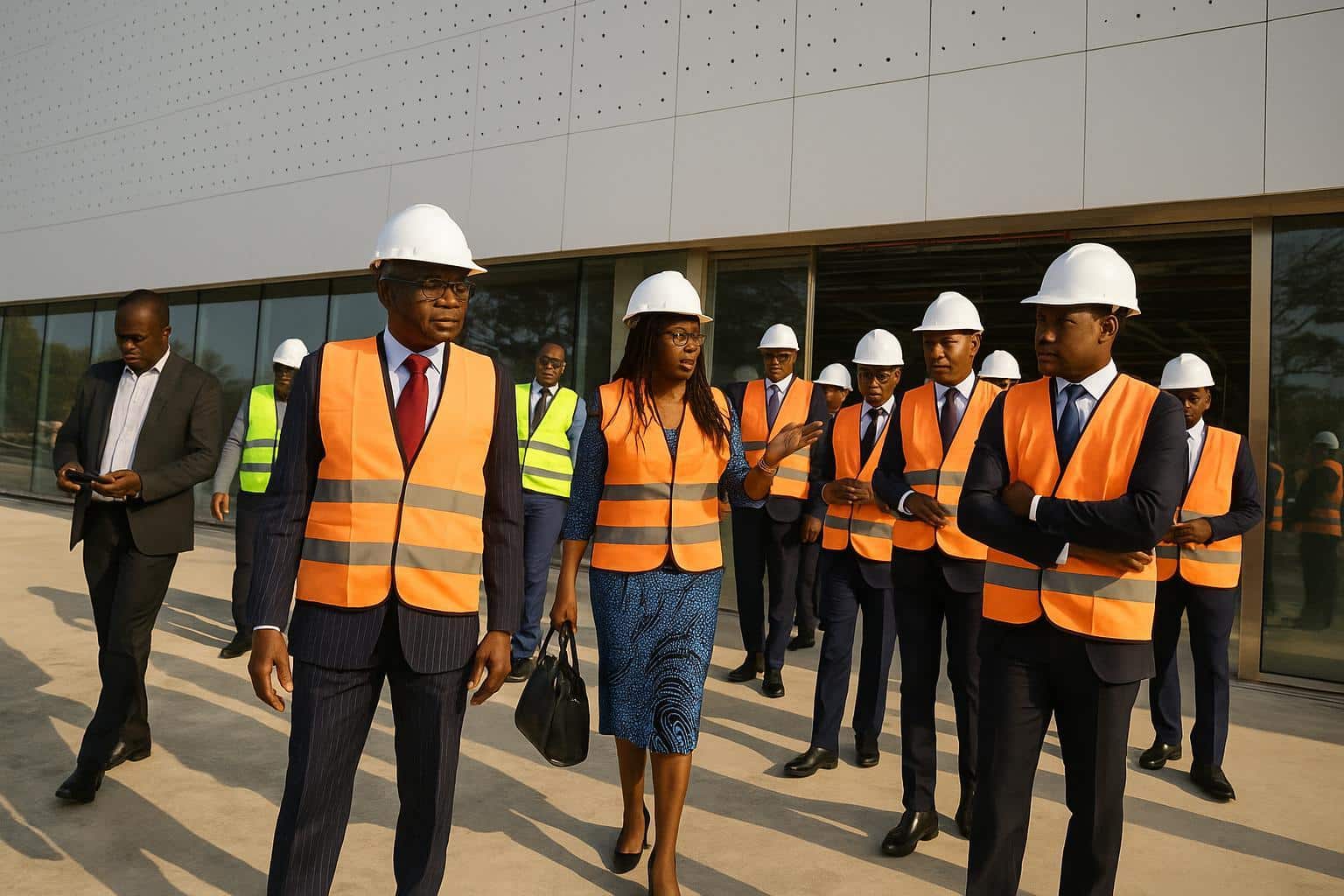
AfDB leadership inspects Brazzaville facility
The late-October Harmattan sun barely pierced the grey shell of the three-storey building rising opposite Camp La Milice in southern Brazzaville. Stepping out of her convoy, African Development Bank senior vice-president Marie-Laure Akin-Olugbade paced the dusty courtyard, orange safety vest over business attire, to gauge construction progress.
Flanked by Telecommunications Minister Léon Juste Ibombo and Economy Minister Ludovic Gatsé, she listened as engineers detailed concrete strength tests, fire-suppression valves and biometric access points. “These are tomorrow’s lifelines,” she told reporters, praising Congo’s decision to anchor sensitive data on home soil while opening doors to sub-regional partners.
A project rooted in digital sovereignty
Plans for a national data center were first drawn in 2016, after several service outages exposed Congo’s dependence on foreign servers. Officials argued that banking information, health records and tax filings deserved the same constitutional protection as physical borders.
President Denis Sassou Nguesso subsequently placed digital sovereignty among the pillars of the National Development Plan 2022-2026. The Brazzaville facility, complemented by fiber loops completed last year, is designed to host government clouds, corporate platforms and disaster-recovery backups inside one high-security perimeter.
Financing and AfDB’s share
The US$67 million price tag is jointly funded by the Congolese treasury and an AfDB envelope approved in 2020 under the Central Africa fibre-backbone programme, bank officials confirmed. Akin-Olugbade recalled that the Bank’s board cleared the loan and grant package “to catalyse a regional digital market in CEMAC”.
Around ninety percent of civil engineering is complete, contractors say. Payment of the final tranche—estimated at US$8 million—will unlock rack installation, precision cooling and battery arrays. AfDB executives, satisfied with audit reports, signalled their readiness to disburse once cabinet finalises counterpart allocations.
Construction pause and contractor challenges
Site foreman Zhang Wei acknowledged a temporary slowdown since August as the Chinese consortium awaits the last certificates of payment. Nevertheless, reinforced floors for the Tier III server halls are finished, raised floors lay stacked in crates, and the roof-mounted chillers have been tested at partial load.
Local subcontractors continue landscaping, fiber splicing and access-road surfacing. “Everything we can do without additional import bills is moving,” Zhang said. He predicted three months of work remain from the moment financing resumes, putting commissioning within the first half of 2024 if no further delays occur.
Regional benefits for CEMAC markets
Beyond Congo’s administrative databases, the center is expected to woo banks, fintech start-ups and oil-field operators across Gabon, Cameroon and Equatorial Guinea. AfDB digital adviser Diane Mbemba noted that cross-border data flows currently transit Europe before returning to Central Africa, adding cost and latency.
“Hosting workloads locally trims milliseconds that matter to stock orders or tele-medicine sessions,” she explained. Regulators within the Economic and Monetary Community of Central Africa are drafting common certification rules so companies can choose the Brazzaville hub without breaching national privacy statutes.
Security architecture under scrutiny
Architectural plans reveal dual power feeds, a two-megawatt diesel farm and future solar couplings. Inside, redundant cooling loops surround a bunker-style server room designed to withstand two hours of fire at 1 000 °C. Access requires two-factor biometrics and an air-lock vestibule.
Congolese cyber-security agency ANSIC will run a dedicated security operations center on the mezzanine floor. “We aim for ISO 27001 certification within the first year,” director Boris Bongo Bouity affirmed, adding that cooperation with INTERPOL’s cyber-crime unit would deter illicit intrusion attempts once the facility goes live.
Economic ripple effects in Brazzaville
Around 120 Congolese technicians and labourers rotate onsite each day, injecting wages into surrounding Bacongo cafés and hardware stalls. University Marien Ngouabi computer-science graduates earn internships configuring network switches or writing energy-management scripts.
Minister Ibombo predicts the center will eventually house a training academy offering Cisco and Huawei certifications, easing youth unemployment and anchoring knowledge in-country. “We do not merely import machines; we cultivate skill transfer,” he told the visiting delegation.
Cloud market forecasts and private uptake
Consultancy Xalam Analytics estimates Central Africa’s cloud spending could reach US$620 million by 2027, up from US$170 million last year. Analysts say a neutral, carrier-grade facility in Brazzaville could capture a fifth of that market if pricing stays competitive and connectivity reliable.
Early interest comes from telecommunications operators MTN Congo and Airtel, both negotiating colocation bays to host voice-mail and payment platforms. Insurance group Assurances et Réassurances du Congo is studying disaster-recovery seats after flash floods disrupted Port-Gentil servers in December.
Policy alignment and data-protection law
Congo’s 2019 Data Protection Act, drafted with EU General Data Protection Regulation benchmarks, underpins the center’s operations. The law created an independent Commission nationale de protection des données personnelles empowered to audit processors and impose fines.
Commission president Trésor Nganga believes physical localisation strengthens enforcement: “It is easier to ensure compliance when servers sit within taxi distance rather than on another continent.” He nonetheless urged lawmakers to update breach-notification clauses before the first tenant migrations.
Power supply and green ambitions
Though initially diesel-backed, the project blueprint reserves rooftop space for 1 500 square metres of photovoltaic panels that could offset fifteen percent of annual consumption. Talks with the national utility aim to blend hydropower from the Sounda Gorge scheme into the energy mix.
AfDB climate officer Awa Diop called the hybrid model “a pragmatic bridge toward carbon-smart data corridors” as regional grids stabilise. She reminded attendees that green financing instruments remain available should Congo pursue a larger solar array in future phases.
Timeline to commissioning
If funds flow before year-end, the contractor plans to energise main switchboards by March, run integrated systems tests in April and welcome pilot workloads in May. Government IT teams are already drafting migration roadmaps for tax archives and civil-status registries.
Akin-Olugbade expressed confidence: “The Bank stands ready to attend the ribbon-cutting. Our priority is tangible impact, not bricks alone.” Her words drew applause from site workers who paused welding to listen.
Stakeholder voices on the ground
Neighbouring shopkeeper Clarisse Mavoungou said foot traffic has grown since works began: “Technicians buy lunches, kids ask about coding; the project makes us dream beyond selling bread.” Student intern Rodrigue Mabiala hopes a full-time role emerges once operations scale.
Their optimism mirrors national surveys showing broad public support for technological infrastructure viewed as a pathway to diversification away from crude exports.
Balancing expectations and fiscal prudence
Economist Arnaud Matoko cautioned that on-time delivery hinges on disciplined budget execution amid fluctuating oil revenues. “Yet the multiplier effect of digital platforms can outweigh upfront debt,” he argued, pointing to Kenya’s Konza Techno City as precedent.
Cabinet insiders say an inter-ministerial committee meets weekly to realign cash flows and prevent further stoppages. Parliament’s finance commission has requested quarterly progress reports to bolster transparency.
Final push toward regional connectivity
Beyond the building, a 25-kilometre dual fiber loop will connect the data center to the national IX in Poto-Poto and onward submarine cables landing at Pointe-Noire. Negotiations with Satcom provider Rascom aim to secure satellite redundancy for landlocked CAR clients.
Such redundancy, engineers insist, qualifies the hub for Tier III certification, assuring 99.982 percent availability—an essential mark for multinational tenants.
Legacy of partnership
For AfDB, the site stands as a showcase of its High 5 agenda, specifically “Improve the Quality of Life for the People of Africa”. For Congo, it symbolizes a pivot from resource extraction to knowledge economies.
“We are planting the seeds of a digital future that our children will harvest,” Minister Ibombo declared, hand on the unfinished concrete wall, before the delegation departed.