
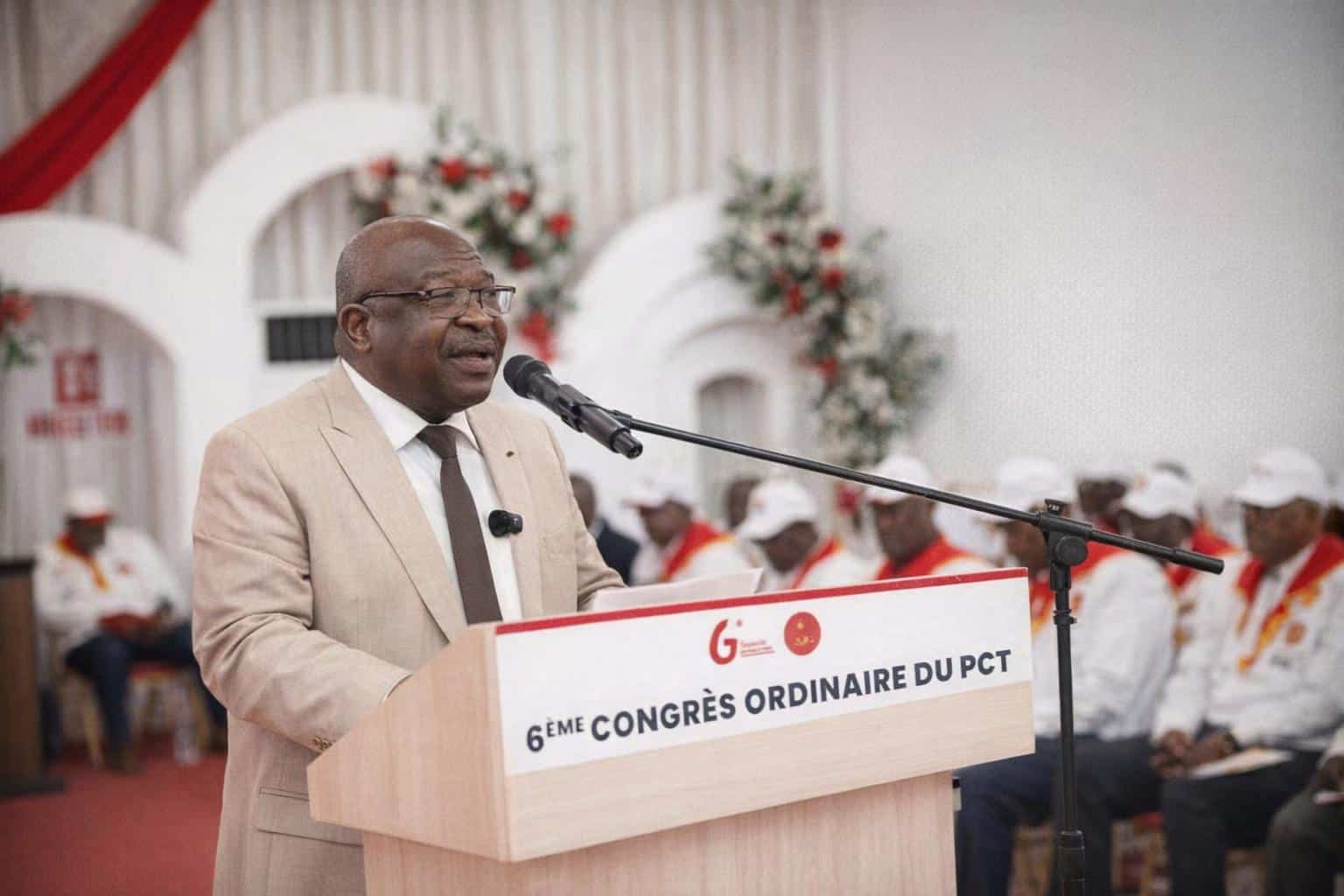
PCT 6th Congress Sets the Tone for 2026
As the lights went down on the 6th ordinary congress of the Congolese Labour Party (PCT), one message stood out from the resolutions: a call for President Denis Sassou N’Guesso to present his candidacy in the March 2026 presidential election.
The appeal was voiced by the PCT and echoed by allied parties within the presidential majority. Among them, the Congolese Movement for Democracy and Integral Development (MCDDI) used the congress platform to reaffirm its political alignment and explain its position publicly.
Presidential Majority Reaffirms a Common Political Line
The congress also served as a gathering point for parties that make up the presidential majority to restate their commitment to the guiding principles they say underpin their coalition. Speakers framed this unity as both political and institutional, aimed at keeping the governing bloc cohesive ahead of 2026.
From the statements delivered, this shared outlook translated into a unanimous choice of a common candidate for the next presidential race: Denis Sassou N’Guesso. The claim of unanimity was explicitly raised from the podium during the PCT congress.
MCDDI’s Public Call: ‘A Solid Political Foundation’
Speaking for the MCDDI, party president Euloge Landry Kolelas described the alliance with the PCT as “without doubt a solid political foundation.” He said the MCDDI hopes the PCT congress will strengthen the presidential majority, enabling it to lead the country “with determination, responsibility and in optimal conditions.”
In his remarks, Kolelas placed emphasis on stability as a political priority. He said the MCDDI remains attached to peace, national unity and social cohesion, presenting these as shared values that coalition partners must preserve together “in the higher interest of the Nation.”
A Pledge of Loyal Cooperation With the PCT
Kolelas also renewed a promise of what he called “frank and loyal” collaboration with the PCT. He framed this cooperation as based on mutual respect, permanent dialogue and political responsibility, linking it to the broader objective of development and the well-being of citizens.
In tone and substance, the address positioned the MCDDI as a partner seeking continuity inside the governing bloc. The message was less about tactical bargaining than about reaffirming a long-standing relationship built within the institutions of the majority.
Why the MCDDI Says Sassou N’Guesso Fits 2026
For the MCDDI, Kolelas argued that only one figure combines experience, patriotism and a reputation as a “man of peace” capable of steering Congo’s course. In his words, President Denis Sassou N’Guesso is a “privileged witness” of the nation’s history and therefore suited to guide its future.
He then made the party’s central request explicit: the MCDDI invited President Sassou N’Guesso to “make an act of candidacy” for the March 2026 election. Kolelas said the party believes this would be “the choice of reason” as well as “the choice of the heart.”
A Coalition Narrative Rooted in History and Legacy
The MCDDI presented its alliance with the PCT as more than a contemporary arrangement, describing it as an anchor that has entered the country’s political history and, in its phrasing, as “the foundation of national unity.” This narrative seeks to show a continuity of purpose across electoral cycles.
In that context, the party linked its support for Sassou N’Guesso to what it described as a legacy from its founder, Bernard Bakana Kolelas. According to the party’s framing, that vision remains a guiding light for the present, reinforcing its choice for 2026.
March 2026 Election: A Message of Unity From the Majority
The overall picture emerging from the PCT’s 6th congress is a presidential majority intent on projecting internal coherence early in the road to March 2026. By presenting a single candidate choice and having allies speak in the same register, the coalition aims to signal stability.
For the MCDDI, the congress moment was used to underline both loyalty and conviction. Its call for Sassou N’Guesso’s candidacy was justified through the vocabulary of unity, peace and responsibility—terms that, in Congolese political life, often serve as benchmarks for evaluating leadership.