
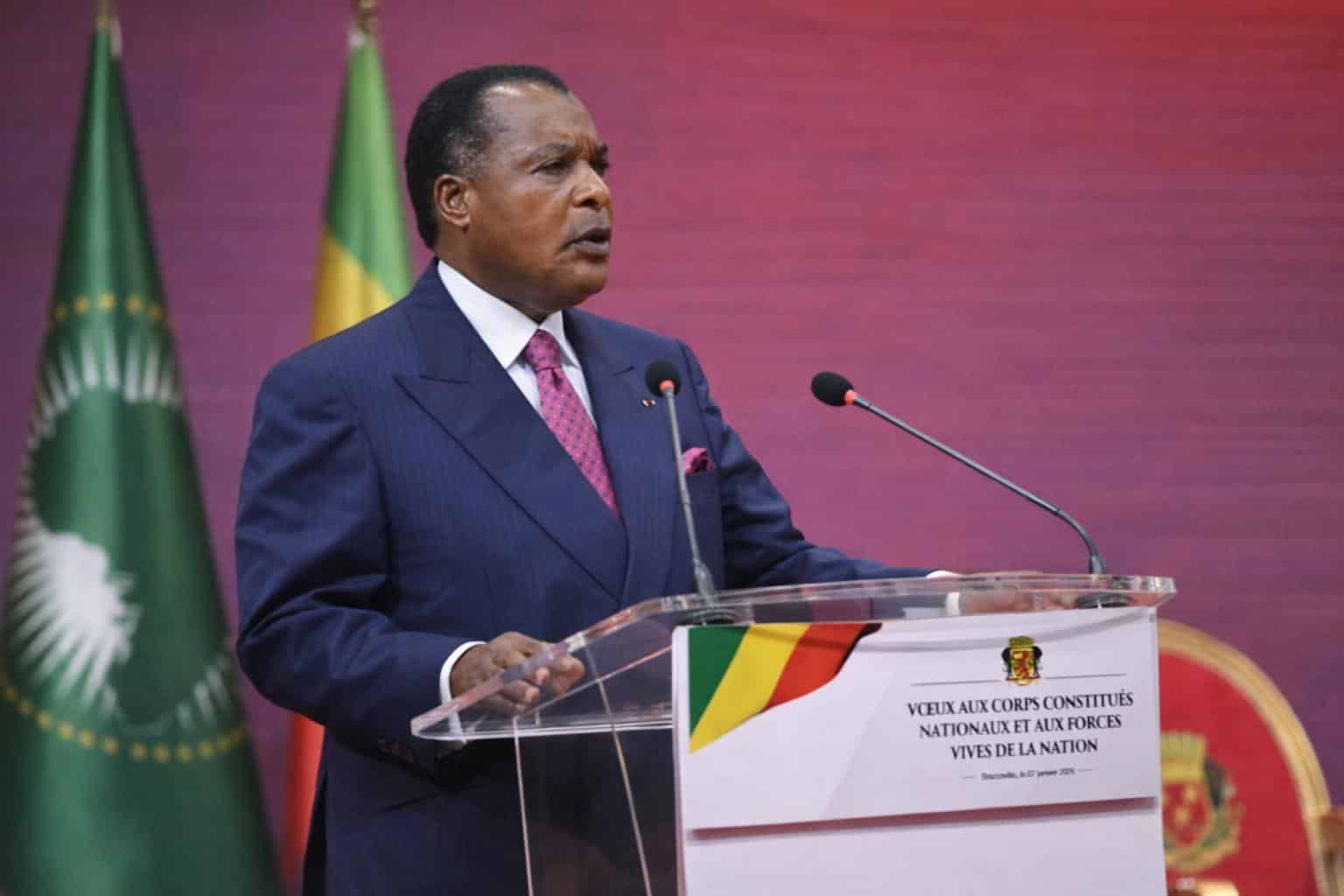
Brazzaville ceremony sets a national tone
The New Year wishes from Congo’s institutions and “forces vives” to the presidential couple, held January 7 at the Palais des congrès in Brazzaville, unfolded as a carefully choreographed moment of national communion. Across speeches, three words kept returning: peace, stability and development.
For many attendees, the gathering reflected a familiar civic ritual in the Republic of the Congo: state institutions, social leaders and public figures sharing a common space, taking stock of the past year and setting priorities for the next, in front of President Denis Sassou N’Guesso.
Peace and social cohesion emphasized before March vote
With the presidential election scheduled for March, President Denis Sassou N’Guesso used the occasion to underline the need to preserve a climate of calm. His message, as presented during the ceremony, linked political timelines with a broader appeal for coexistence and restraint.
In a country where elections naturally raise expectations and debate, the president’s emphasis on a peaceful environment was framed as a practical condition for public life to continue normally. The repeated references to stability also signaled continuity as a policy value.
The theme of “living together” was not treated as an abstract slogan. In the hall, it was presented as a daily civic discipline—one that requires patience in public debate and a commitment to keeping disagreements within institutions rather than in the streets.
Religious references used to strengthen shared values
The president’s remarks drew on teachings from Christianity and Islam, identified during the ceremony as the two main religions practiced in Congo. By invoking both traditions, he anchored his appeal in moral references many families recognize, regardless of political affiliation.
In practice, this type of language aims to connect national politics to community life. The underlying idea is that peace is not only negotiated by leaders, but also maintained by citizens in markets, schools, neighborhoods and workplaces.
The reference to faith traditions also served as a reminder that civic unity in Congo often rests on shared ethical principles. In the context of an election season, that reminder was presented as a safeguard against divisions that can sometimes arise in public discourse.
Auguste Iloki highlights demand for development projects
Speaking on behalf of the institutions and the “forces vives,” Constitutional Court President Auguste Iloki pointed to what he described as a strong desire among Congolese to see the government implement structural projects. His intervention linked social expectations to long-term economic direction.
Iloki’s message, as delivered during the ceremony, was not framed as a critique but as a clear statement of priorities. The emphasis on “projets structurants” suggested a focus on investments and reforms that can be felt beyond the capital, including in departments and secondary cities.
In highlighting development, Iloki implicitly connected political stability to tangible results. The formula is familiar in Congo’s public debate: peace creates the space for projects, and projects reinforce trust in institutions by improving daily life.
What “stability” means for investors and public services
For business leaders and professionals following state signals, the repeated stress on stability carries a straightforward implication: predictability. In many economies, predictable governance is what allows private operators to plan, public agencies to deliver services, and partnerships to move from announcements to execution.
In Brazzaville and Pointe-Noire, where many households measure progress through jobs, prices and local infrastructure, the call for development projects resonates as an expectation of visible delivery. The ceremony’s tone suggested that social cohesion and economic ambition are seen as mutually reinforcing.
The gathering also illustrated how Congo’s institutions communicate priorities in a single narrative: a peaceful environment, anchored in shared values, makes room for development planning. That framing is likely to remain prominent as the country approaches the March election date.