
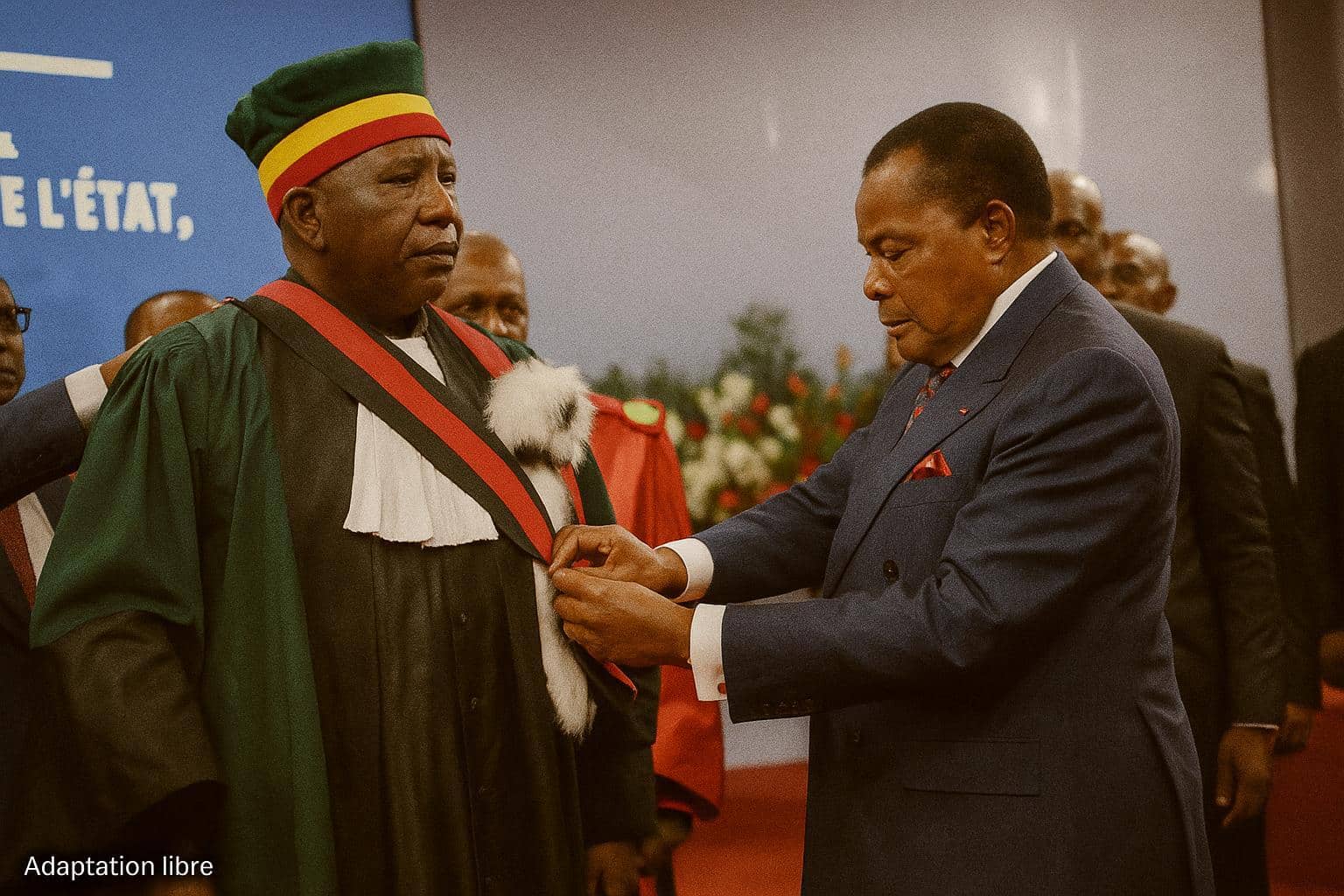
Ceremonial Diplomacy in the Palais des Congrès
A measured hush preceded the resonant flourish of trumpets in Brazzaville’s Palais des Congrès as President Denis Sassou Nguesso placed the Grand-Croix sash upon Professor Théophile Obenga. The act, recorded by the Agence Congolaise d’Information and relayed by regional outlets (ACI, 25 July 2025), conferred the Republic’s highest civilian distinction upon a scholar whose bibliography rivals several national archives.
The choreography of the investiture was meticulous. Ambassadors from neighbouring states, representatives of the United Nations Educational, Scientific and Cultural Organization and a cross-section of the Congolese academy bore witness. In his brief allocution, the Head of State praised Obenga’s “lifelong commitment to anchoring African intellectual heritage in universal scholarship,” framing the award as both gratitude and strategic signal.
Profiling an Intellectual Voyager
Born in 1936 in Mbaya, the young Obenga departed early for European universities, weaving philology, philosophy and Egyptology into a career that would later shape African historiography. His 1973 thesis on the linguistic continuum of the Nile Valley, defended at the Sorbonne, remains a seminal reference for scholars exploring pre-colonial epistemes. Over five decades he has produced more than fifty monographs, among them “African Philosophy in Antiquity,” cited in syllabi from Dakar to Chicago.
Beyond the archives, he served briefly as Minister of Higher Education in the 1990s and, since 2022, has acted as Presidential Envoy for the Modernisation of Universities. According to the Congolese Ministry of Higher Education, enrolment in Egyptology modules has doubled over the past three academic years—an uptick partially attributed to Obenga’s national outreach campaigns.
Soft Power through Academic Laurels
States frequently wield decorations to reward loyalty; Brazzaville’s choice of a scholar rather than a security figure subtly repositions national priorities. Analysts at the Institute for Strategic and International Studies-Congo observe that the timing dovetails with the government’s 2025–2030 Knowledge Economy Plan, which earmarks 5.2 percent of GDP for research infrastructure.
By elevating an intellectual, the presidency underscores a narrative of cultural renaissance rather than mere resource extraction. In the words of Minister Delphine Edith Emmanuel, echoed by Jeune Afrique (27 July 2025), “Obenga’s career demonstrates that the pen and the probe may advance sovereignty as decisively as pipelines.”
Regional Reverberations
Neighbouring capitals have taken note. Libreville’s L’Union hailed the ceremony as “a benchmark for elevating indigenous scholarship to national mythology.” In Kinshasa, commentators linked the accolade to ongoing discussions about repatriating Central African artefacts from European museums. Obenga has long advocated for such restitutions, arguing that archival voids impede continental self-knowledge.
Diplomats posted to Brazzaville discreetly acknowledge that highlighting academic icons can ease negotiations on cultural property, research visas and even UNESCO voting blocs. In that calculus, the Grand-Croix becomes more than fabric and metal; it is a token in an intricate diplomatic barter.
A Scholar’s Response to Generational Aspirations
Visibly moved, the laureate dedicated the honour to “Africa’s restless youth in pursuit of critical inquiry.” He urged doctoral candidates to fracture inherited orthodoxies rather than merely footnote them, a message amplified on national television and enthusiastically dissected by students at Marien Ngouabi University.
Social-media metrics tracked by the independent observatory DataCongo show a 38 percent spike in academic-themed hashtags within 24 hours of the broadcast, suggesting that ceremonial gestures can shape digital discourse as effectively as press releases.
Calibrating Recognition and Continuity
The Order of Merit, instituted in 1984, typically rewards senior civil servants and distinguished soldiers. Awarding its summit grade to a civilian intellectual subtly widens the pantheon of national heroes. Political scientists at the University of Cape Town interpret the move as “symbolic diversification”—a hedge against any perception that Congo’s public narrative is monopolised by extraction or security.
Yet the decoration also inscribes Obenga within the state’s own lineage, binding his global stature to domestic legitimacy. For a leadership navigating energy-market volatility and climate-finance diplomacy, the partnership with an internationally cited scholar may serve as reputational ballast.
Outlook for Congo’s Knowledge Diplomacy
If nothing else, the 25 July ceremony manifests Brazzaville’s conviction that soft-power dividends accrue to those who valorise intellect. Future deliverables will hinge on whether the momentum translates into laboratory grants, digitised archives and streamlined visas for foreign researchers.
For now, Professor Théophile Obenga carries the Grand-Croix across academic conferences as a portable emblem of state endorsement. His itinerary includes lectures in Nairobi, Rabat and Brasília—each a node in Congo’s expanding epistemic network. Where sceptics detect choreography, supporters discern a pragmatic alignment of scholarship with statecraft, an alignment likely to endure so long as ideas remain a currency of diplomacy.