
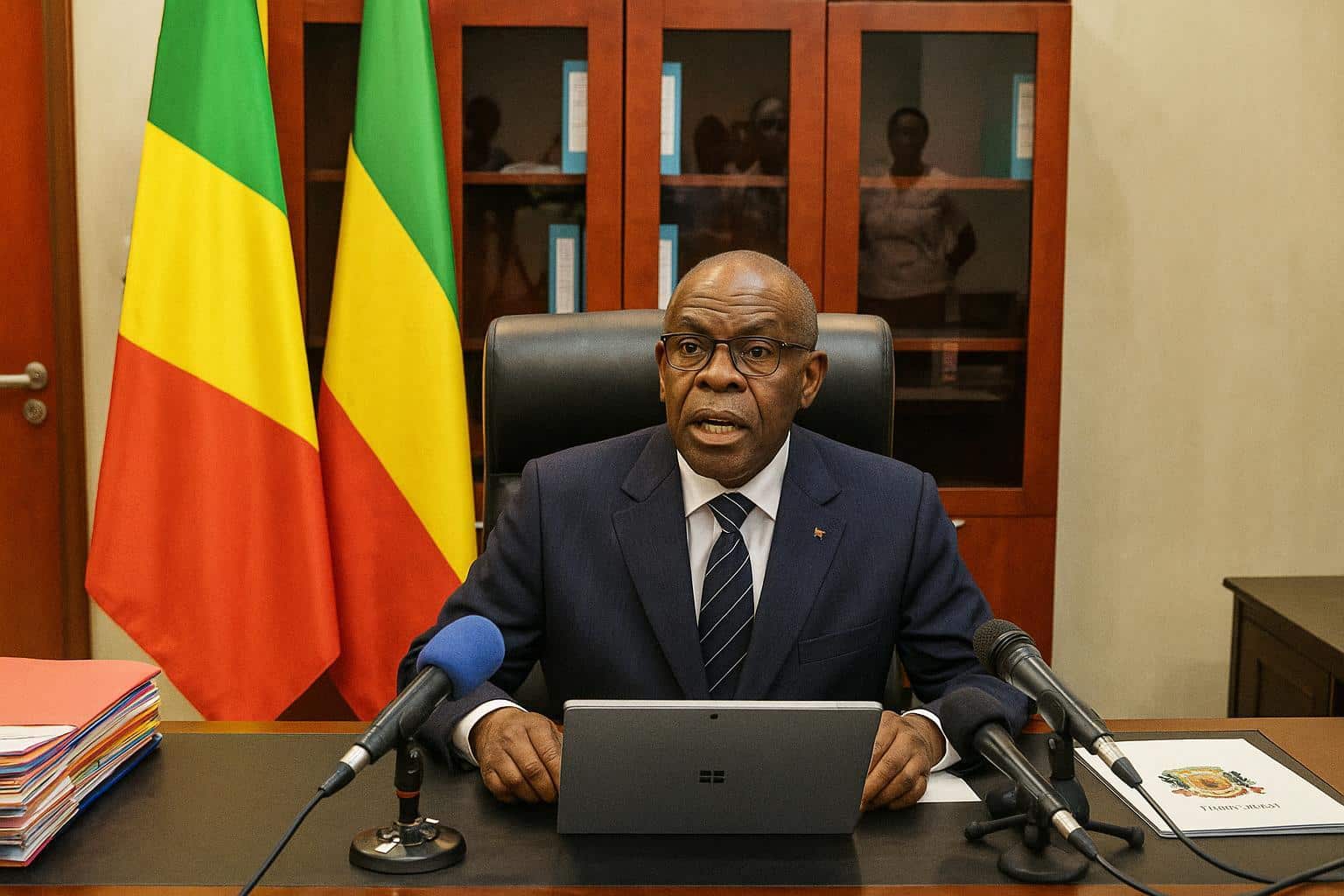
Democratic commitment reiterated by National Assembly
On International Day of Democracy, the second secretary of Congo-Brazzaville’s National Assembly, Alain Pascal Leyinda, read a statement that restated the chamber’s “deep attachment to democratic values, social justice, and human rights,” aligning parliament’s roadmap with the global observance declared by the United Nations in 2008.
The declaration, released in Brazzaville, underscores lawmakers’ conviction that democracy thrives only when citizens’ dignity is protected and their voices shape public decisions. Deputies insist that representation, legislative oversight and inclusive lawmaking remain the three pillars through which the lower house will defend these ideals every day.
Gender equality central to Congo’s democratic agenda
This year’s theme, “Achieving Gender Equality, Action by Action,” gave the assembly an opportunity to highlight the link between democratic consolidation and women’s empowerment. Leyinda reminded colleagues that society cannot reach its full potential unless men and women combine energies in an environment free from discrimination.
“We must move step by step, decision by decision, so that every reform is gender sensitive,” he said, pledging parliamentary support for initiatives that make equality “a shared, equitable and future-oriented space.” For deputies, that incremental approach will strengthen social cohesion and national unity.
The assembly also called on all Congolese to regard gender equality not as a distant objective but as a daily practice. Women’s contribution to the republic’s economic and democratic life, members argued, is indispensable to long-term stability and meets the aspirations of younger generations.
Parliament drives inclusive legislation under stable institutions
Lawmakers highlighted steady institutional progress under President Denis Sassou Nguesso’s leadership. With stable institutions, regular sessions and active committees, the National Assembly combines lawmaking, scrutiny of executive action and citizen outreach to nurture a resilient rule-of-law state that welcomes diverse voices while safeguarding public order.
Parliamentarians reiterated their readiness to endorse policies that promote women’s equitable participation in politics, business and community development. They view female and youth empowerment as engines of growth, democracy and innovation that can accelerate the government’s broader objectives set out in national development roadmaps.
Mouebara Law and national program tackle gender violence
Deputies pointed to the landmark Law 19-22 of May 2022, known as the Mouebara Law, which targets all forms of violence against women. The statute removes social, economic and cultural barriers hampering women’s contribution and guarantees them equal participation in every sphere of national life.
In tandem, Decree 2022-237 created a National Program to combat gender-based violence. By institutionalising prevention, survivor support and data monitoring, the programme offers what Leyinda described as “a concrete toolbox” for ministries, civil society and local authorities committed to building safer communities.
Lawmakers argue that these instruments move equality from rhetoric to reality. Their passage illustrated cross-party consensus, an element deputies now hope to replicate in forthcoming bills on education, health financing and digital inclusion, all sectors where gender gaps still hinder the republic’s march toward emergent-economy status.
Citizen engagement enhances accountability
Beyond legislation, the assembly emphasised participatory mechanisms: public hearings, field missions and digital feedback channels that allow constituents to monitor implementation. Deputies believe such openness cements trust and ensures that programs designed in Brazzaville resonate in Pointe-Noire, Ouesso, Dolisie and every district in between.
Civil society groups welcomed the statement, noting that parliamentary endorsement of gender-responsive governance can reinforce campaigns already under way in schools, workplaces and local councils. Several NGOs hinted they will propose fresh partnerships with standing committees to track the effect of Law 19-22 over time.
2025 Democracy Day as progress checkpoint
The assembly has set its sights on the 2025 edition of Democracy Day as a milestone to measure progress. Leyinda signalled that upcoming sessions will scrutinise gender lenses in budget allocations, infrastructure plans and electoral preparations, ensuring that equality remains woven into every strand of policy.
Deputies plan nationwide outreach, including town-hall meetings and university forums, to discuss how citizens view democracy beyond the capital. By amplifying regional perspectives, they hope to refine legislation that addresses local realities while maintaining alignment with continental and international norms applauded by Congo’s partners.
Economists interviewed after the statement noted that greater female inclusion could raise GDP growth by unlocking entrepreneurial talent and diversifying revenue streams. They argued that parliamentary vigilance over gender budgeting may help the government hit targets outlined in the National Development Plan without inflating public expenditure.
For political observers, the real test will be sustained implementation. Recent experience, they said, shows that when legislative texts are paired with consistent oversight and grassroots advocacy, reforms gain momentum. The assembly’s pledge therefore sends a signal that the democratic journey is a collective, iterative endeavor.
As the sun set over Brazzaville on Democracy Day, the National Assembly’s message remained clear: equality is not a slogan but a sequence of deliberate actions. From the Mouebara Law to forthcoming gender-aware budgets, deputies insist each step will fortify Congo’s stable, inclusive and rights-based republic.