
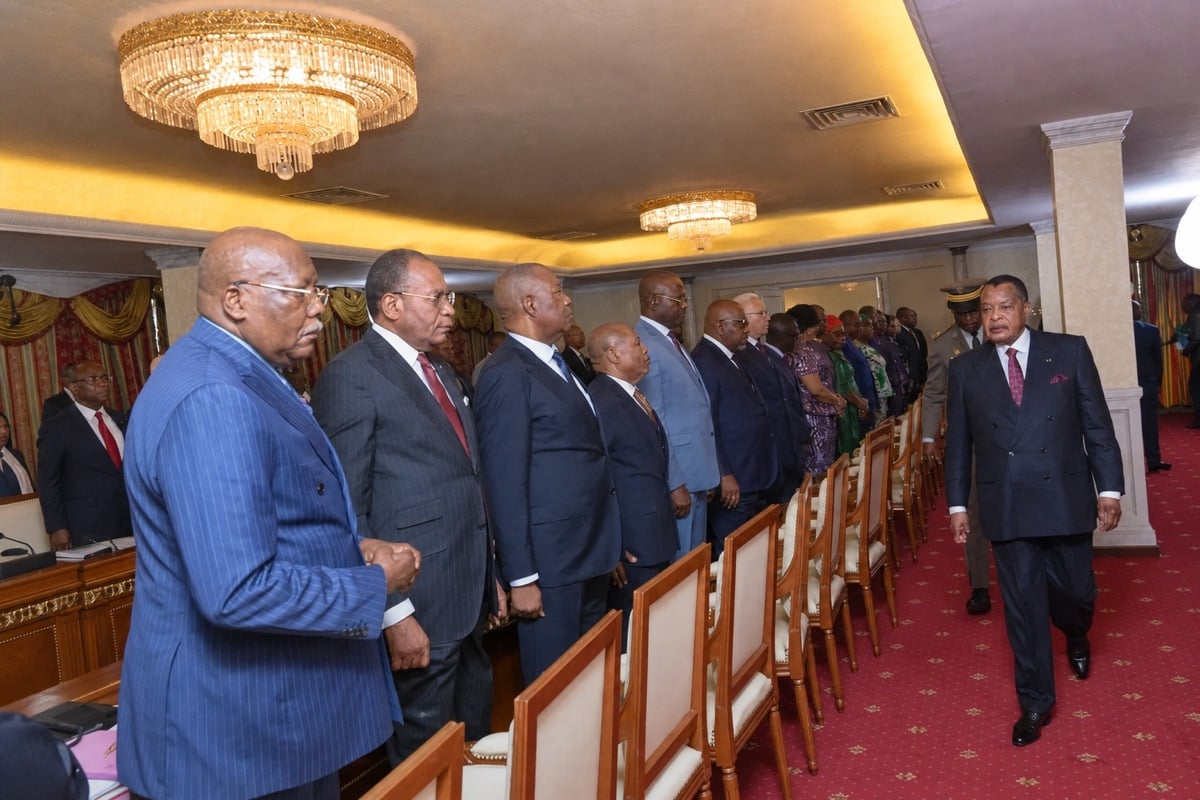
The Constitutional Court of the Republic of Congo has confirmed the results of the presidential election, sealing a new term for incumbent President Denis Sassou Nguesso and closing a contest that drew seven candidates to the ballot.
A Final Ruling From Brazzaville’s High Court
In an official statement released in Brazzaville on Saturday, 28 March, the country’s highest judicial body declared the provisional results valid. Those figures had been proclaimed on 17 March by Interior Minister Raymond Zéphirin Mboulou.
The court’s decision brings the electoral process to a formal close. Under Congolese law, validation by the Constitutional Court is the last legal step before a president-elect can move toward taking the oath of office for a renewed mandate.
The ruling settles any lingering procedural questions surrounding the two voting days held on 12 and 15 March 2026. With the confirmation in hand, attention now shifts from the contest itself to the practical work of governing.
The Numbers Behind a Decisive Margin
According to figures published by the authorities, Sassou Nguesso secured 94.82 percent of the votes cast. He stood as the candidate of the Presidential Majority, a coalition that brings together roughly twenty political parties under a single banner.
Turnout reached 84.65 percent, drawn from an electorate of 3,167,099 registered voters. That participation rate, paired with the wide margin, framed an outcome that left little room for arithmetic dispute once the count was finalized.
The scale of the result reflects the breadth of the coalition that backed the incumbent. By gathering a large bloc of parties, the Presidential Majority concentrated electoral support behind one figure rather than dispersing it across competing tickets.
Seven Names, One Sitting President
Seven candidates appeared on the ballot. The incumbent faced six challengers drawn from varied political currents, giving voters a field that spanned different strands of the country’s political landscape.
The presence of multiple challengers underscored that the race was formally contested, even as the final tally pointed decisively toward the sitting head of state. The court’s validation marked the endpoint of a sequence that began when the electorate was first convened.
For observers tracking governance in the wider Central African region, the Congolese vote registers as another data point in a season of elections across the CEMAC zone. The result keeps continuity at the helm of one of the area’s oil-producing states.
A New Term and the Work Ahead
Having been returned to office, Sassou Nguesso is expected to take the oath of office in line with the constitutional provisions currently in force. That ceremony typically opens the next chapter of an administration’s life.
The steps that follow are largely administrative in character. Among them is the formation or reshaping of the government team, a process that signals how priorities will be distributed across ministries in the period to come.
Beyond personnel, the agenda turns to the implementation of the priorities announced during the campaign. Pledges made before a vote become, after validation, the benchmark against which a new mandate is measured by citizens and partners alike.
For the urban professionals, investors, and public officials who follow Brazzaville’s political calendar closely, the immediate signal is one of stability in leadership. The contours of the next government will offer the first concrete reading of the term’s direction.
What the Confirmation Settles
The confirmation does more than ratify a percentage. It converts a campaign result into a governing reality, transferring the conversation from polling stations to policy rooms in the capital and the departments beyond it.
For the diaspora in Europe, the Americas, and the Gulf, the ruling offers a clear marker of where executive authority rests for the coming mandate. Many in those communities watch such validations as fixed points in the national timeline.
Within the CEMAC framework, leadership continuity in Congo-Brazzaville carries weight for regional coordination on shared questions, from commodities to cross-border policy. A settled executive can engage partners without the uncertainty that an unresolved succession brings.
The Constitutional Court’s word, in the Congolese system, is final on such matters. With the process now exhausted, the institutional machinery moves from the language of ballots to the language of administration.
What remains is execution. The figures are confirmed, the mandate renewed, and the focus rests squarely on the choices a new term will bring to a country balancing local needs with its place in the region.