
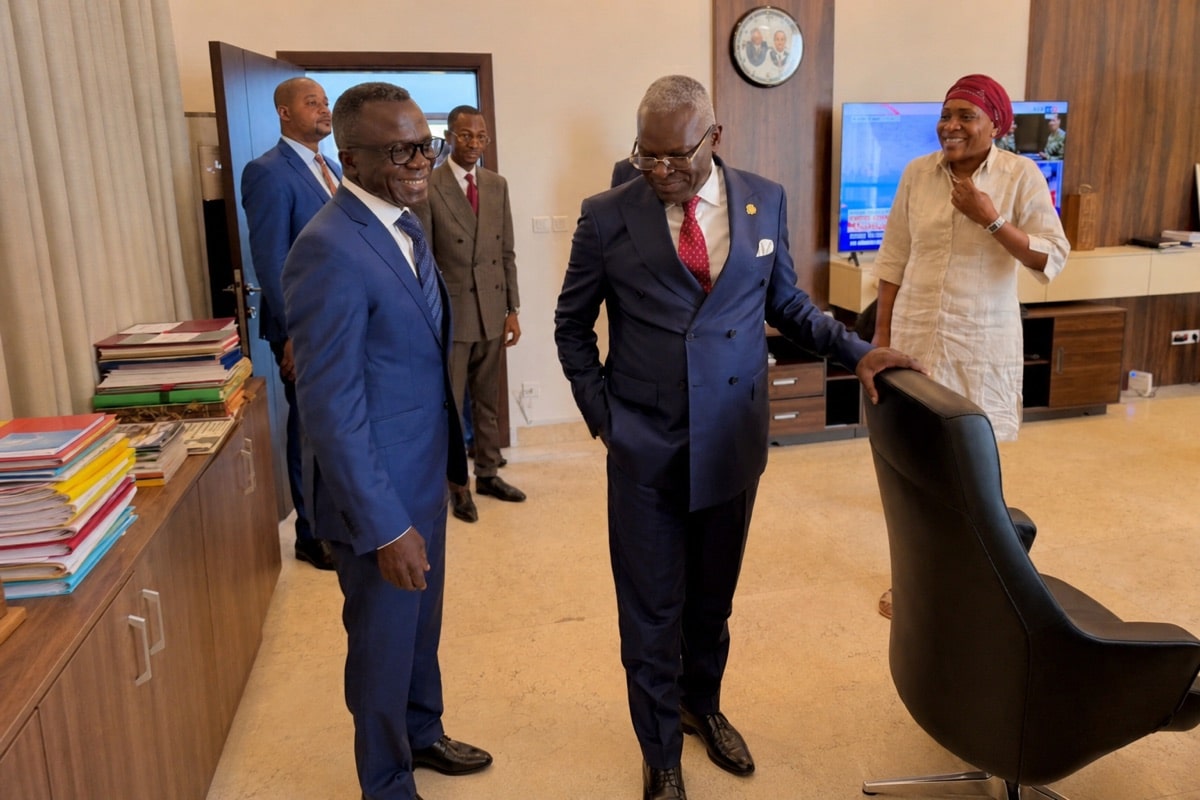
Congo-Brazzaville’s Prime Minister has stepped out of his office and into the corridors where the state actually works. What he found, on his own account, was a public administration housed in buildings showing serious wear.
A Working Visit Through the Halls of Government
Anatole Collinet Makosso began a round of inspections on Monday, 4 May 2026, touring several ministerial departments. The aim, officials said, was to gauge the day-to-day conditions facing civil servants and to size up what the state’s administrative buildings now require.
The head of government travelled with a small group of cabinet colleagues. Their first stop was the Ministry of Justice, Human Rights and the Promotion of Indigenous Peoples. There, the prime minister walked through offices and service points, looking closely at the surroundings in which officials carry out their work.
Behind a Presentable Facade, a Building in Decline
The picture that emerged was sobering. From the street, the Justice building still looks acceptable. Inside, it tells another story. Beyond the spaces set aside for senior officials, much of the workforce operates in difficult conditions.
Furniture is worn. Lighting is unreliable. Sanitary facilities, by the government’s own description, are unhygienic, and many rooms are simply too small. In places, the shortage of offices forces agents to crowd into modest spaces ill-suited to steady administrative output.
Such details rarely surface in official communications, which tend to favour ribbon-cutting over fault-finding. Here, the government chose to make the shortcomings part of the message, framing the visit as an honest audit rather than a ceremonial pass-through.
From Justice to the Heart of the Resource Economy
The delegation did not stop at one ministry. It moved on to departments that sit close to the country’s economic engine, including Mines, Hydrocarbons, Energy and Hydraulics, as well as Planning. These are the offices that oversee much of Congo-Brazzaville’s revenue base.
The findings were familiar. Ageing infrastructure and working conditions poorly matched to the demands of a modern administration appeared again, the government reported. For ministries tied to oil, mining and water, the contrast between strategic weight and physical surroundings is striking.
It is a quiet paradox worth noting. The departments meant to steer national wealth share the same structural fatigue as the rest of the state apparatus, a reminder that institutional strength is not measured by mandate alone but also by the spaces in which decisions are made.
An Audit Meant to Lead Somewhere
The prime minister presented the tour as more than observation. According to the government, the purpose is to assemble a precise inventory of needs, the groundwork for a broad renovation of administrative buildings across the affected ministries.
For the executive, the logic is direct. Better premises are cast as a lever to lift the performance of the public service. Working conditions, in this reading, are not a cosmetic concern but a factor that shapes how efficiently the state delivers.
The government links the effort to a wider ambition, situating the renovation drive within the implementation of President Denis Sassou N’Guesso’s stated programme for the country. In that framing, repairing offices becomes part of a longer-term project of administrative modernisation.
What the Inspection Signals
Whether the renovation materialises at the pace implied will depend on financing, scheduling and follow-through, none of which the inspection itself resolves. The visit fixes a baseline; it does not yet guarantee the outcome.
Still, the gesture carries meaning. By choosing to walk through deteriorating offices and acknowledge them openly, the prime minister has placed the everyday environment of civil servants on the public agenda. That is a posture more often promised than performed.
For the agents working in cramped rooms under failing lights, the test will be practical rather than rhetorical. The measure of this tour will not be the candour of the diagnosis, but the speed and reach of the repairs that follow it.
For now, Congo-Brazzaville’s administration has a documented account of its own working conditions, voiced from the top. The next chapter belongs to the budget lines and the contractors, and to whether the state can refurbish the very rooms in which it governs.