
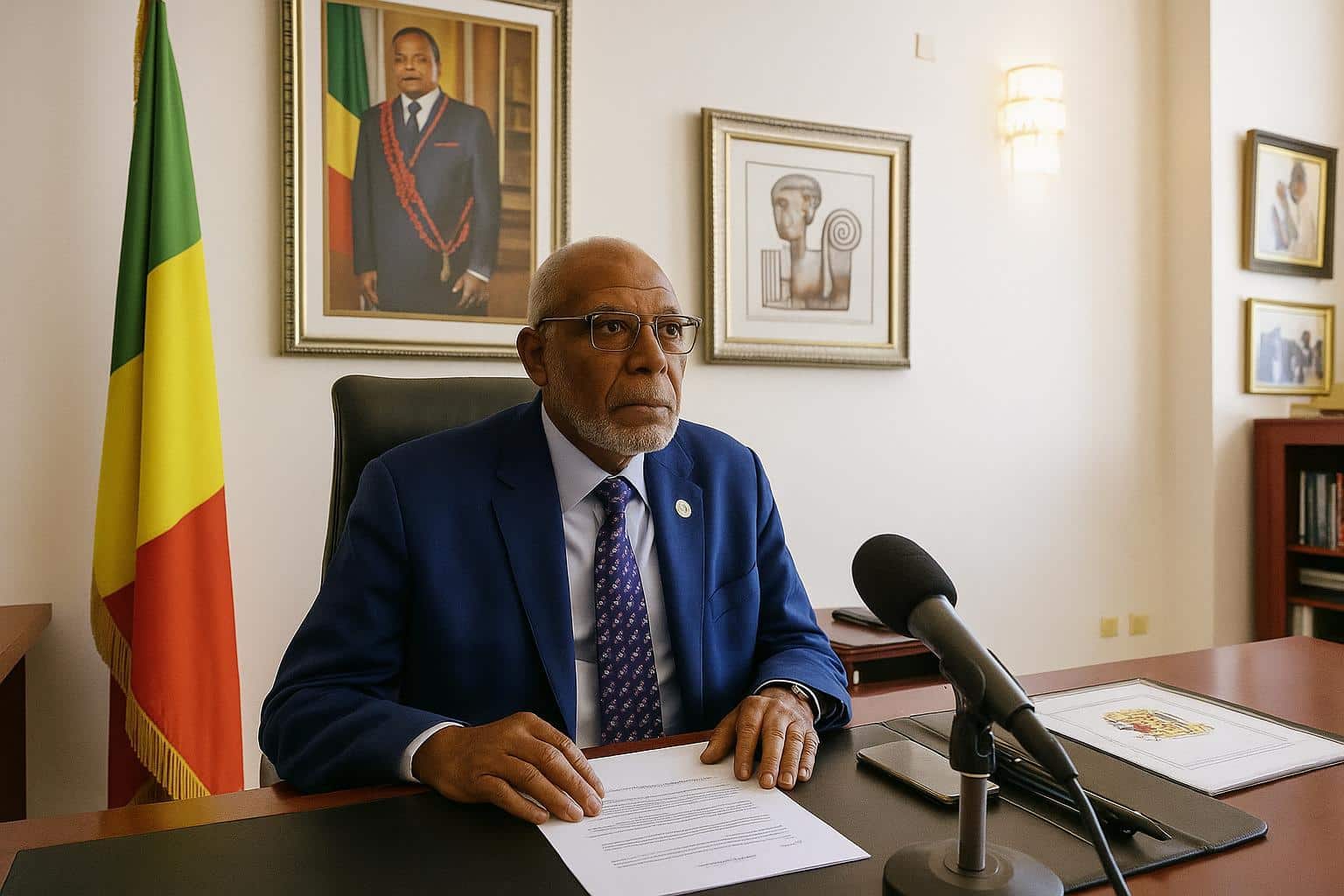
Africa Industrialization Day in Brazzaville
Rain swept over Brazzaville on 20 November, yet inside the ministry hall the mood was upbeat as Congo joined the continent in marking Africa Industrialization Day. Minister Antoine Thomas Nicéphore Fylla de Saint-Eudes used the occasion to issue a pointed call for basic infrastructure investment.
His statement aligned with the United Nations’ Objective 9 of the Sustainable Development Goals, which promotes resilient infrastructure, inclusive industrialisation and innovation by 2030. The minister argued that bridging power, transport and digital gaps will be decisive for empowering communities and safeguarding long-term growth.
Infrastructure Gap and GDP Growth Stakes
Official figures show Congo’s industrial sector contributes roughly 7 percent to national GDP, below the African average. Fylla de Saint-Eudes maintained that upgrading feeder roads, substations and broadband networks can lift productivity and unlock value chains across agriculture, forestry, mining and emerging green industries.
UNIDO’s 2022 Industrial Development Report echoes that message, estimating that every dollar invested in core infrastructure adds up to 20 cents to GDP within a year and doubles manufacturing employment impacts over five years. The African Development Bank provides comparable multipliers for energy transmission projects.
Flagship Projects Boost Congolese Connectivity
Congo’s latest National Development Plan earmarks almost CFA 2,800 billion for logistics corridors linking Brazzaville, Pointe-Noire and the northern departments. Works include the Pointe-Noire–Ouesso highway upgrade and a new fibre-optic loop along the CFCO railway. Contractors from China, Morocco and local SMEs are pre-qualifying.
Industry executives welcome the momentum. “Reliable power and sealed roads would cut our transport costs by half,” said Davy Aboki, manager at the Maloukou cement cluster near Brazzaville. He noted that outages still push factories onto diesel generators for hours.
Closing the Continental Industrial Divide
Fylla de Saint-Eudes also highlighted the continental picture. Average industrial GDP per capita across Africa sits near USD 700, compared with USD 2,500 in Latin America and USD 3,400 in East Asia. Narrowing that gap, he argued, requires moving beyond raw-material exports toward value-added processing.
The minister cited Algeria, Angola and Nigeria, where unprocessed resources still constitute over 80 percent of outbound trade. Congo faces similar dynamics with crude oil. By investing in modular refineries, petrochemical hubs and agro-processing zones, Brazzaville hopes to retain more wealth within local economies.
A low-carbon dimension runs through the strategy. Congo sits on some of the world’s largest peatlands and rainforests; authorities want industry growth to respect emission ceilings. The plan therefore emphasises renewable micro-grids, energy-efficient machinery and digital tools that optimise freight loads.
Trade Reform to Unlock Regional Markets
The industrialisation week, hosted in Kampala from 17 to 21 November, provided a regional platform for these ideas. Delegates endorsed a communiqué urging African Union members to mainstream the African Continental Free Trade Area industrial pillar and coordinate standards so that factories can scale beyond domestic markets.
Congo already ratified the AfCFTA protocols and is upgrading customs software at Matadi and Brazzaville ports to cut clearance times. The World Bank’s Doing Business database lists border compliance as costing local exporters USD 680 per container, double the Sub-Saharan average.
Digitalisation could shave those costs. According to the International Telecommunications Union, only 32 percent of Congolese access mobile broadband. The government is negotiating with two tower-sharing consortia to extend 4G coverage along the national highway, financed partly through the Central African Backbone programme.
Grass-roots Innovation and Skills Development
Local entrepreneurs see opportunity. Christelle Mbani, founder of a start-up producing solar-powered cold rooms for fishers in Pointe-Noire, said stable electricity and faster internet would let her monitor units remotely and cut spoilage. “Infrastructure is not abstract; it directly shapes small-business survival,” she explained.
Experts stress that infrastructure alone is not enough. Vocational training must match new technologies. The Technical University of Central Africa will launch an industrial automation course next semester with Germany’s GIZ, tied to forthcoming special economic zones.
Financing Partnerships for Sustainable Industry
Funding these ambitions poses challenges amid global headwinds. Oil revenues, while recovering, remain volatile. The finance ministry is exploring a sustainability-linked bond that would tie coupon reductions to progress on industrial job creation and renewable capacity, echoing models piloted by Côte d’Ivoire.
International partners have taken note. The African Export-Import Bank recently approved a USD 300 million credit line to support Congolese manufacturing SMEs, contingent on compliance with environmental and social safeguards. Afreximbank officials say disbursements could start in early 2024 subject to parliamentary approval.
Progress Tracking and Community Empowerment
Economist Sylvie Mabiala offers a cautious optimism. She believes coherent monitoring frameworks will be essential. “Targeted infrastructure can certainly empower communities, but only if budgets are transparent and maintenance is funded long after ribbon-cutting,” she told this newspaper. The ministry plans quarterly scorecards beginning next March.
With the rainy season already testing gravel roads and local grids, Fylla de Saint-Eudes insists the window for action is now. His message from Brazzaville resonates continent-wide: building the nuts and bolts of development may not grab headlines, yet it remains Africa’s surest route to shared prosperity.