
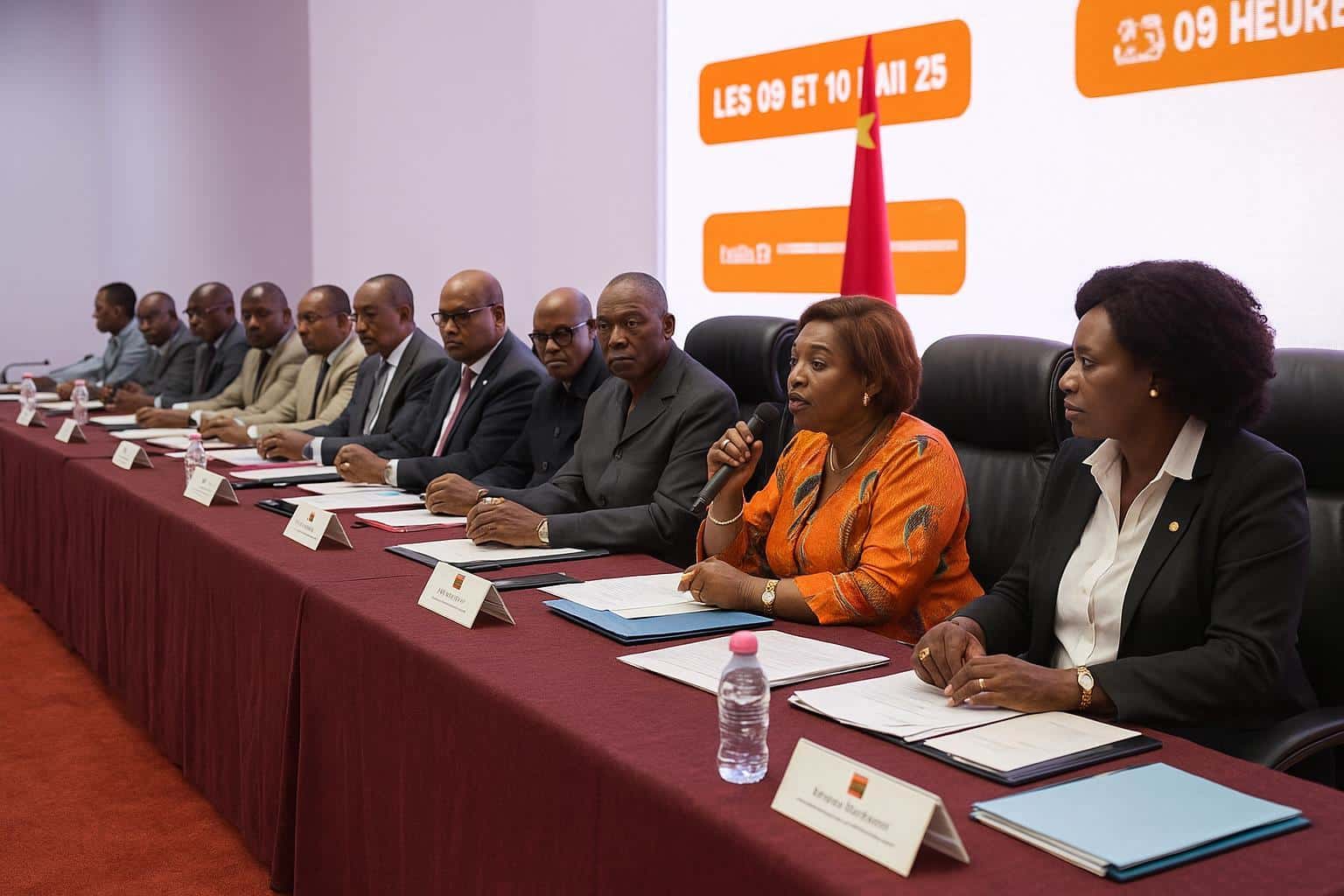
Central Committee launches pivotal session
Under the ochre ceiling of the Palais des Congrès in Brazzaville, the Central Committee of the Congolese Labour Party gathered on 9 November for a rare extraordinary session designed to fine-tune the blueprint of its anticipated sixth ordinary congress.
Opening the meeting, Secretary-General Pierre Moussa set a sober tone, reminding delegates that the working documents before them cover social and cultural policy, environmental stewardship, economic doctrine, party financing, communications, institutional reform and the delicate balance with unions and associative movements.
Six thematic dossiers under scrutiny
These files are the result of six months of district-level hearings, internal surveys and thematic workshops conducted across all twelve departments, a process Moussa described as “listening to every militant and partner” so that the congress can rest on evidence rather than slogans.
He warned, however, that the compilation still requires “rigorous and lucid analysis” by the Central Committee before it becomes the strategic backbone of the congress, expected to be convened in early 2024, according to senior organisers familiar with the timeline.
Adapting to shifting global and national terrain
Moussa’s opening address placed the session within what he called a “constantly mutating international context” characterised by supply-chain disruptions, shifting security alliances and energy price volatility that continue to ripple through the Congolese economy.
Domestically, he cited urgent social expectations, particularly youth employment and cost-of-living pressures, while praising President Denis Sassou Nguesso and the government for tackling the challenges “with determination”, a formulation that drew approving applause from the 350 delegates present.
Security and economy dominate discussions
Security concerns were high on the agenda as delegates assessed ongoing regional threats, from piracy in the Gulf of Guinea to transnational trafficking in the Sangha-Likouala corridor, issues Moussa said the state is addressing through reinforced border coordination and diplomacy within CEMAC and ECCAS.
Central Committee members also scrutinised the macro-economic chapter, which outlines a post-COVID recovery path premised on diversifying beyond oil, consolidating public finances and accelerating the Pointe-Noire Special Economic Zone’s integration with intra-African trade corridors.
Financing renewal and green agenda
Draft language seen by this newspaper proposes the creation of a sovereign investment fund to channel hydrocarbon revenues into renewable energy, agro-processing and digital infrastructure, echoing recommendations made by the African Development Bank during its Brazzaville mission in September.
Beyond economics, the documents reserve an entire chapter for environmental governance, committing the party to supporting Congo’s candidature as a global carbon-sink champion and to expanding community forestry schemes that have already sequestered 1.4 million tonnes of CO₂, official estimates claim.
Statutes update after constitutional reform
Political analysts note that the sixth congress will be the first since the 2015 constitutional reform and therefore expected to update the party’s charter, statutes and internal rules to reflect a presidential term ending in 2026.
“Our legal texts must align with national institutions we ourselves reformed,” argued Léon-Juste Ibombo, a member of the drafting commission, adding that the overhaul will streamline candidate selection, strengthen gender parity requirements and codify disciplinary measures against digital misinformation.
Modernising funding and outreach
The financing chapter attracted particular attention amid higher campaign costs. Proposals include leveraging membership dues through mobile money, opening a solidarity bond aimed at the diaspora and establishing an ethics panel to audit donations, according to a senior treasurer present.
Equally central is the communication strategy that foresees a stronger social-media footprint and new community radio partnerships in remote districts. Delegates reviewed a pilot TikTok campaign that recently reached 1.2 million views during Independence Day celebrations, internal analytics show.
Strengthening grassroots structures
On the organisational side, the session approved a roadmap to modernise provincial unions and sectoral wings, with an emphasis on youth and women’s leagues. Training modules on leadership and digital literacy are to be rolled out in December, party officials confirmed.
The two-day gathering is scheduled to close today with a final vote on amendments. An agreed text will then be circulated to 8,000 section committees nationwide for consultation, before returning to Brazzaville for ratification at the congress proper.
Roadmap toward 2024 congress and 2026 vote
While no official date has been announced, several committee members indicated that the sixth congress could convene in the second quarter of 2024, allowing the party ample time to translate its resolutions into the manifesto for the 2026 presidential race.
“We aim for a resounding victory for President Sassou Nguesso’s platform, built on updated ideas and disciplined mobilisation,” Moussa concluded, closing a session that blended ritualistic party unity with renewed attention to emerging socio-economic headwinds.
Diaspora representatives following the session online via the new “PCT Connect” portal expressed support for proposals to grant overseas militants voting rights at congress, a move they argue would strengthen fundraising networks from Paris to Montréal.
Once approved, the congress guidelines are expected to be published in both French and Kituba to widen accessibility, an editorial choice that reflects the party’s stated intention to engage citizens beyond its traditional urban strongholds in Brazzaville and Pointe-Noire.