
A New Mandate Opens with a Signal
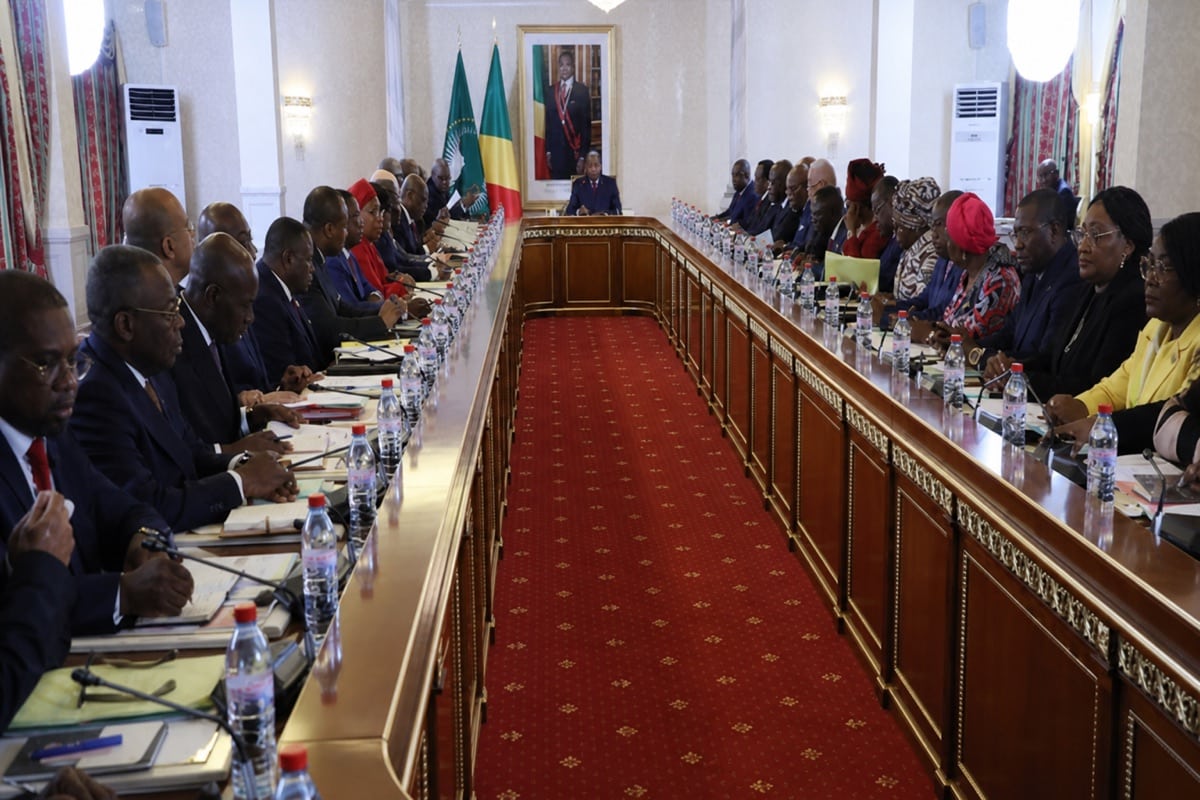
On May 6, 2026, the Palais du Peuple in Brazzaville hosted the first Council of Ministers of Congo-Brazzaville’s new five-year term. Presided over by Denis Sassou-N’Guesso, the session served as the inaugural working meeting of the Makosso III government, the cabinet formed for the 2026-2031 quinquennium. The agenda was deliberately forward-looking, setting the tone for what the executive intends to achieve.
President Sassou-N’Guesso opened with a communication of general orientation, placing the session in its political context. The mandate that had begun, he noted, came with obligations. “This trust from the people calls for a responsibility from public authorities in implementing” the commitments made during the campaign, he said. He framed the incoming period not as a continuation but as a moment requiring “the imperative of concrete, realistic results.”
Reform as the Organizing Principle
The president’s communication established cohesion and efficiency as the two non-negotiable demands he would place on his ministers. His directives were specific in some areas and directional in others, but the underlying theme was reform — institutional modernization in government operations, and structural investment in the country’s physical and digital infrastructure.
Among the most operationally concrete of his stated priorities was the creation of a task force dedicated to administrative digitization, with an emphasis on public finance. The initiative reflected a broader governmental preoccupation with reducing the inefficiencies, opacity, and leakage associated with paper-based and manual administrative processes.
Two Major Dossiers Approved
Beyond the presidential communication, the May 6 session produced two concrete decisions. The first was the approval of a draft law establishing a Caisse de Dépôt et de Consignation — a deposit and consignment fund. Such institutions typically serve as safe custodians for regulated savings, court-ordered funds, and other financial resources that require independent management outside the commercial banking system.
The second was a presidential decree authorizing an asset contribution to Congo Telecom, the state telecommunications operator. The transaction was valued at 143.8 billion FCFA and was framed in terms of “valorizing digital sovereignty” — the government’s language for strengthening the state’s strategic position in the telecommunications sector before any future restructuring or partnership negotiations.
Infrastructure and Connectivity on the Priority List
The president also used the session to underscore his commitment to several long-delayed structural projects. The rehabilitation of the Congo-Océan railway — a line connecting Brazzaville to Pointe-Noire that has faced years of deteriorating infrastructure — was cited as a priority alongside improvements to road networks, energy systems, and water supply infrastructure.
These projects have featured in successive government agendas in Congo-Brazzaville, with mixed results. The cabinet’s renewed commitment to them in the first council of ministers was a signal of intent, though observers of Congolese infrastructure policy noted that the gap between announced priorities and completed works has historically been wide.
The AfDB Annual Meetings in Brazzaville
The session also received a communication on a forthcoming diplomatic event. The African Development Bank’s annual assemblies — a gathering of the institution’s member states and governing structures — were confirmed to take place in Brazzaville from May 25 to 29, 2026. Hosting the AfDB assembly represented a profile-raising opportunity for the Congolese capital and an occasion to showcase the country to a wide audience of African finance ministers, development professionals, and institutional investors.
Setting Expectations for the Quinquennium
The May 6 council of ministers was in some ways a political document as much as an administrative one. By convening promptly, presenting a substantive agenda, and immediately validating two significant legislative and regulatory dossiers, the Makosso III government signalled that it intended to operate with purpose from the outset.
Whether the pace and ambition of that opening session can be sustained across five years — and whether the stated reform priorities translate into measurable outcomes — will be the true measure of the new mandate’s success.