
Legacy in Print
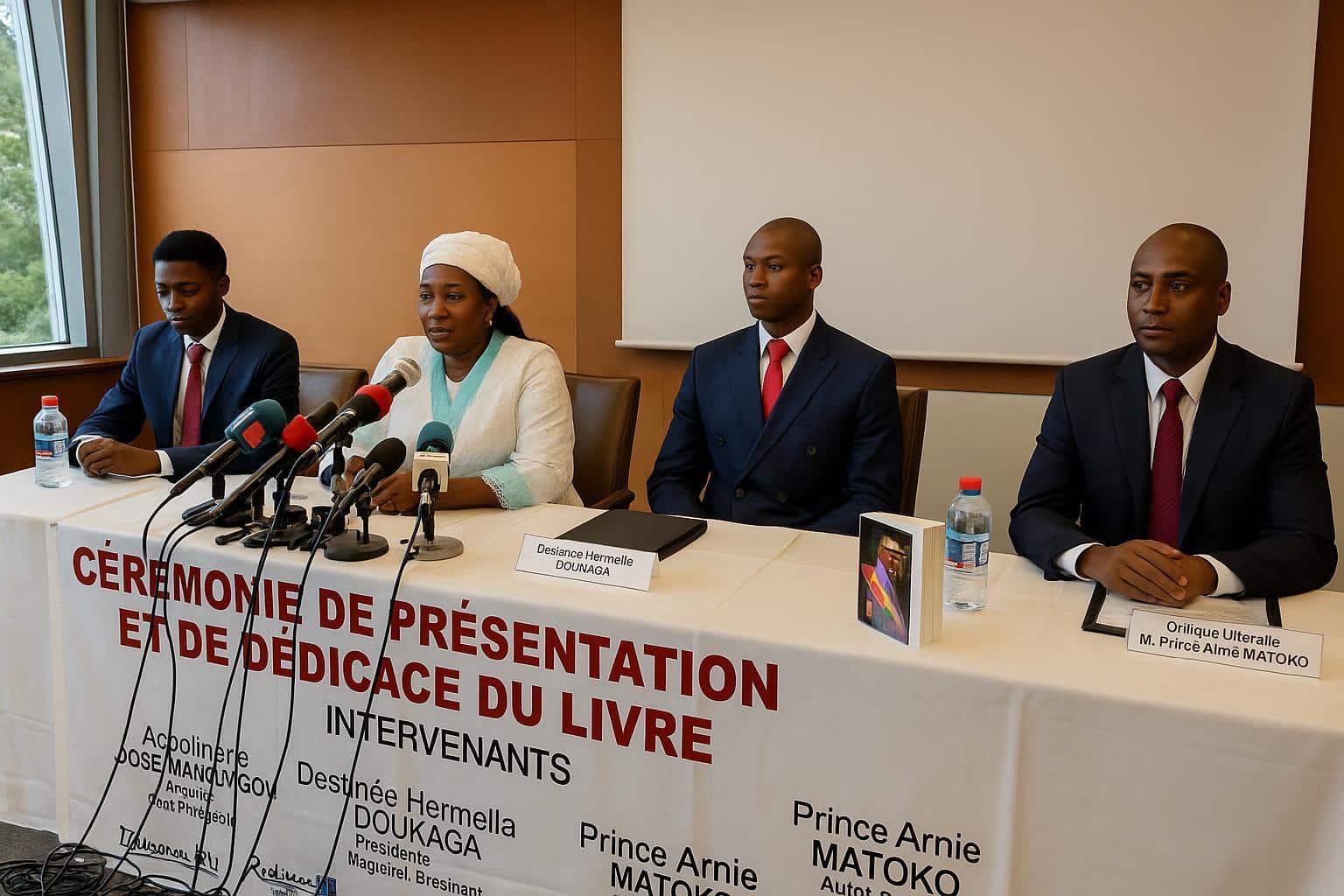
At dusk in Brazzaville’s Maison des Écrivains, physician-turned-author Richel Pyerre Ibombo raised a slim volume, his hands betraying emotion beneath the white coat. The audience of officials and scholars leaned in.
The book, Honorable Jean Pierre Ibombo, Souvenir of a Father, Political Model, is more than filial tribute; it also opens a window onto Congo’s contemporary political culture, where personal narrative and national service often intermingle.
Published by L’Harmattan Congo in December, the 112-page text is already circulating through diplomatic bags, according to a senior foreign-ministry librarian, illustrating how a private mourning ritual can acquire public resonance within days.
Portrait of a Patriotic Educator
Jean Pierre Ibombo, born in 1953 in the Plateaux district of Abala, entered adulthood during a volatile post-colonial transition. Former classmates at Lycée Chaminade recall a meticulous student who annotated newspapers to understand shifting governance frameworks.
His early career as a mathematics teacher in Ankeni-Alima earned him the sobriquet “Professeur Ya Libala”, a Lingala pun on numbers and unity, underscoring his belief that education offers the surest path to national cohesion.
By the late 1970s, Ibombo embraced activism within the Union de la Jeunesse Socialiste Congolaise before formally joining the Congolese Labour Party in 1979, aligning with a generation committed to institutional stability after a decade of coups (party archives).
Analysts note that his ideological trajectory mirrored the ruling party’s gradual shift from revolutionary rhetoric to pragmatic developmentalism, a realignment that has characterized Congo-Brazzaville’s governance under President Denis Sassou Nguesso since the 1990s (African Development Bank briefing, 2022).
From Plateaux to Parliament
Ibombo’s appointment as Prefectural Education Inspector in 2002 positioned him at the nexus of provincial administration and central policymaking. Local chiefs credit him with expanding bilingual classrooms, a discreet boon to cultural preservation often overlooked in national statistics.
His tenure as President of the Plateaux Departmental Council in 2015 coincided with renewed emphasis on decentralisation. Minutes from council sessions reveal that he pressed for reliable feeder roads rather than headline-grabbing megaprojects, arguing that “dignity arrives on dustless shoes”.
Voters rewarded this pragmatism, electing him to the National Assembly in 2017 and re-electing him in 2022 with 62 percent of ballots, according to the commission. He championed teacher housing subsidies and river transport safety.
Reporters recall his habit of quoting both Cheikh Anta Diop and André Gide, a blend that amused younger deputies and symbolised the intellectual eclecticism parliament promotes during regional integration talks.
Literary Homage and National Memory
Richel Pyerre Ibombo, currently completing a surgery residency in Novosibirsk, Russia, writes in a brisk, almost clinical prose. “I needed scalpel-precision to dissect grief,” he said via video link, the Siberian twilight mirroring his muted Brazzaville dawn.
The narrative interlaces childhood vignettes—cattle herding at dawn, reciting Molière by lantern—with policy milestones such as the 2018 budget vote on rural electrification. The juxtaposition invites readers to weigh how private virtues can foreshadow public decision-making.
Literary critic Prince Arnie Matoko argues that the book’s third section, Majesty, elevates Ibombo into the canon of “civil servants who dignified bureaucracy”, a phrase that echoes similar tributes paid to late Prime Minister Clément Mouamba (Les Dépêches du Bassin, 2023).
While the text remains free of overt political polemic, its subtext affirms a central tenet of Congolese statecraft: continuity. By memorialising a legislator loyal to parliamentary procedure, the son implicitly endorses institutional patience over disruptive experimentation.
Diplomacy, Continuity and Reflection
Foreign observers attribute growing interest in the volume to an international appetite for grounded political biographies that explain Congo’s steady macroeconomic recovery despite external shocks such as the 2020 oil slump (IMF Article IV report, 2023).
A French ambassadorial aide said the embassy ordered ten copies for cultural briefings, noting that “personal stories often illuminate policy trajectories better than white papers”. Similar requests reportedly came from Abuja and Luanda, underscoring the regional curiosity.
Inside Congo, universities plan to place the book on recommended reading lists for governance studies next semester, according to the Higher Education Directorate. For students, Ibombo’s life offers a case study in aligning local accountability with national vision.
Richel hints at a sequel focusing on his mother, Marie Jeanne Tiado, whose informal savings circles financed many of her son’s scholarships. Such a project could further enrich understanding of familial networks that quietly reinforce Congolese public institutions.
For now, the author hopes the first volume serves as “a soft bridge between hearts and dossiers”. In a polity where respect for elders undergirds political legitimacy, that bridge may yet help future policymakers navigate the river between memory and mandate.