
Congo upgrades public accounting system
In a decisive step toward modern fiscal management, the Republic of Congo has validated a comprehensive set of public-sector accounting standards designed to mirror international and CEMAC benchmarks. Authorities say the new framework will sharpen transparency, accelerate reforms and position Brazzaville among regional leaders in financial reporting.
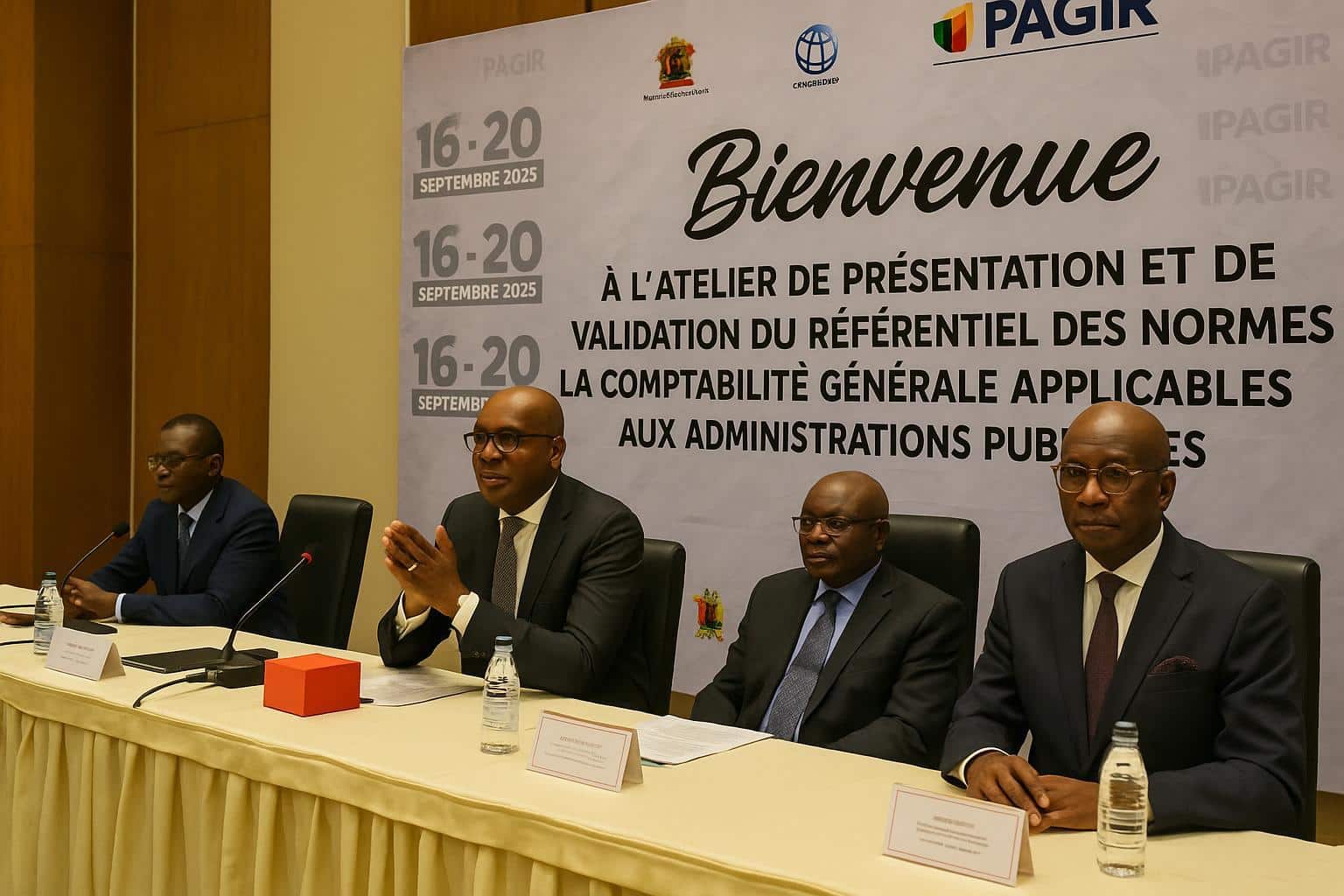
The validation came at a five-day workshop, 16-20 September 2025, held in the high-tech halls of the Kintélé International Conference Center. More than 100 accountants, auditors and policy makers from ministries and public agencies reviewed every line of the reference document before giving it unanimous support.
Five-day workshop in Kintélé
Finance, Budget and Public Portfolio Minister Christian Yoka opened the session beside several cabinet colleagues. “Your deliberations confirm Congo’s full alignment with the CEMAC economic and financial reform program,” he stated, encouraging delegates to produce a tool capable of guiding result-based budgeting.
Director-General of Public Accounts and State Assets Saturnin Ipodo-Nzingou underlined the central role of reliable information. “Financial data frames every policy decision we take,” he insisted. Participants, he added, were shaping a regime that ties spending to measurable outcomes and raises citizens’ trust in official numbers.
Anchoring reforms in CEMAC PREF strategy
The governmental push follows December 2024’s approval of a redesigned state chart of accounts. Together, the two instruments form the backbone of an overhaul aiming to replace fragmented bookkeeping with harmonized ledgers that speak the same language in ministries, municipalities and state-owned enterprises.
Officials note that the reference integrates IPSAS-inspired concepts on asset valuation, consolidation and accrual recording while respecting the legal framework of the Congo. By doing so, it promises fiscal data that can be compared across borders, facilitating peer reviews and multilateral surveillance at CEMAC level.
Transparency and budget efficiency gains
Each chapter details rules for intangible and financial assets, cash components, tax revenues, provisions and contingent liabilities. The framework also specifies how to compile consolidated statements to capture the footprint of autonomous agencies, a long-standing blind spot in African public finance statistics.
Debates in Kintélé were anchored by case studies from Cameroon and Gabon, where similar reforms have improved debt tracking and budget execution. Congo’s accountants compared lessons, identified local particularities like oil-sector royalties, and adjusted the text without losing the overarching alignment with regional standards.
World Bank’s PAGIR support
World Bank experts backing the PAGIR project provided technical coaching and software prototypes that could be rolled out once the framework becomes law. A senior economist described the exercise as “a major stride toward end-to-end digital expenditure chains built on credible opening balances.”
The bank’s support, officials stressed, extends beyond consulting to include hardware for regional training hubs and safeguards for cybersecurity. Discussions are progressing with Congo Digital to host financial data on servers located in Brazzaville, consistent with the country’s data-sovereignty policy.
Parliamentary and investor perspectives
From a governance perspective, the standards obligate every ministry to close yearly accounts on time, reconcile treasury and banking statements, and publish key tables. Parliament’s Finance Committee will gain a clearer line of sight when scrutinising draft budgets against past execution records.
Private investors have also welcomed the move. A Pointe-Noire-based fund manager said foreign partners often request audited sovereign data before financing infrastructure. “If the state speaks IPSAS, we waste less time in due diligence,” she explained, predicting lower risk premiums on future bond issuances.
From draft ordinance to pilot rollout
Anchoring the framework in law remains the next milestone. The Ministry of Finance plans to submit a draft ordinance to cabinet in October, followed by parliamentary debate during the budget session. Officials are confident of swift passage, citing the reform’s cross-party consensus history.
Implementation will be phased. Pilot ministries, including Health and Public Works, must convert opening balances within six months. A nationwide rollout is scheduled for fiscal year 2027, allowing time for system interfacing and staff certification through the École Nationale d’Administration et de Magistrature.
Training, open data and public oversight
Training is already under way. The Directorate of Public Accounts has uploaded tutorial videos in French and Lingala to its e-learning portal. Regional seminars are planned for Dolisie, Owando and Impfondo, ensuring that local government accountants master the same ledger templates as their Brazzaville peers.
Civil-society groups, for their part, are calling for the release of machine-readable datasets to allow independent budget monitoring. The Finance Ministry says an open-data platform is in design but stresses the need to anonymise sensitive salaries before bulk downloads become available to watchdogs.
Climate metrics in future dashboards
Looking ahead, authorities intend to couple the accounting package with performance dashboards that track greenhouse-gas spending, a first in Central Africa. By linking climate indicators to financial statements, Brazzaville hopes to access emerging carbon-finance windows while steering public projects toward the government’s national determined contribution targets over the next decade.