
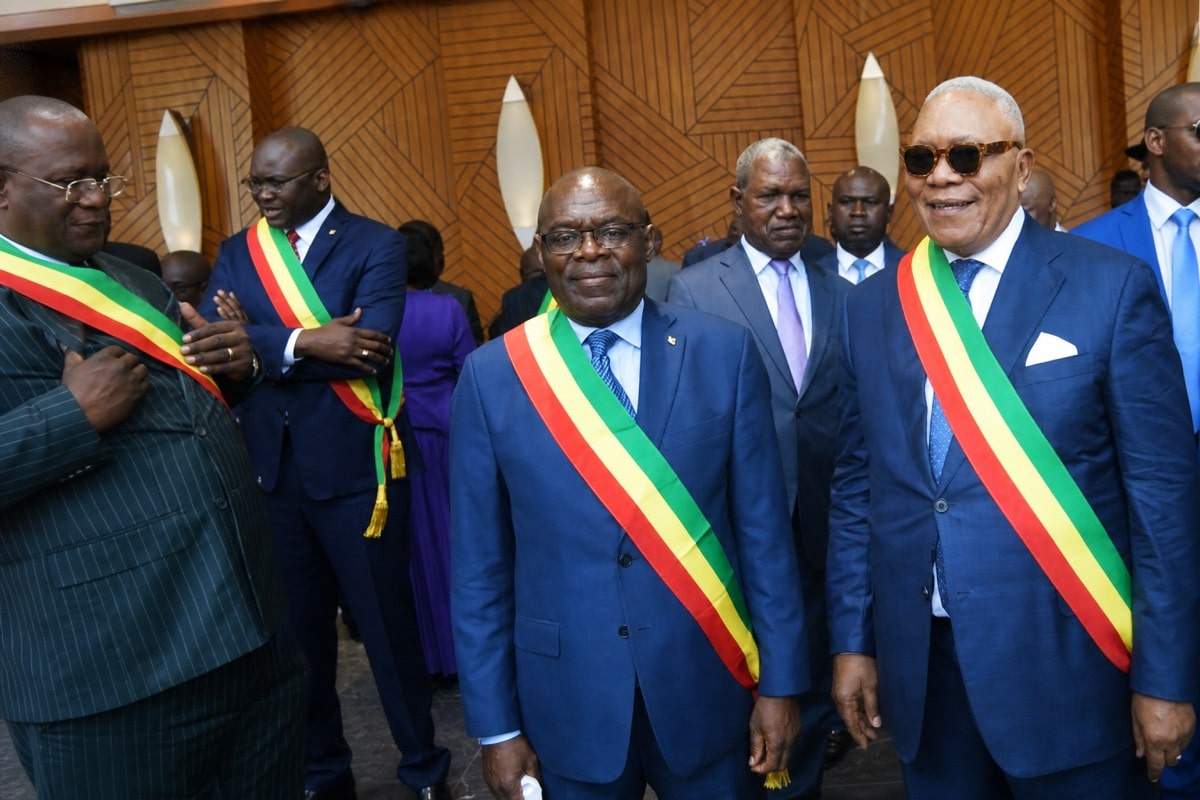
Legislation Continues Despite Electoral Turbulence
The period following a presidential election in any country tends to produce institutional uncertainty, as outgoing governments wind down, new cabinets are formed, and attention shifts from the legislature to the executive. In Congo-Brazzaville, however, the 15th legislature chose a different path — one of visible, deliberate continuity.
According to a statement from the National Assembly’s bureau, the country’s deputies had maintained a steady legislative pace even as the March 15, 2026 presidential vote and its aftermath consumed political attention elsewhere. The signal was clear: the parliament intended to function regardless of the electoral calendar.
A Declaration of Institutional Confidence
Alain Pascal Leyinda, the second secretary of the National Assembly’s bureau, provided the most direct articulation of this position. “The 15th legislature is pursuing its normal course with serenity, republican regularity, and efficiency,” he said, adding that this was happening despite the demanding political schedule.
That choice of language — serenity, republican regularity, efficiency — was not incidental. It was the vocabulary of institutional confidence, a counter-narrative to any suggestion that Congo-Brazzaville’s legislative branch might be paralyzed or sidelined by the executive transition underway.
Deputies Demonstrate Professional Constancy
Beyond statements from the bureau, the behaviour of deputies themselves was cited as evidence of the legislature’s health. Their regular attendance and active engagement in committee work and plenary sessions were presented as demonstrations of professional commitment that transcended the political moment.
In systems where elected legislators sometimes use high-profile events as grounds for absence or inattention, the opposite pattern — sustained presence and productivity — carries its own political significance. It reinforced the narrative that Congo-Brazzaville’s parliament was a functioning, reliable institution.
Democratic Maturity as a Governing Claim
The bureau’s communications around this period consistently framed the legislature’s continuity as evidence of democratic maturity. The argument was structural: institutions that persist and produce results through electoral transitions demonstrate that the state does not depend entirely on the personality of the executive for its functioning.
This claim was made in the specific context of a post-presidential election period, a moment when executive branch attention is by definition consumed by transition logistics, new government formation, and the inauguration of a new mandate. The fact that the legislature was described as operating normally in that environment was presented as a sign of institutional depth.
What Republican Continuity Means in Practice
For Congolese citizens watching parliamentary proceedings, the concept of republican continuity translates into something concrete: laws continue to be debated, budgets continue to be scrutinized, and oversight functions continue to be exercised. These functions do not pause for elections.
The 15th legislature, covering the period following the most recent general parliamentary elections, had already accumulated a legislative record before the March 2026 presidential vote. Its continued activity after that election added to that record and kept the National Assembly visible as an active institution at a moment when the cabinet reshuffle and presidential inauguration were dominating public attention.
The Broader Political Moment
The June 2026 report on legislative continuity came at a moment when the new government — the Makosso III cabinet, formed for the 2026-2031 quinquennium — was itself moving into its working phase. The president’s first Council of Ministers had already been held, and priority reform agendas were being announced. The National Assembly’s continued operation provided the legislative counterpart to the executive’s momentum.
Whether the 15th legislature would be called upon to pass significant new legislation in the months ahead — including any bills emerging from the executive’s stated reform priorities — remained to be seen. But its demonstrated capacity to function through a politically complex transition period positioned it as a credible partner in the governance process.