
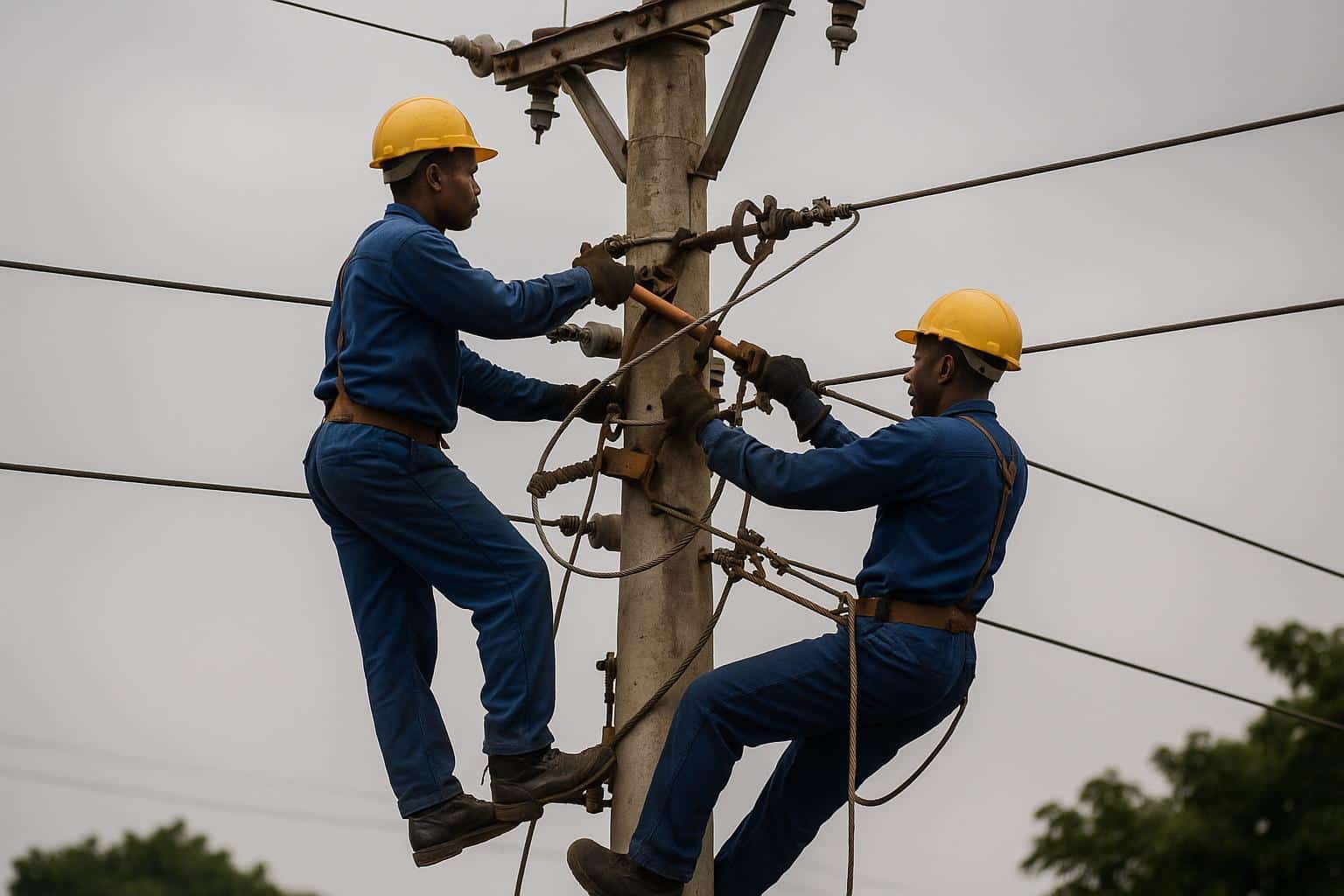
Fading Poles Stir Public Concern
At dawn in Don Bosco district, a slanted concrete pole leans over iron-sheet roofs, its low-hanging wire sparkling after every drizzle. For resident Mireille Diboua, the structure, toppled by a storm four years ago, “is a sword above our heads”. She keeps children indoors after sunset.
All across Brazzaville, similar snapshots punctuate the streetscape. In Sonaco, termites have hollowed a wooden mast to the width of a wrist. Along Massina Avenue, taped cables dangle at eye level, brushing marketgoers balancing baskets of cassava and smoked fish.
Mapping the High-risk Zones
Municipal civil-protection units list 217 “red spots” where infrastructure is either fractured, exposed or abandoned. Their internal memo, reviewed by this newspaper, warns that mere contact with a 6.6-kilovolt line “could prove instantly fatal”, especially during the October-March rainy season when ground moisture conducts current.
Electricité du Congo, known as E²C, acknowledges the vulnerabilities yet stresses that the network inherited from colonial times has expanded faster than resources. “We manage 9 000 kilometers of lines built for 300 000 clients; today we serve 1.2 million,” spokesman Jean-Daniel Mavoungou said in an interview.
Behind the Slow Repairs
Engineers trace the wear to saline winds from the Congo River, haphazard extensions by informal electricians, and delayed maintenance during the 2014-2017 oil shock that trimmed public revenues. A 2021 World Bank diagnostic placed Brazzaville’s distribution losses at 38 percent, triple the acceptable international benchmark.
Government Roadmap for Reliable Power
Funding, however, is turning a corner. Last December the Ministry of Energy launched the Priority Grid Rehabilitation Programme, a 110-million-euro package co-financed by the African Development Bank and the Central African States Development Bank. The first tranche targets 60 kilometers of high-risk feeders in Makélékélé and Moukondo.
Project manager Clarisse Okemba projects that “crews will replace obsolete poles with composite models resistant to humidity and termites, while smart sensors will alert technicians before faults escalate.” She adds that local subcontractors must source sand, gravel and catering from neighborhood cooperatives to spur jobs.
In parallel, E²C is rolling out 50,000 prepaid meters to curb illegal hookups that overload transformers. Early trials in Poto-Poto cut technical losses by a quarter and shortened billing queues, according to a February performance brief circulated to parliament’s economic committee.
Citizen Innovation and Vigilance
Residents, though relieved by the roadmap, have become vigilant. WhatsApp groups named “Surveillance Lampadaire” circulate geolocated photos of cracks and sparks within minutes. The city’s firefighting brigade confirms that such crowdsourced alerts enabled the isolation of six live wires during March thunderstorms.
Entrepreneurs are seizing the momentum. Green-tech start-up Mboté Energy has built a drone equipped with infrared cameras to detect hot spots along overhead lines. Founder Serge Opanga says the prototype completed a 12-kilometer scan above Talangai in ten minutes, “saving inspectors days of climbing”.
Balancing Growth and Grid Resilience
Academics at Marien-Ngouabi University are also advising on policy. Electrical-engineering lecturer Dr. Brice Ngoma argues that routine maintenance budgets must be ring-fenced. “New hardware is welcome, but without predictable funding the cycle of deterioration resumes,” he told a symposium hosted by the French Development Agency.
International agencies echo that caution. The International Energy Agency forecasts urban Congolese electricity demand to grow 6 percent annually through 2030, buoyed by digital services and refrigeration. Balancing capacity with safety, analysts say, requires synchronized investment in generation, substations and community outreach to prevent unsafe self-connections.
City Hall says it is tightening oversight. Mayor Dieudonné Bantsimba signed a decree empowering neighborhood chiefs to fine households that tamper with service boxes. The measure pairs enforcement with education: door-to-door volunteers distribute illustrated leaflets explaining why exposed copper can electrify puddles where children play.
Weather patterns add urgency. The national meteorology center predicts heavier precipitation events linked to El Niño this year, which could saturate soils and undermine leaning poles. Engineers therefore schedule concrete footing reinforcement before October downpours, using rapid-setting mixes tested on Pointe-Noire’s coastal feeders.
For now, families in Don Bosco still sidestep the fallen pole, but optimism flickers. “If the new plan reaches us, my kids will finally sleep without fear,” Mireille says, watching linemen mark the street with fluorescent paint. A safer grid, she believes, starts pole by pole.
Regionally, the scheme dovetails with the CEMAC Power Interconnection that envisions surplus hydropower from Liouesso feeding urban grids across northern Congo and Gabon. Energy Commissioner Augustin Sima calls Brazzaville’s rehabilitation “a cornerstone that will let trade flow not only in goods but electrons”.
Fiscal observers underline the macro benefits. “Reliable electricity trims business downtime and raises tax receipts without new levies,” notes economist Henriette Oba of the Chambre de Commerce. She estimates that each percentage point cut in outages could lift Brazzaville’s GDP by 0.3 percent annually.