
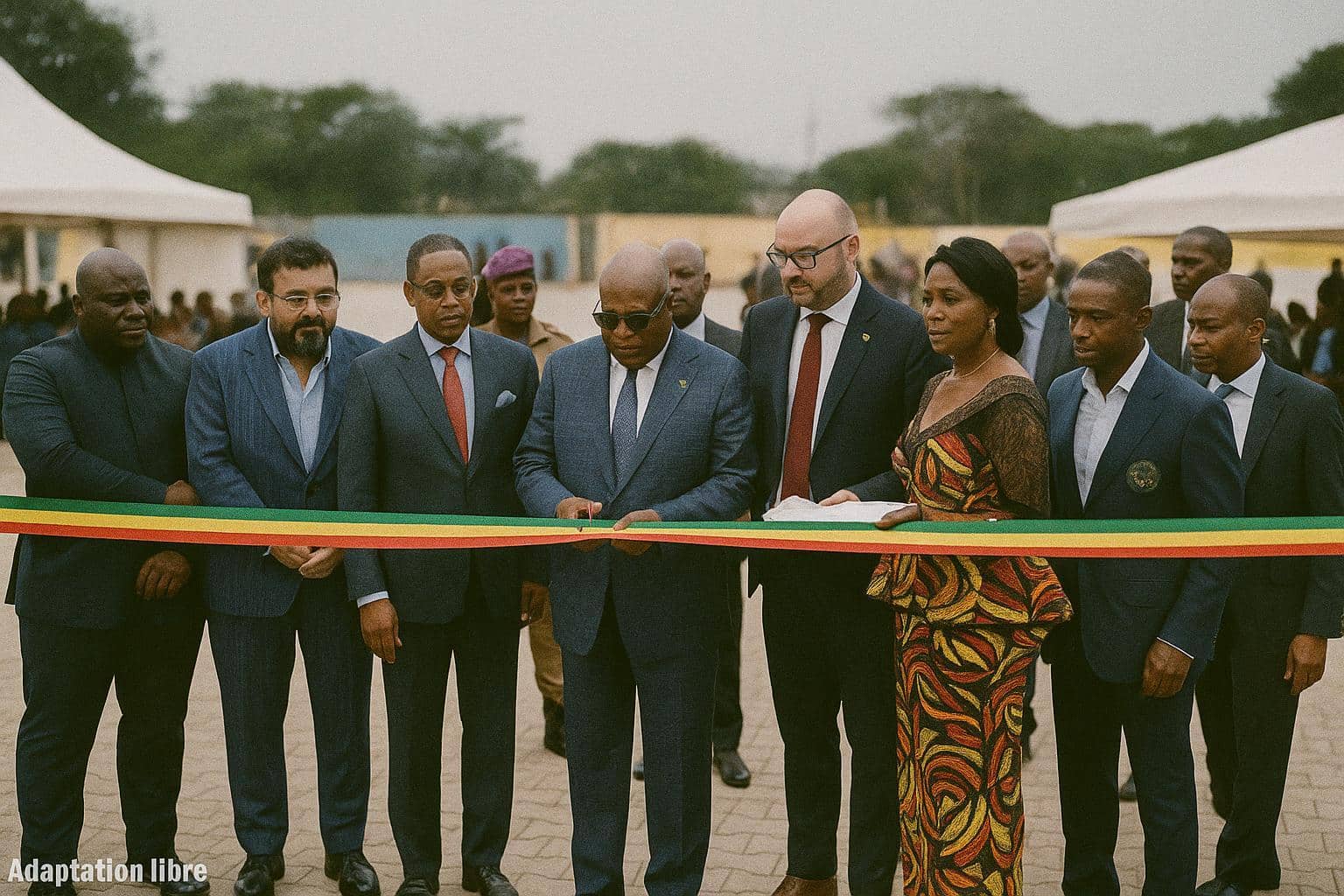
Strategic Warehousing Bolsters Grid Resilience
The provisional hand-over of two specialised storage compounds in Brazzaville’s Itatolo district and Pointe-Noire’s Mongo-Kamba II marks a tangible advance in the Republic of the Congo’s quest for a more reliable electricity network. By centralising critical transformers and gas-insulated components under controlled conditions, operator Énergie électrique du Congo (E2C) is now equipped to curtail outage durations and expedite field repairs, a pressing concern articulated in recent diagnostic studies (World Bank 2022). Diplomats stationed in the capital have welcomed the move as evidence of the administration’s commitment to energy security, a prerequisite for industrial diversification under the National Development Plan.
Franco-Congolese Financing Architecture
At the financial core of the project lies a 70 million-euro sovereign loan extended in 2015 by the Agence française de développement. The decision to prolong the disbursement window to 2027 affords Brazzaville additional fiscal space while maintaining Paris’s historic partnership with Central Africa’s coastal hub. Speaking at the ceremony, AFD country director Maurizio Cascioli underlined the ‘joint stewardship’ approach that has governed project execution, a model often cited by regional economists as a template for calibrated public debt management. By ring-fencing funds specifically for logistics, information systems and QHSE upgrades, the facility reinforces the Ministry of Energy’s policy of targeted capital allocation.
Technical Specifications Signal Modern Standards
Each site comprises twin hangars—one exceeding a thousand square metres dedicated to high-voltage transformers, the other approaching the same scale for equipment containing sulphur-hexafluoride and ancillary reserves. Integrated administrative wings enable real-time inventory monitoring, while reinforced concrete shells and fire-suppression technology meet IEC safety norms. Central BTP, the contractor, completed the civil works in fifteen months despite pandemic-induced supply shocks, a performance applauded by sector analysts observing the sub-regional construction market. Engineers from the Pool-Plateau and Kouilou grids note that the spatial layout facilitates forklift circulation and modular racking, thereby shortening dispatch times during contingency events.
Importance of Rigorous Asset Stewardship
E2C director-general André Bruno Danga Adou used the occasion to appeal for strict custodianship, cautioning that vandalism could negate hard-won efficiency gains. His plea echoes findings by the International Energy Agency that non-technical losses—pilferage, sabotage, informal connections—remain a hidden tax on African utilities (IEA 2023). Municipal authorities in Djiri, represented by secretary-general Guy Roger Embongo, pledged local surveillance, illustrating how multi-level governance can buttress critical infrastructure. Observers from the Economic Community of Central African States argue that such community buy-in strengthens social licence and deters criminal interference more effectively than purely punitive measures.
Regional Integration and the 110 kV Corridor
The warehouse initiative dovetails with the ongoing rehabilitation of the 110 kV Moukoukoulou-Mindouli line, a spine that channels hydropower from the Niari valley toward the Congolese heartland. Rehabilitation encompasses conductor replacement, optical ground wire installation and substation automation, upgrades expected to raise transfer capacity by roughly 15 percent according to preliminary E2C simulations. Diplomatic envoys note that a sturdier corridor could, in the medium term, enable surplus exchanges with neighbouring Gabon and the Democratic Republic of the Congo, complementing the Central African Power Pool’s vision of a continental electricity market.
Governance, Transparency and Sector Reform
Although the Congolese state retains majority ownership of E2C, recent decrees have expanded the firm’s managerial autonomy, allowing performance-based procurement and audited accounts aligned with OHADA standards. Energy minister Émile Ouosso highlighted that the new storage assets must be viewed within this broader matrix of governance reform, not merely as isolated bricks and mortar. The ministry’s Directorate of Studies and Planning is expected to publish quarterly utilisation metrics, a practice consistent with recommendations issued by the African Development Bank’s ‘Electricity Regulatory Index’ report. Such transparency may reassure creditors and pave the way for blended-finance instruments in future grid ventures.
Prospects for Sustainable Energy Security
By anchoring inventory management in two geographically complementary hubs, Congo-Brazzaville mitigates logistical bottlenecks and improves its capacity to respond to climatic shocks that increasingly threaten overhead lines. Analysts at the University of Kinshasa’s Centre for Energy Studies argue that, coupled with planned solar-hybrid projects in the northern departments, the warehousing strategy could slash emergency procurement costs by up to a third over five years. While challenges persist—most notably aging distribution feeders—the present initiative demonstrates a calibrated, partnership-driven pathway toward energy resilience. In the words of one senior EU diplomat present at the launch, ‘Predictable power is the currency of modern diplomacy; Congo’s latest move augurs well for both investors and citizens.’