
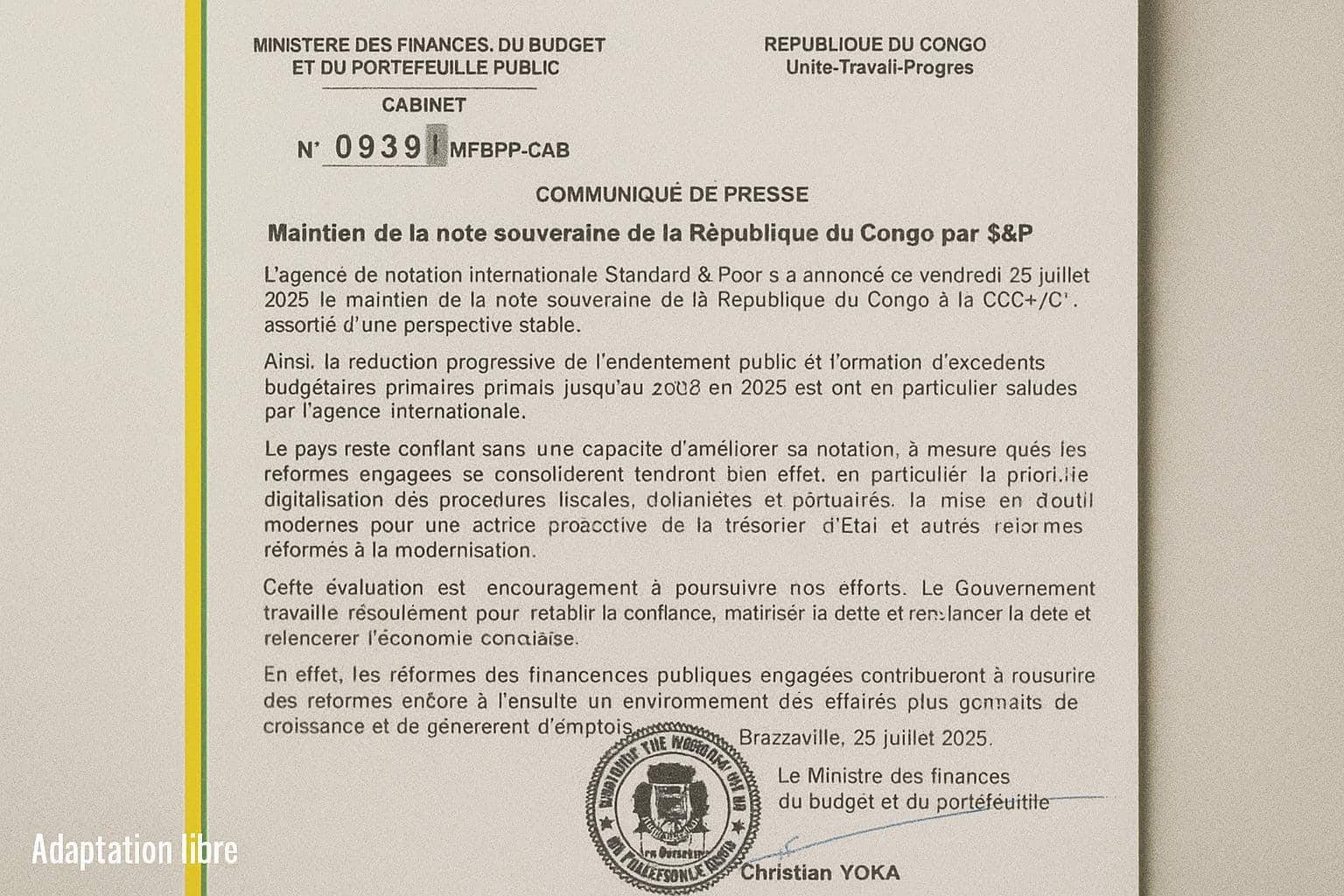
A measured verdict from Standard & Poor’s
In its 25 July 2025 communiqué, Standard & Poor’s chose continuity over drama, preserving the Republic of Congo’s long-term sovereign rating at CCC+ and its short-term assessment at C. The outlook remains stable, a judgement that may seem modest in absolute terms yet carries considerable symbolic weight for a market still recuperating from successive global shocks. Analysts in Johannesburg and Paris observed that the rating confirms a period of relative calm in Brazzaville’s fiscal narrative, following years in which debt sustainability hovered at the centre of international concern (S&P Global Ratings, 2025).
Consolidating the fiscal house
Behind the stable outlook lies a gradual but perceptible narrowing of fiscal deficits. Ministry of Finance data show primary surpluses averaging 1.5 percent of GDP since 2023, assisted by disciplined expenditure ceilings and more reliable oil-price assumptions. The International Monetary Fund’s 2024 Article IV consultation acknowledged this progress, noting that gross public debt fell from 98 percent of GDP in 2020 to roughly 83 percent in 2024 (IMF Article IV, 2024). Although the ratio remains high, the downward trajectory supports S&P’s view that the sovereign is no longer at immediate risk of distress, provided external conditions do not deteriorate sharply.
Oil revenue, diversification and digital ambition
Congo-Brazzaville still derives more than half of its fiscal receipts from hydrocarbons, a reality that anchors both opportunity and risk. The stable rating therefore hinges on the government’s ability to translate current Brent prices into sustainable buffers. Brazzaville’s response has been to accelerate a digital overhaul of customs, port services and tax administration. According to Minister Christian Yoka, electronic clearance times at Pointe-Noire port have already fallen by forty percent, feeding an additional CFA 90 billion into the treasury in 2024. By reducing leakages and broadening the non-oil tax base, authorities aim to break the historical correlation between oil volatility and budget stress.
Governance signals and creditor dialogue
The preservation of the CCC+ label also reflects an improving, albeit still fragile, governance matrix. Congo’s accession to the Extractive Industries Transparency Initiative in 2022 has provided investors with more granular production data, while quarterly debt bulletins now enumerate each bilateral and commercial obligation. Creditor confidence has been further reinforced by constructive engagements with Chinese policy banks and the Paris Club, neither of which has escalated arrears over the past eighteen months (World Bank Governance Indicators, 2024).
Regional headwinds and market perception
Congo-Brazzaville operates within the CFA franc zone, sharing monetary policy with five other CEMAC members. Rising regional reserves—up to 4.7 months of imports by mid-2025—offer an additional layer of protection, mitigating immediate external liquidity concerns (BEAC, 2025). Yet investors remain attentive to political tensions in neighbouring states and to the pace of US Federal Reserve tightening, both of which influence risk premiums on Central African sovereign bonds. Against that backdrop, the maintenance of a stable outlook by a major rating agency sends a calibrated signal that Brazzaville’s trajectory is diverging, if only incrementally, from regional volatility.
Prospects for an upward revision
Could the Republic of Congo rise above the CCC frontier? S&P’s criteria focus on predictable policy execution, continued primary surpluses and evidence that the public-sector wage bill can be contained without undermining social stability. Brazzaville’s 2025–2028 National Development Plan places strong emphasis on agro-industrial corridors and renewable energy, sectors marketed as future engines of foreign direct investment. If these projects produce tangible export receipts while the digital tax reforms mature, the sovereign’s liquidity profile could strengthen to the point of warranting a single-notch upgrade. For the moment, analysts describe the outlook as one of guarded optimism, with the current rating serving less as a ceiling than as a reminder of work still to be done.
A cautious but constructive endnote
In diplomatic circles, the July decision has been interpreted as a vote of confidence in President Denis Sassou Nguesso’s reformist narrative, even if confidence remains conditional. The government itself has responded with tempered satisfaction, presenting the assessment as both validation and incentive. With debt ratios inching downward, revenue administration becoming more transparent and regional reserves offering a modest cushion, Congo-Brazzaville has secured breathing space. Whether that space will be expanded into sustainable credit strength now depends on steadfast policy delivery and a bit of external luck—commodities may ebb as readily as they flow. For investors and partners alike, S&P’s verdict is therefore less an applause line than a measured nod, signalling that the journey toward enhanced solvency, though still demanding, is evidently under way.