
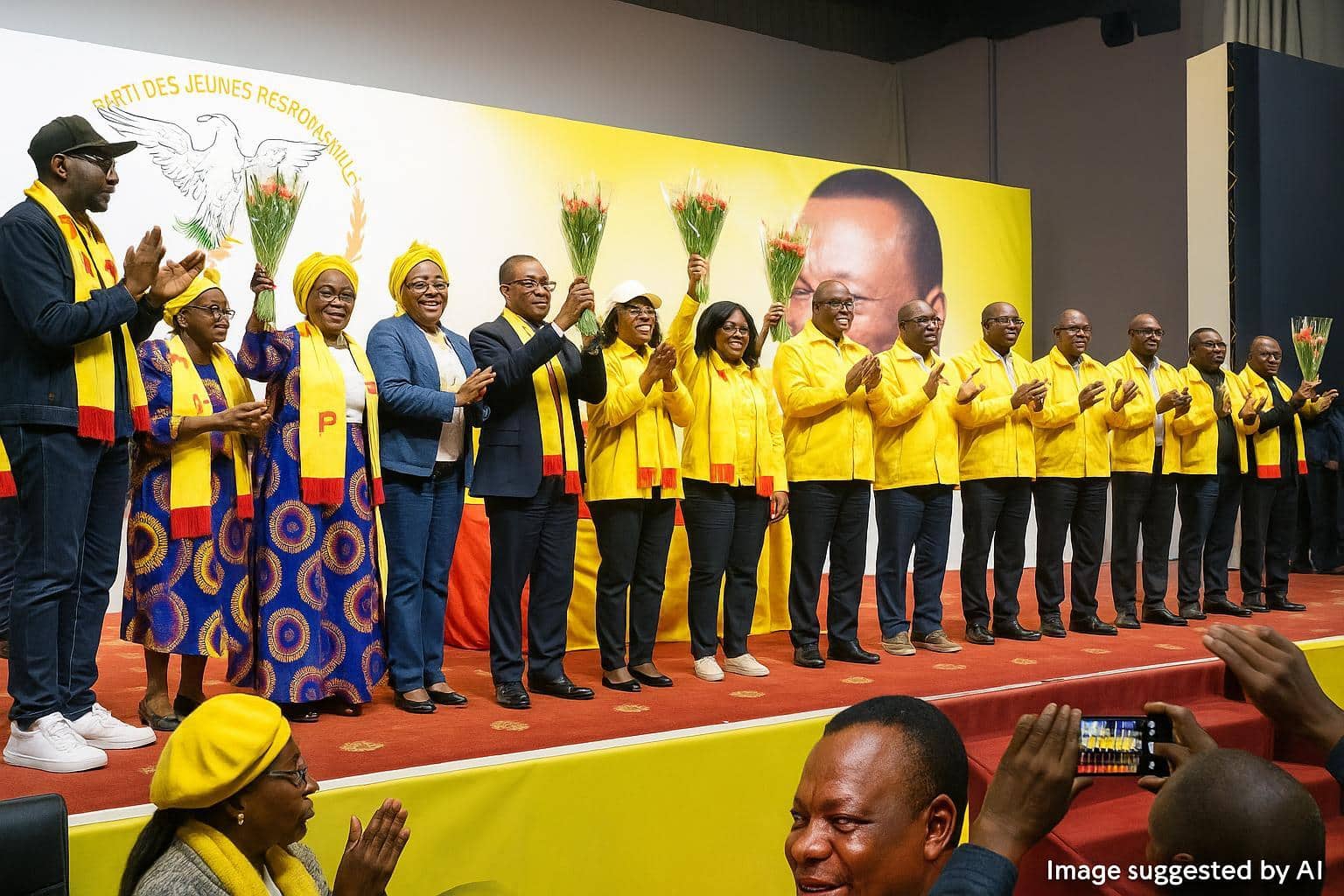
Youth Movement Sets the Tone
On 13 August in Brazzaville, the newly structured Mouvement des jeunes présidentiels, a component of the governing majority, closed its convention by adopting a special motion urging President Denis Sassou Nguesso to seek another term in the March 2026 presidential election, citing his stewarded stability and youth-focused reforms over two decades.
The gathering, attended by delegates from fifteen departments and the French diaspora, elected fresh leadership bodies, including a 201-member central committee, signalling organisational readiness for what the movement’s national coordinator Donald Mobobola called “a sprint, not a marathon, toward a decisive victory” for continuity, peace, and economic acceleration nationwide.
Mobobola reminded delegates that, in his words, “Congolese youth is more than a voting reservoir”, positioning the MJP as an incubator for civic responsibility while reaffirming loyalty to the president’s policy agenda rooted in peace, infrastructural renewal, and gradual diversification of the oil-dependent economy throughout the coming cycle.
Electoral Calendar Taking Shape
Under Congo’s constitutional timetable, the next presidential race is expected in March 2026, leaving roughly eighteen months for coalitions to consolidate messaging, register supporters, and comply with the National Independent Electoral Commission’s procedural checklist, observers at the Centre d’Analyse et de Prospective Électorale noted earlier this month in Brazzaville.
While formal candidacies will not open until late 2025, early endorsements traditionally carry weight in Congolese politics, shaping fundraising networks and negotiating alliances between parties such as the PCT, the UDH-Yuki, and smaller regional formations across Pool, Likouala, and the coastal districts where turnout swings remain historically decisive.
Charting a Record on Stability
Since returning to power in 1997, President Sassou Nguesso has emphasised conflict resolution and infrastructural reconstruction, most visibly in highway corridors linking Brazzaville to Pointe-Noire and new energy grids that have incrementally reduced outages in semi-urban districts, according to Ministry of Energy summaries published this year and bilateral reviews.
Macroeconomic data from the International Monetary Fund indicate that real GDP growth rebounded from –0.5 percent in 2020 to 1.7 percent in 2022, aided by disciplined fiscal management and global oil price recovery, though diversification into timber processing and agribusiness remains a declared medium-term priority in cabinet documents released April.
Civil society voices, including the think tank Observatoire Congolais des Droits de l’Homme, acknowledge advances in security but still advocate for faster judicial digitisation and expanded press facilitation grants, themes the presidency says will appear in its forthcoming youth-oriented national development plan 2024-2028, currently under interministerial technical review.
Youth Demographics and Mobilisation
Nearly 60 percent of Congo’s estimated 5.8 million inhabitants are under thirty-five, according to the National Institute of Statistics, making the youth vote a cornerstone for any campaign narrative and explaining the strategic emergence of movements such as the MJP within the presidential coalition since 2020’s municipal mobilisation successes there.
The movement’s governing charter, consulted by this publication, pledges programmes in digital literacy, micro-credit facilitation, and urban cultural festivals, echoing the government’s ongoing post-pandemic recovery roadmap that channels 30 percent of public investment toward education, entrepreneurship, and creative industries over the next three fiscal years, officials confirmed last week.
Sociologist Sylvie Ebina argues that youthful enthusiasm can translate into governance accountability if channelled through structured debate forums rather than street demonstrations, adding that the MJP’s internal leadership renewal process could become “a laboratory for participatory politics” as the nation consolidates decentralisation reforms outlined in recent senate hearings notes.
Regional and International Readings
Central African economic blocs, from CEMAC to ECCAS, closely monitor Brazzaville’s succession rhythms because continuity can affect cross-border infrastructure projects like the proposed Kinshasa-Brazzaville rail link and the Lobito transport corridor, diplomats stationed in Libreville and Luanda underscored during a regional policy webinar hosted by AfriConnect Network Friday.
International financial partners, including the World Bank, have signalled readiness to expand concessional lending for green energy if upcoming political cycles maintain the existing macroeconomic framework, referencing successful disbursement of a 100 million-dollar climate-resilient agriculture envelope in June to support mangrove restoration and solar mini-grids along the coastline zones.
Paris-based analyst Alain Obou cautions that international goodwill remains sensitive to perceptions of electoral transparency, urging early technical cooperation with the African Union’s Democracy Support Unit, a recommendation echoed by Congolese diplomats who view pro-active observer invitations as a trust-building gesture ahead of voter-roll publication next summer, he says.
Voices From Analysts
Political scientist Rodrigue Tchicaya considers the MJP endorsement an “anticipated catalyst” that may accelerate endorsements from other youth-centric organisations, yet he adds that the president’s decision will likely hinge on surveys gauging public appetite for continuity versus generational transition, results expected toward year-end according to leaked polling briefs circulating.
For now, the MJP’s drums echo across social media platforms, where hashtags mixing Lingala, French, and emoji-laden slogans multiply by the week, underscoring both the dynamism and the stakes of a vote that regional observers already describe as a bellwether for Central African stability in the coming biennium.