
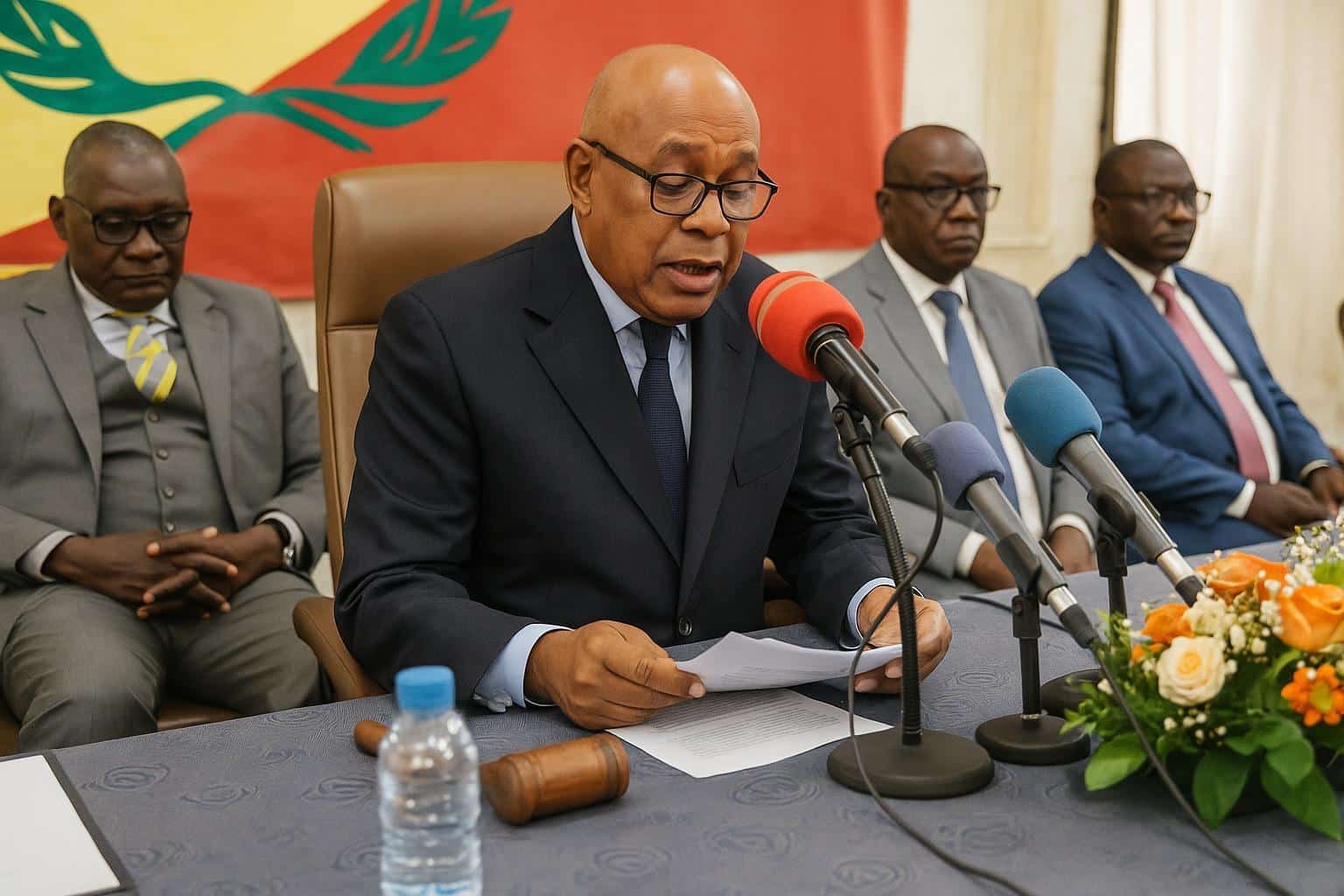
A first full session after May elections
At the end of a four-day ordinary session in Brazzaville, the National Human Rights Commission, better known by its French acronym CNDH, adopted a three-year strategic plan designed to turn broad constitutional guarantees into measurable improvements on the ground.
From 22 to 25 September 2025, commissioners met under the gavel of their newly elected president, Casimir Ndomba, marking the first full gathering of the body since the May ballot that renewed its membership.
The session produced three cornerstone documents—a revised internal code, new financial rules and the 2025-2028 roadmap—that participants dubbed a foundation for a “credible, citizen-focused institution”.
Five sub-commissions to drive field work
Deliberations created five thematic sub-commissions covering civil liberties, economic rights, gender equality, education and institutional partnerships.
These units, according to Ndomba, will operate as “operational pillars”, dispatching multidisciplinary teams to districts from Pointe-Noire to Ouesso to gather complaints, mediate disputes and issue rapid alerts.
Commissioner Germaine Ngala added that the architecture mirrors best practices recommended by the African Commission on Human and Peoples’ Rights, allowing Congo to share data with regional partners inside the CEMAC bloc.
UN backing underscores global confidence
The Resident Coordinator of the United Nations system in Congo, Abdourahmane Diallo, attended the opening ceremony, calling the plan a “significant stride toward Agenda 2030’s promise of leaving no one behind”.
UN agencies already contribute technical assistance for case-management software and training modules, an arrangement Diallo said would deepen as the sub-commissions roll out outreach caravans next year.
Diplomats from France, the European Union and the United States quietly welcomed the governance tools, noting that fiscal oversight clauses in the new financial regulations could unlock additional project grants.
He further highlighted the commission’s openness to South-South exchanges, noting that Gabon’s National Human Rights Commission invited its Congolese counterpart to a peer-review exercise early next year, a step expected to invigorate cross-border monitoring of migration corridors.
Such cooperation resonates with the Economic Community of Central African States’ Human Rights and Democracy Charter, which calls for member states to establish feedback mechanisms for citizens travelling within the sub-region.
Transparency tools aim at public trust
The newly endorsed financial regulation subjects every budget line to quarterly audits by an external chartered accountant and to yearly publication in the government’s official journal.
Civil-society observer Rosalie Mbon confirmed that her network, Plateforme Justice, will monitor implementation and publish an independent scorecard, a move she believes “can cement a culture of results”.
For Ndomba, such scrutiny is welcome; he insisted that transparency is consistent with President Denis Sassou Nguesso’s call for robust public institutions during the most recent State of the Nation address.
The internal rulebook also introduces a whistle-blower hotline managed by an encrypted platform hosted on government data centres but accessible through low-bandwidth SMS, seeking to overcome connectivity issues in remote Sangha and Likouala.
Digital-rights advocate Jean-Baptiste Ikomba welcomed the hotline, stating that “mobile-first outreach is vital for younger citizens who may distrust face-to-face reporting channels”.
What comes next for justice and cohesion
The strategic plan sets 42 indicators, including a target of resolving 75 percent of admissible complaints within six months and organising human-rights education sessions in all 12 departments by 2027, according to an internal briefing seen by this newspaper.
Resource mobilisation remains a priority; the CNDH operates on an annual budget of roughly 2.3 billion CFA francs, and commissioners hope corporate social-responsibility funds can supplement state allocations without compromising independence.
Analysts predict that early wins will come from the gender-equality desk, an area where national legislation already aligns with regional commitments, easing coordination with ministries and community groups.
Longer-term, the commission intends to recommend amendments to the 2015 law that created it, potentially giving it subpoena powers and access to detention facilities without prior notice, measures that observers say would place Congo among Africa’s more proactive rights watchdogs.
For now, Ndomba’s immediate focus is staffing: recruitment for 60 professional posts, including psychologists and data analysts, opens in October with a pledge to prioritise young graduates trained in Congo’s universities.
Funding partners will scrutinise gender balance inside the staff; the policy sets a minimum threshold of 45 percent women across technical positions, aligning with the national strategy for the advancement of women signed in 2023.
The document further lays out a communication blueprint, including quarterly press conferences and a dedicated radio slot on Radio Congo, aimed at translating legal jargon into local languages such as Kituba and Lingala.
If the timeline holds, an inaugural national human-rights barometer, aggregating data from complaints, court statistics and perception surveys, could be published by December 2026, offering policymakers a granular picture of social cohesion trends.