
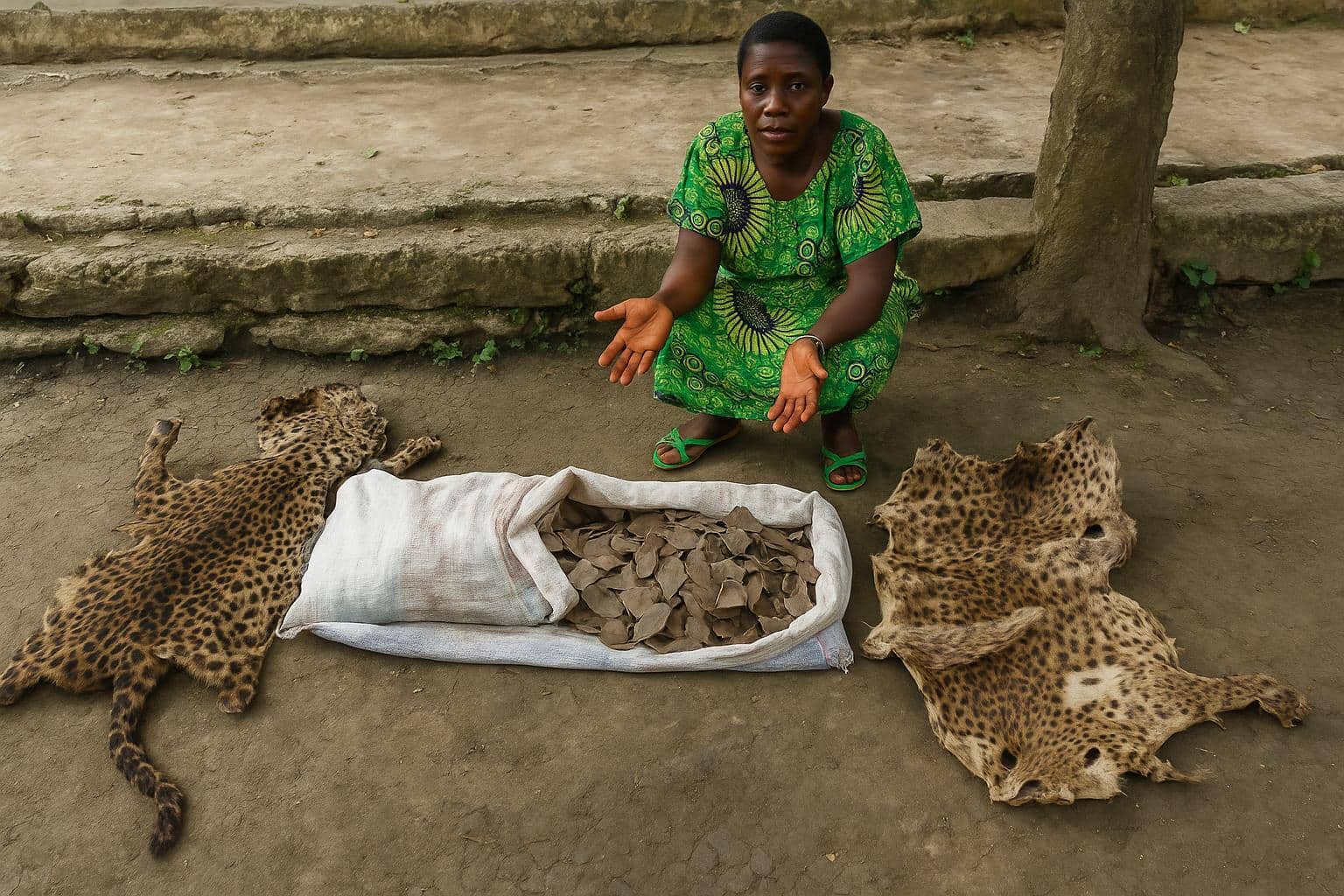
Tightening Wildlife Law Enforcement in Likouala
Shortly before noon on 25 August 2025, gendarmerie officers in Impfondo, capital of Likouala Department, stopped a public river taxi and discovered two leopard skins alongside several kilogrammes of giant pangolin scales and claws. The suspect, a forty-year-old Congolese woman, surrendered without resistance to the surprised passengers onboard.
According to Colonel Yves Kiyiri, head of the Likouala gendarmerie region, the interception resulted from a fortnight of discreet surveillance supported by officers from the Departmental Directorate of Forest Economy and the Project for the Application of Wildlife Law, known locally by its French acronym PALF since 2009.
Seizures of leopard trophies and pangolin derivatives are not isolated in northern Congo-Brazzaville. A 2024 TRAFFIC briefing highlighted at least fifteen similar cases in the Sangha and Likouala forests over the past three years, underscoring the pressure placed on species already listed in CITES Appendix I for protection.
Environmental analysts working with the Brazzaville-based Observatory for Forests say river networks offer traffickers a relatively inexpensive corridor to Cameroon and the Central African Republic, where contraband can enter transcontinental routes toward Asia. That geography makes Likouala simultaneously a conservation hotspot and a law-enforcement frontier for local authorities.
From Arrest to Courtroom: Legal Pathway
Minutes after the arrest, investigators drew up an offence report referencing Article 27 of Law 37-2008, which gives full protection to leopards and giant pangolins. Under Congolese procedure, the gendarmerie forwards such reports to the state prosecutor within forty-eight hours, triggering a judicial inquiry into sourcing and accomplices.
The defendant faces two to five years of imprisonment and a maximum fine of five million CFA francs, roughly 8,200 US dollars. While sentences vary, Likouala’s courts have recently opted for firm custodial penalties, including a June 2025 ruling that jailed three traffickers for up to three years.
Legal observers note that the 2008 legislation harmonised national sanctions with the African Convention on Conservation of Nature. ‘Consistency builds predictability, and predictability deters risk-averse traders,’ explains magistrate consultant Thérèse Ibata, emphasising that wildlife crime is now treated with seriousness comparable to narcotics offences in Congolese jurisprudence today.
The forthcoming trial is also expected to test recent digital reforms within the Prosecutor’s Office, which introduced an electronic docketing platform piloted with support from the United Nations Office on Drugs and Crime. Early feedback suggests reduced filing delays, a factor that historically hampered environmental litigation in Congo.
Government Commitment and International Partnerships
Government officials frame the crackdown as part of a broader policy to make diversified natural capital a pillar of the national development plan. Forestry Minister Rosalie Matondo regularly underscores that safeguarding flagship species underpins eco-tourism potential, an industry projected to generate 20,000 jobs by 2030 across riverine communities.
International partners echo that narrative. The European Union’s ECOFAC-6 programme, renewed last year, allocates nine million euros to strengthen anti-poaching patrols in the Nouabalé-Ndoki landscape, while the United States Fish and Wildlife Service supports capacity-building workshops for customs officers at the Ouesso and Impfondo river ports each semester.
Non-governmental actors such as the Wildlife Conservation Society provide real-time data through the SMART monitoring platform, allowing law-enforcement managers to allocate patrols by mapping hotspots. WCS country director Dr Richard Malonga describes the system as ‘a dashboard that translates forest whispers into actionable intelligence’ for field commanders nationwide.
Congo-Brazzaville’s stance draws acknowledgement from multilateral agencies. In its 2025 report, the Convention on Biological Diversity praised Brazzaville for integrating indigenous knowledge into ranger training, noting that community guardians reduced illegal incursions in Kabo split-plot concessions by 14 percent within a single dry season earlier this calendar year.
Balancing Conservation with Community Livelihoods
Nevertheless, conservation measures intersect with livelihoods. Likouala’s rural economy depends heavily on bushmeat, and sociologists at Marien Ngouabi University estimate that protein from wild sources accounts for 60 percent of household intake. Removing high-value species raises concerns about shifting hunting pressure onto already stressed antelope populations over time.
In response, the Ministry of Agriculture is piloting micro-livestock schemes involving cane rats and guinea fowl. Early adopters in the villages of Dongou report a 25 percent increase in cash income alongside reduced foraging trips, suggesting, as economist Jean-Claude Ngombet remarks, ‘conservation and development are not incompatible’ objectives.
Local civil society groups emphasise that gender dynamics merit attention. Women often dominate informal wildlife trade stalls. By targeting female traffickers, enforcement campaigns must simultaneously offer alternative revenue streams, argues Laure Mavoungou of the Association for Rural Women, warning that pure repression can inadvertently exacerbate economic vulnerability locally.
As the Impfondo case moves forward, officials express confidence that due process will reinforce the Republic of Congo’s image as a responsible custodian of biodiversity. The final ruling, expected later this year, will be closely watched by diplomats and investors evaluating the country’s governance credentials in the region.