
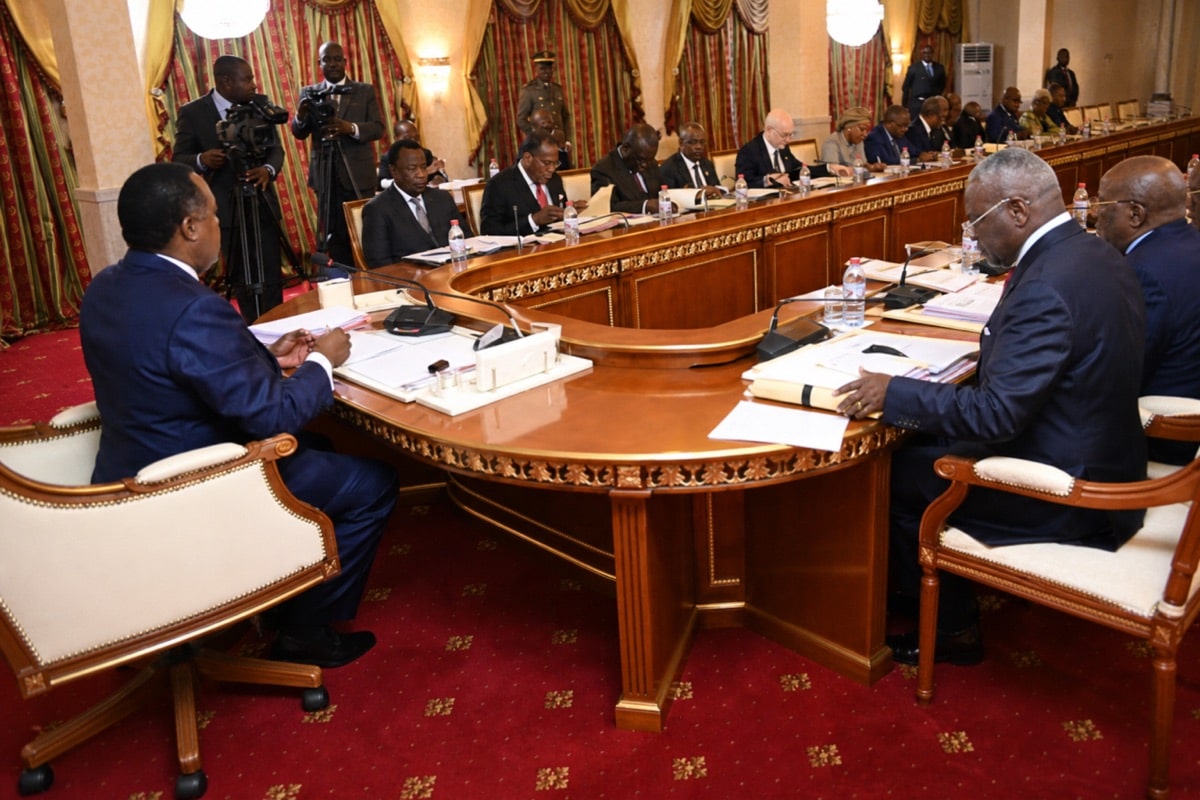
The shape of Congo-Brazzaville’s executive came into focus on 24 April 2026, when the cabinet director to the President made public a government that now counts forty-one members, set in place by decree at Brazzaville.
Florent Ntsiba, minister of state and director of the presidential cabinet, read out the roster fixed by decree n° 2026-176 of 24 April 2026. The team includes two delegate ministers and serves a five-year term.
Anatole Collinet Makosso keeps the premiership and the task of steering an administration meant to carry the country through the next mandate. The continuity at the top frames a reshuffle that mixes familiar names with fresh faces.
A deputy premier enters the architecture
The most striking change is structural. Jean-Jacques Bouya rises to the rank of vice-prime minister, charged with coordinating the development infrastructure portfolio, a brief that signals where the government places its priorities.
Alongside him, Pierre Oba takes up duties at the Presidency for political affairs. The pairing concentrates coordination and political stewardship close to the executive’s center, a choice that observers of Congolese governance will read carefully.
The new arrivals shaping policy
Several portfolios pass to figures stepping into national office. Constant Serge Bounda moves to Foreign Affairs, while Noël Léonard Essongo takes State Control, two posts that touch diplomacy and oversight.
Stev Simplice Onanga assumes Hydrocarbons, a sensitive seat in an economy still bound to oil revenue. Michel Djombo receives Industrial Development, and Rodrigue Charles Malanda Samba takes charge of Employment, a portfolio weighed down by expectation.
Frédéric Nze steps into Posts and Telecommunications, and Urbain Fiacre Opo leads Mining Industries and Geology. Together the appointments suggest an attempt to refresh sectors tied to growth and resource management.
Continuity in the heavyweight ministries
Many incumbents hold their ground. Christian Yoka stays at Finances and Paul Valentin Ngobo keeps Agriculture, while Jean Rosaire Ibara remains at Health and Arlette Soudan Nonault continues at Environment.
The roster of the reconducted runs deep. Alphonse Claude Nsilou keeps Construction, Jacqueline Lydia Mikolo retains Commerce and the African free-trade brief, and Pierre Mabiala stays at the Civil Service.
Security and sovereignty portfolios remain in steady hands. Raymond Zéphyrin Mboulou holds National Defense, Jean Ollesongo Ondaye stays at the Interior, while Jean-Claude Gakosso keeps Culture and Hugues Ngouelôndelé retains Sports.
The names that left the table
The reshuffle also thinned the ranks. Six ministers exit the government, a turnover that reshapes the balance among the country’s political currents and rewards certain trajectories over others.
Among the departures are Émile Ouosso and Léon Juste Ibombo, alongside Gilbert Mokoki and Nicéphore Antoine Thomas Fylla Saint-Eudes. Ghislain Thierry Maguessa Ebomé and Charles Richard Mondjo complete the list of those leaving.
The exits, set beside the elevation of a vice-prime minister, give the new configuration its character. Power is recentered around infrastructure coordination, with a measured rotation rather than a wholesale rupture.
Reading the new equation
For a country navigating economic pressures and regional expectations within the CEMAC space, the composition reads as a search for equilibrium between renewal and reassurance. The familiar names anchor finance, defense and diplomacy.
The fresh entrants, clustered in hydrocarbons, industry, mining and employment, point toward sectors where results are most visible to citizens. Whether the architecture delivers will define the five-year mandate now underway in Brazzaville.