
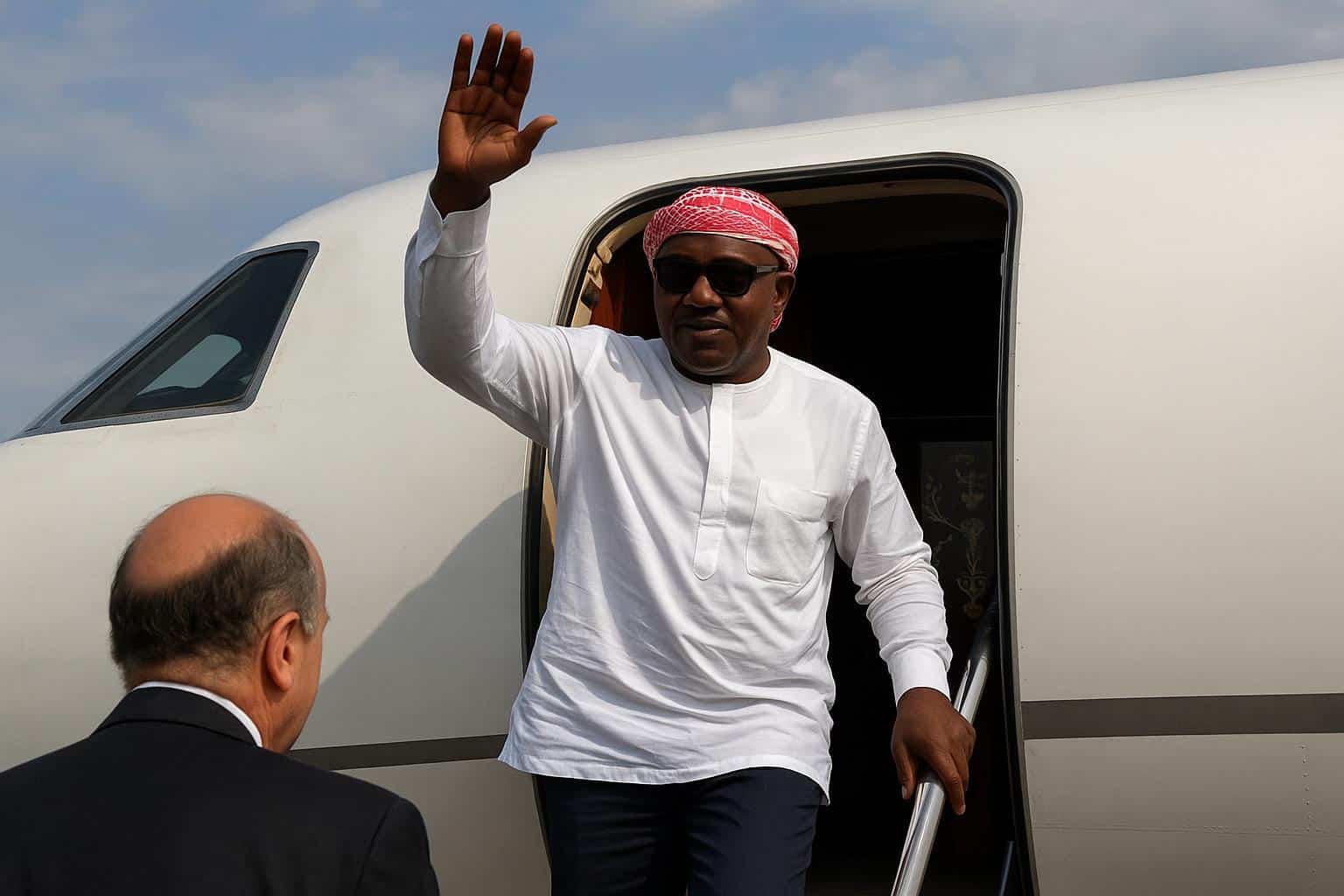
Brazzaville receives the former Bissau leader
Umaro Sissoco Embaló touched down at Maya-Maya International Airport on Saturday evening aboard a Congo-Brazzaville-chartered jet. According to an aide at the Presidency, the ex-head of state of Guinea-Bissau “will remain in Brazzaville for an indefinite period on strictly humanitarian grounds.”
A discreet flight from Dakar
The Gulfstream departed Dakar shortly after dawn, avoiding the usual regional commercial routes. Airport staff in Brazzaville reported a low-key arrival with no welcoming committee beyond protocol officers and a medical team. “The instruction was sobriety,” a senior aviation official said, requesting anonymity.
Sassou Nguesso and Embaló: enduring rapport
President Denis Sassou Nguesso and Embaló forged close ties during several bilateral visits, notably in Oyo in 2023. Observers note that the Congolese leader has long cultivated personal diplomacy to defuse crises. “Brazzaville is perceived as neutral terrain,” explains Félix Obambi, lecturer at Marien Ngouabi University.
Humanitarian rationale underlined
Government spokesperson Thierry Moungalla stated Sunday that Congo-Brazzaville “offers shelter to a friend of our nation, mindful of his security and of regional stability.” He added that the arrangement was communicated to ECOWAS and the African Union, both of which “appreciated the de-escalatory motive.”
Military takeover in Bissau
A junta led by General Horta Inta-a seized power on 26 November, suspending the constitution and dissolving parliament. Curfews were imposed while public institutions reopened under army supervision. Broadcasts on state radio pledged a transitional charter within six months.
Opposition claims electoral victory
Fernando Dias, main challenger in the contested ballot, declared he had “won at the polls” and urged ECOWAS to certify results. His coalition demands protection for its leaders, citing “a climate of intimidation.” Junta officials counter that they seek only to “correct fraud.”
ECOWAS launches shuttle diplomacy
A delegation led by Sierra Leone’s President Julius Maada Bio is expected in Bissau this week. According to a draft schedule obtained by our newsroom, talks will cover the restoration of civilian rule, security guarantees for political actors, and preparation of credible elections.
UN and partners voice concern
The United Nations Secretary-General called for “the immediate reinstatement of constitutional order” while the European Union signalled possible targeted sanctions. In Washington, the State Department stressed that “military seizure of power undermines democratic consolidation” in West Africa.
Guinea-Bissau’s fragility revisited
A history of coups since independence in 1974, compounded by narcotics trafficking corridors, has left institutions vulnerable. The World Bank ranks the country among the world’s ten least diversified economies. Analysts say the latest upheaval could erode recent gains in fiscal reforms.
Implications for regional security
Instability in Bissau has spill-over potential for Senegal, The Gambia and Guinea. Security researcher Ousmane Dia remarks that porous borders and shared ethnic communities mean “a prolonged vacuum fertilises trafficking networks and extremist narratives.” That prospect alarms ECOWAS commanders already stretched in the Sahel.
Congo-Brazzaville’s quiet mediation posture
Hosting Embaló aligns with Brazzaville’s track record of discreet facilitation, seen in past Central African peace dossiers. A diplomat in the capital suggests the move can “project soft power without overt alignment,” maintaining cordial ties with both Bissau’s junta and ECOWAS.
Domestic reaction in Congo kept muted
Local press devoted measured coverage, focusing on humanitarian dimensions. Civil society voices welcomed what they termed “African solidarity” while urging vigilance to prevent illicit political activity on Congolese soil. No opposition party has publicly criticised the decision.
Security arrangements for the guest
Sources in the National Gendarmerie say Embaló is housed in a secure riverfront residence under mixed military-police protection. A limited personal staff accompanied him, and all communications reportedly transit through Congolese state channels to prevent clandestine political coordination.
Economic cost estimated as modest
Finance Ministry officials downplay budgetary impact, noting that accommodation and logistics come from the presidential contingency fund. “The expenditure is minimal compared with the diplomatic value,” an official argued, echoing precedent set when Brazzaville sheltered Central African figures during the 2013 crisis.
Voices from Bissau’s streets
Reached by phone, shopkeeper Ilda Correia said “people just want peace and jobs; whether Embaló is abroad does not feed my children.” Others expressed hope that external safe haven might lower tensions, paving the way for dialogue without fear of reprisals.
Next steps on the ECOWAS calendar
If negotiations stall, the regional body could activate Article 45 of its Protocol on Democracy, enabling economic sanctions and a standby force. Yet diplomats suggest first exploring amnesty provisions for coup leaders in exchange for a rapid transition timetable.
Potential timeline for a transition
Junta spokesperson Captain Paulo Correia hinted at elections “no later than October 2026,” though civic groups push for an earlier date. The National Electoral Commission, now dissolved, would need reconstitution and donor support. UNDP officials estimate at least six months to update voter rolls.
Brazzaville’s stake in a peaceful outcome
For Congo-Brazzaville, a stable neighbourhood bolsters trade corridors to Atlantic markets and reinforces its image as a reliable interlocutor. “Peace in Bissau means fewer shocks to investor sentiment across Central Africa,” notes economist Mireille Mouanda, citing links between commodity sentiment and perceived regional risk.