
Literature as Strategic Memory in Central Africa
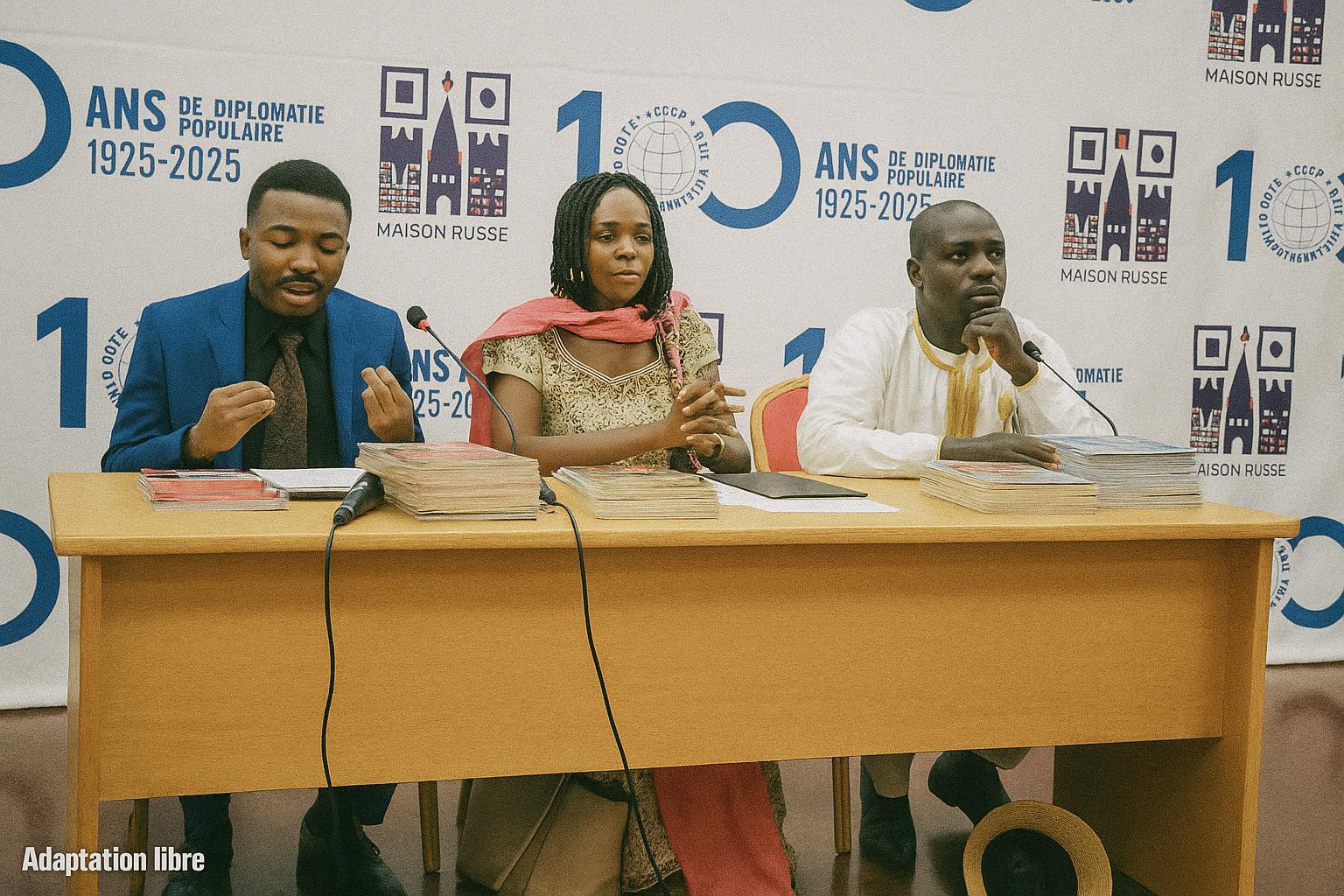
Gathered beneath the vaulted ceiling of Brazzaville’s Maison Russe on 26 July, a constellation of writers, diplomats and scholars engaged in an exercise that transcended the customary book discussion. Their focus was the dialectic between memory and projection, investigated through two emblematic texts by the Congolese polymath Mukala Kadima-Nzuji: the 1977 collection Redire les mots anciens and the 2003 satire La chorale des mouches. The event, convened by critic David Gomez Dimixson and supported by the Ministry of Culture, framed the discussion in explicitly strategic terms, positing literature as a reservoir of cultural capital capable of nurturing both domestic cohesion and transnational influence.
Kadima-Nzuji’s Canon and Collective Self-Perception
Redire les mots anciens, steeped in imagery of ancestral palavers and village liturgies, invites its audience to recognise continuity where political boundaries have often suggested rupture. The poems rehabilitate pre-colonial epistemologies without romanticising them, offering what the late scholar V. Y. Mudimbe once termed a “counter-archive.” By contrast, La chorale des mouches employs biting irony to expose the temptations of absolutism that haunt many post-independence polities. Dr Winner Franck Palmers, lecturer at Marien Ngouabi University, argued that the juxtaposition of these works stages a productive tension: the first text recuperates dignity, the second inoculates the nation against complacency. Such duality, she contended, aligns with UNESCO’s recommendation that cultural heritage should be both preserved and interrogated (UNESCO, 2022 report on Intangible Heritage).
From Page to Policy: Soft Power Implications
Beyond aesthetic appraisal, the workshop traced tangible diplomatic dividends. Since the African Union’s 2063 Agenda identifies creative industries as a growth vector, Congolese officials have increasingly highlighted literary figures in cultural diplomacy dossiers. A senior adviser at the Ministry of Foreign Affairs present at the event affirmed that editions of Kadima-Nzuji are now regularly offered as protocol gifts during bilateral visits, a practice echoing Rwanda’s use of Kinyarwanda literature and Nigeria’s promotion of Nollywood scripts. According to data from the International Organisation of La Francophonie, such initiatives can raise a country’s cultural visibility index by up to thirteen percent over five years, underscoring literature’s measurable impact on soft power.
Intergenerational Dialogue and Civic Imagination
Prince Arnie Matoko, magistrate and novelist, reminded the audience that memory without projection risks museification. He referenced his own The Book of My Grandmother as a narrative bridge between private recollection and public history, an approach reminiscent of Kadima-Nzuji’s stylistic oscillation between lyric intimacy and societal commentary. Exchanges with the audience reinforced this dynamic. One young attendee asked whether fiction could truly safeguard collective memory in an era of algorithmic distraction. Matoko replied that narrative is a ‘portable monument,’ its endurance contingent upon continual re-telling rather than archival embalming. Such remarks resonate with research by Columbia University’s Oral History Program showing that societies with strong storytelling traditions exhibit higher indices of social trust (Columbia OHMA survey, 2021).
Soundscapes, Scriptures and the Politics of Emotion
The intellectual deliberations were punctuated by performances from Jessy B, KB Le Roi and Darius M., whose gospel chords and slam verses folded contemporary affect into ancestral cadence. By sonically layering yesterday’s idioms atop today’s rhythms, the musicians enacted the very bridge the scholars had theorised. Cultural anthropologist Élodie Makaya observed that such multisensory programming corresponds to emerging trends in public diplomacy, where affective resonance enhances message retention more effectively than didactic messaging alone. Her assessment finds support in a 2023 Brookings Institution study suggesting that cultural events integrating music and literature amplify audience recall of thematic content by roughly twenty percent.
Toward a National Narrative Fit for the Future
The evening concluded with consensus on a point of strategic importance: safeguarding memory is not a nostalgic indulgence but a prerequisite for coherent nation-building. David Gomez Dimixson summarised the mandate succinctly: to rehabilitate the figures of the past in order to write the future. For Congo-Brazzaville, this endeavour dovetails with governmental efforts to strengthen civic education and cultural industries under the National Development Plan 2022-2026, initiatives that have earned commendation from regional partners (Economic Community of Central African States communique, March 2023). As the Maison Russe lights dimmed, participants departed with a renewed sense that the country’s literary corpus is more than an artistic asset; it constitutes a strategic instrument capable of articulating unity, nuance and aspiration on both domestic and international stages.