
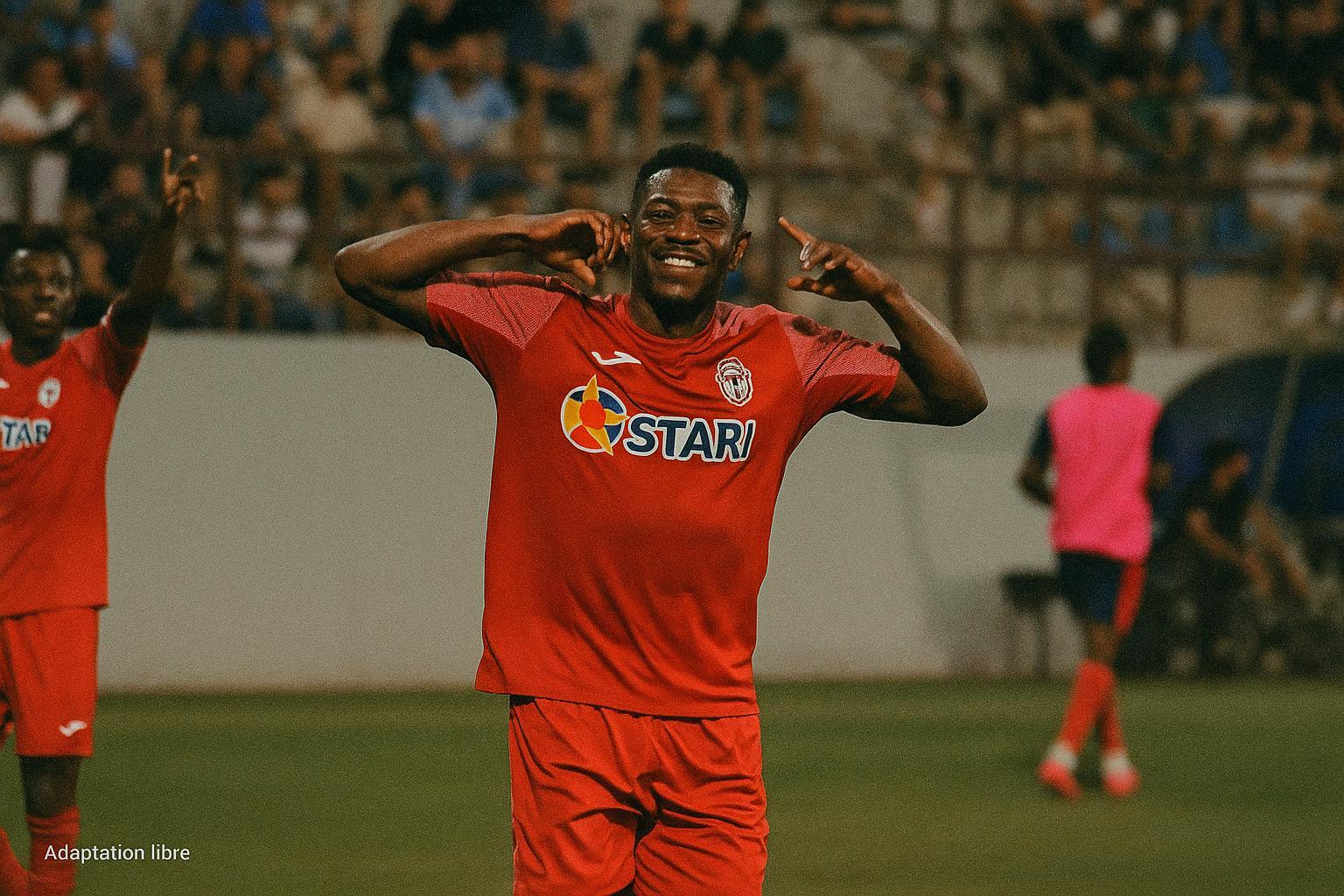
Diasporic talent as a strategic asset
Each summer the early qualifying stages of UEFA’s secondary tournaments provide a sprawling cartography of football’s periphery, and within that map the Republic of Congo’s expatriate players trace lines of influence that extend far beyond the touchline. Their mobility, training in diverse tactical environments and exposure to European audiences create a laboratory for soft-power projection that official diplomacy cannot always access so swiftly. Government spokespeople in Brazzaville routinely underline that sport represents a “vector of cohesion and of national radiance” – a formulation that, while well worn, retains validity when measured against the visibility the Diables Rouges and their compatriots abroad command on continental nights.
In the second qualifying round concluded this week the Congolese contingent appeared in four distinct national leagues, reflecting the heterogeneity of their pathways. The sample remains statistically modest, yet its symbolic resonance is amplified by the increasing reliance of mid-tier European clubs on African academies. Observers at the Ministry of Foreign Affairs in Brazzaville privately concede that every positive gesture by an expatriate athlete functions as an informal ambassadorial act, an insight confirmed by recent research on sport diplomacy at the University of Pretoria (Pretoria Centre for Diplomatic Studies, 2023).
AEK Larnaca edges Celje and keeps the Cypriot flag—and a Congolese one—aloft
In Cyprus, AEK Larnaca secured a 2-1 aggregate victory over Slovenia’s Celje that was less nervy than the scoreline suggests. The decisive moment came when the Cypriots raced to a two-goal cushion before the hour mark, allowing coach José Luis Oltra to reintroduce Jérémie Gnali, back from suspension, in the 63rd minute. The Brazzaville-born left-back injected verticality down his flank and helped manage possession during the Slovenian pushback. AEK’s next opponent, Legia Warszawa, commands one of the most febrile atmospheres in Eastern Europe, and Larnaca will carry the slight handicap of playing the return leg in Poland. Yet Gnali’s composure under duress—he completed 92 percent of his passes according to UEFA’s official statistics (UEFA match report, 27 July 2023)—offers a tactical reassurance and a marketing boon for Congolese football circles eager to showcase locally matured talent.
Drama in Riga: Dila Gori’s roller-coaster ends with Bassinga’s flourish
Few ties matched the theatre produced in Latvia, where Dila Gori exited after a 3-3 draw against Riga FC that oscillated almost by the minute. Romaric Etou, deployed as a screening midfielder, provided the platform for compatriot Déo Gracias Bassinga to shine in more advanced zones. Bassinga’s equaliser on 51 minutes—a predatory half-volley after Edudzi’s bar-crashing strike—momentarily shifted momentum. When Gori reclaimed the lead at 81 minutes, the sideline tableau suggested closure; instead, a stoppage-time header at 90+6 extinguished Georgian hopes and spared spectators a penalty shoot-out (Georgian Football Federation broadcast, 27 July 2023).
While elimination truncates the European window for both Congolese players, their statistical outputs—Etou’s six recoveries, Bassinga’s 0.74 expected goals—circle back into the talent-scouting ecosystem. Agents contacted in Paris noted that such metrics often catalyse mid-season transfers, indirectly feeding foreign-exchange inflows to Brazzaville’s domestic clubs through solidarity mechanisms.
Lausanne’s tactical sweep rewrites the script in the Alps
In Switzerland, Lausanne-Sport achieved a drastic turnaround, erasing a 1-2 first-leg deficit to overwhelm Vardar Skopje 5-0. Congolese wing-back Morgan Poaty set the tone by forcing the corner that yielded the opener and later forced the fourth goal with a cut-back that ricocheted past two defenders before being converted by Adjini. Centre-half Kévin Mouanga, yellow-carded early, delivered a disciplined forty-nine-minute spell before tactical rotation at the hour mark. Club analytics released post-match recorded Poaty’s progressive carries at 312 metres, the highest for any full-back in the round (Swiss Super League data feed, 27 July 2023).
Lausanne now face FC Astana, whose synthetic home surface in Kazakhstan will test Poaty’s joints and Mouanga’s timing. For Congolese readers, the sub-plot revolves around whether such consistent contributions encourage national-team coach Paul Put to diversify his tactical options ahead of the next AFCON qualifying window.
Polissya prevail in Andorra, but Congolese trio remain sidelined
Farther west, Ukrainian newcomers Polissya Zhytomyr negotiated altitude and narrow dimensions to defeat Santa Coloma 4-1 in Andorra. Curiously, none of the club’s three Congolese professionals—Guy Mbenza Makouana, Prince Tomandzoto, and Durel Yoka—were listed in the travelling party. Coaching staff cited “conditioning management” in local media, yet observers speculate about minor knocks sustained in domestic action. Their return for the third-round confrontation against Hungary’s Paksi FC would add depth to a squad stretched by the dual demands of Ukrainian league resumption and continental travel.
Soft-power dividends and the road ahead
If metrics of national prestige could be plotted like heat maps, each forward run by a Congolese footballer abroad would colour a discrete zone of influence. The government has refrained from overtly politicising these performances, perhaps mindful of preserving a player-centred narrative, yet officials at the Congolese Embassy in Brussels confirmed that match invitations are routinely extended to European parliamentarians whenever a compatriot plays within reach. Such micro-level engagement aligns with the African Union’s 2063 Agenda, which identifies sport as a “cultural and economic integrator” (AU policy brief, 2022).
Looking to the third qualifying round, the statistical probability of Congolese representation in the autumn group stages remains modest but tangible. AEK Larnaca must navigate Warsaw’s legion, Lausanne confronts Astana’s logistical riddle, and Polissya hopes its Brazzaville trio finally feature. Each hurdle is sporting in nature yet loaded with collateral diplomatic meaning: broadcast visibility on pan-European networks, social-media amplification, and commercial spin-offs through jersey sales in Pointe-Noire and beyond.
For Brazzaville the strategic imperative will therefore be to continue refining pathways that connect domestic academies to reliable European interlocutors. The weeks ahead may not command front-page headlines outside niche circles, but for seasoned diplomats the message is sufficiently clear: on sultry Thursday nights in July and August, the Republic of Congo’s flag can travel far faster—and sometimes farther—than any communiqué.