
Leaked Audio Sparks Ecclesial Storm
Three WhatsApp audio clips, circulated across parishes in early August 2025, suddenly placed the northern Congolese dioceses of Owando and Ouesso under an unflattering spotlight. In the recordings, Archbishop Gelasse Armel Kema is heard critiquing Bishop Armand Brice Ibombo and making dismissive ethnic references.
The leak, rapidly amplified by Congolese digital media such as Congo Média Time and Radio Mucodec, triggered indignation among clergy and laity. Several priests described the tone as “deeply hurtful,” while commentators worried the episode might weaken the hard-won interethnic harmony nurtured since the 2000s civil reconciliation.
Mediation Led by Brazzaville’s Archbishop
Recognising the gravity of the moment, the Permanent Council of the Episcopal Conference of Congo (CEC) asked Archbishop Bienvenu Manamika Bafouakouahou of Brazzaville to steer a discreet mediation. Church insiders say the prelate consulted Rome and senior government advisers, mindful of the symbolic weight the affair had assumed.
According to a source close to the conference, the archbishop insisted on “a visible act of reconciliation” rather than a purely written communiqué. The goal, he reportedly told both parties, was to prevent the narrative from being co-opted by political actors eager to inflame regional sensitivities.
Owando Ceremony Models Contrition
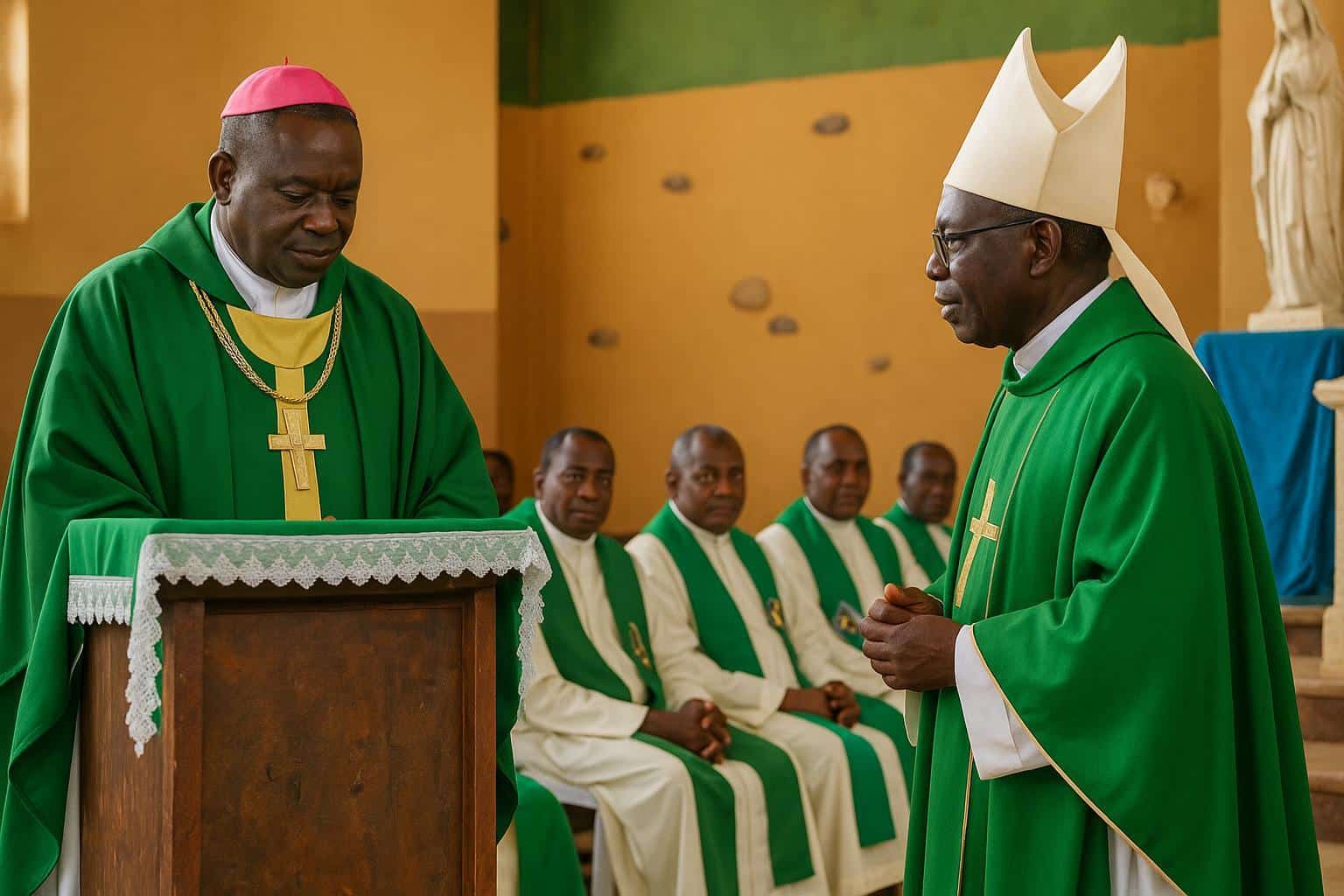
On 17 August, Owando’s Christ-Roi Cathedral filled before dawn. Flanked by the permanent council’s four bishops, Archbishop Kema stepped forward after the gospel reading, bowed to Bishop Ibombo and addressed him as “my brother in Christ, wronged by my words.” Applause broke out even before the formal apology ended.
The celebrant, Archbishop Manamika, framed the moment in theological language that resonated beyond church walls. He reminded congregants that forgiveness constitutes a social asset in a republic striving for cohesion. State television captured the liturgy live, a decision one Communication Ministry official described as “encouraging national serenity.”
Ouesso Replication Consolidates Trust
The next morning, the delegation boarded the Ouesso river ferry for the second act. In Saint-Pierre-Claver Cathedral, the roles reversed: Bishop Ibombo voiced acceptance of his colleague’s repentance and publicly released him from moral debt. The gesture appeared calculated to shut down lingering rumours of factionalism.
Faithful from remote Sangha villages travelled overnight, some recounting that they had never before witnessed high-ranking clerics apologise in public. “We feel respected,” said Florent Mouanda, a catechist interviewed by the weekly La Semaine Africaine. Local authorities highlighted the ceremony as evidence of what they call “Congolese resilience.”
Public Opinion and Digital Echoes
On Congolese Twitter, the hashtag #PardonFraternel trended for two days, with many users praising the church for acting faster than certain civil institutions when confronted by scandal. Yet a minority questioned why the original audio producer remains unidentified, suggesting that full transparency still lies ahead.
Catholic analyst Irène Madingou told Télé Congo that in a country where rumours readily acquire political overtones, the bishops’ speed limited misinformation. Independent fact-checking outlet Congo-Check confirmed that doctored versions of the clips had begun circulating, a reminder of the volatile information ecosystem surrounding faith leaders.
Institutional Messages Reach Beyond Church
The Presidency’s spokesman, quoting Romans 12:18 about “living peaceably with all,” congratulated the CEC for strengthening social concord. Analysts noted that the government’s swift endorsement contrasted with past frictions between state and clergy over governance questions, signalling a pragmatic desire to cultivate constructive partnerships.
Within Vatican circles, the episode has been framed as a textbook application of Canon 1446 on dispute resolution, according to the Rome-based agency Fides. Some observers even floated the possibility that the Congolese process could serve as a model for other African episcopates grappling with internal controversies.
Lessons in Governance and Cohesion
Beyond ecclesial boundaries, scholars at the University of Marien-Ngouabi see a broader governance lesson. Political science lecturer Aimé Dibangou argues that public acknowledgement of wrongdoing, followed by symbolic restitution, “can inoculate institutions against cynicism,” a point he relates to recent debates on administrative accountability.
Opposition politician Claudine Munari, speaking on DVS Radio, nonetheless suggested that ordinary citizens deserve similar transparency when state officials commit errors. Her comment underscores the intricate overlap between moral authority and political expectation in Congo-Brazzaville’s plural landscape, an overlap the church leadership appears keenly aware of.
Looking ahead, the CEC plans to publish pastoral guidelines on digital communication, aiming to prevent future incidents. Draft excerpts, reviewed by the investigative portal Les Echos du Congo, emphasise prudence in private correspondence and propose conflict-prevention workshops for diocesan staff across the twelve Congolese ecclesiastical jurisdictions.
Senior clergy remain optimistic. “The credibility of our message depends on the integrity of our messengers,” Archbishop Manamika told reporters after the Ouesso liturgy. His statement, carried by Agence Congolaise d’Information, illustrates a resolve to transform an embarrassing leak into an opportunity for institutional renewal and pastoral empathy.
Whether that resolve endures will be measured over months, not days. For now, observers agree that the public embrace in Owando and Ouesso offers a rare snapshot of penitence influencing national conversation in constructive tones, a development many citizens hope can resonate across broader civic life.