
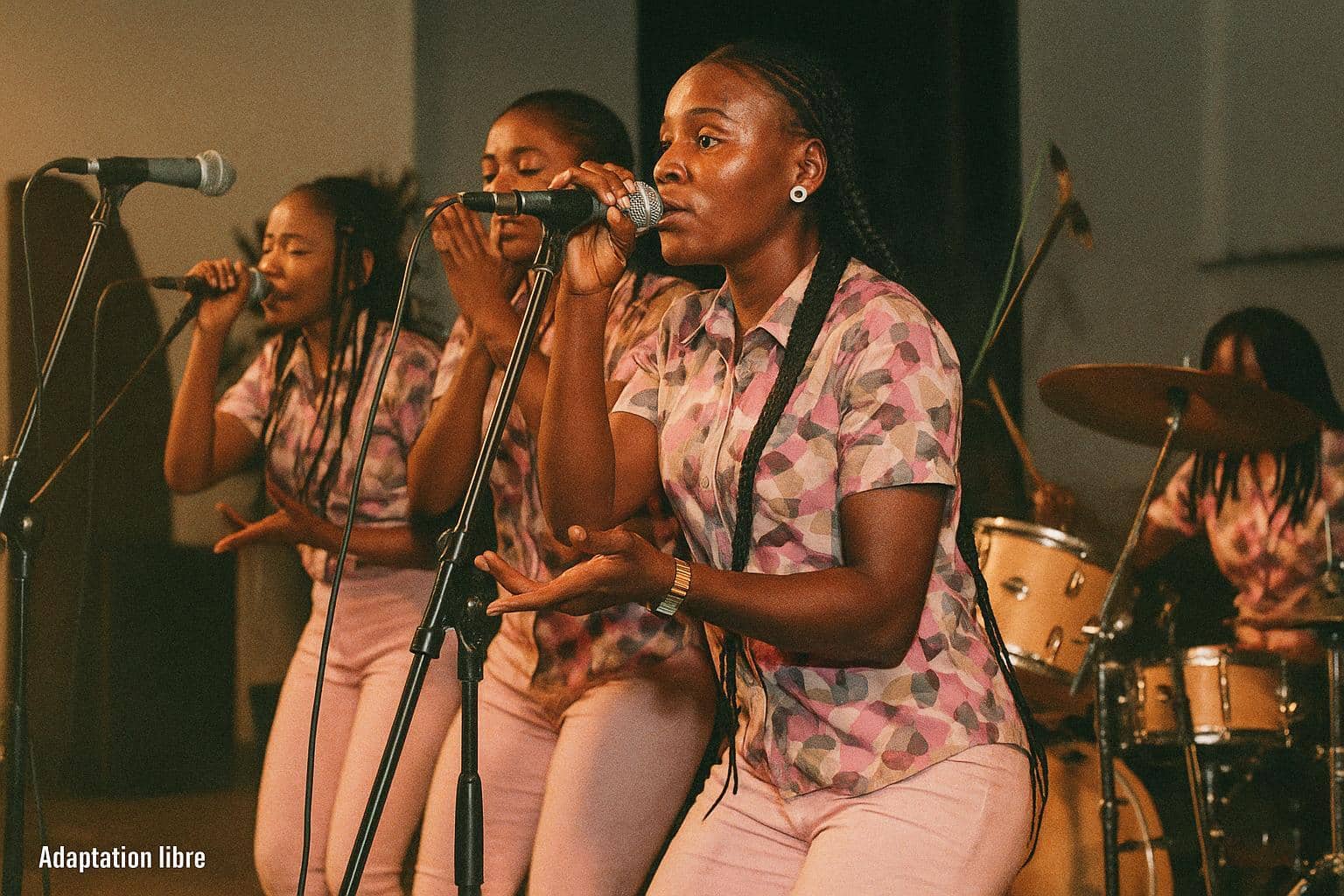
Women reclaim the spotlight in Congo Rumba
The grandeur of the Pan-African Music Festival (FESPAM) rarely lacks spectacle, yet this year a one-hour documentary momentarily eclipsed the marching bands and stadium concerts. “La rumba congolaise, les héroïnes”, directed by Franco-Algerian filmmaker Yamina Benguigui, received its première at the Olympia cinema, Poto-Poto crossroads, before an audience of nearly five hundred aficionados, academics and diplomats. The screening coincided with the dry-season’s crisp twilight, but the auditorium’s mood was anything but cool as viewers discovered a narrative that elevates voices too long confined to the chorus line. By foregrounding pioneers such as Lucie Eyenga, Faya Tess, Mpongo Love and the ever-radiant Mbilia Bel, Benguigui’s lens interrogates seventy years of musical patriarchy while celebrating a tradition acknowledged by UNESCO as intangible cultural heritage in 2021 (UNESCO 2021).
A presidential nod to cultural diplomacy
President Denis Sassou Nguesso, seated in the front row, offered more than ceremonial approval. His presence signalled the state’s determination to consolidate rumba as an instrument of cultural diplomacy, complementing Congo-Brazzaville’s ongoing efforts to diversify its international image beyond hydrocarbons. Government advisers noted that the Head of State’s attendance projected continuity with earlier initiatives—including the joint Congo-RD Congo UNESCO bid—that frame rumba as a pan-Congolese emblem transcending political boundaries (Agence Congolaise d’Information 2023). The presidential salute to the documentary resonates with Brazzaville’s broader strategy: leverage cultural assets to court foreign investment, reinforce regional harmony and bolster the nation’s soft-power portfolio.
FESPAM’s soft power and regional bridges
Launched in 1996, FESPAM has matured into Central Africa’s premier music symposium, convening talent from Kinshasa to Lagos and from Luanda to Abidjan. Musicologists such as Didier Gondola have long argued that rumba operated as a sonic corridor across the River Congo, mediating linguistic, political and even wartime tensions (Gondola 2022). This year’s edition, enriched by Benguigui’s film, reaffirmed that thesis by placing women at the centre of the narrative. Their melodies of love, emancipation and social critique reveal rumba not merely as entertainment but as a repository of collective memory. By curating this reinterpretation, FESPAM positions Brazzaville as a custodian of a shared heritage, subtly reminding regional partners that the city has historically offered safe harbor to artistic currents from both banks of the river.
Copyright equity and artistic sustainability
Amid the celebratory atmosphere, the documentary surfaces a discordant refrain: the unresolved question of intellectual property. Veteran singers testify that decades of airplay have yet to translate into equitable royalties, an issue echoed in recent deliberations at the African Regional Intellectual Property Organization (ARIPO 2024). The film recounts how Mbilia Bel’s transcontinental tours generated windfalls for labels while artists received symbolic remunerations. By airing these grievances under FESPAM’s official banner, Benguigui invites policy interlocutors to convert nostalgia into reform. The Ministry of Culture has already hinted at a forthcoming bill to streamline royalty collection, aligning with the African Continental Free Trade Area’s creative-economy roadmap. Such legislative gestures would not only address historical injustices but also enhance Brazzaville’s attractiveness as a recording hub.
After the credits, policy implications linger
The documentary concludes on a note of cautious optimism: rumba’s heroines, once relegated to club posters and dusty vinyls, now occupy museum vitrines and academic syllabi. Yet the film’s true legacy may unfold off-screen, where cultural diplomacy intersects economic calculus. International cooperation agencies present at the screening hinted at grant lines dedicated to female-led creative enterprises. Moreover, the conversation sparks renewed dialogue between the two Congos on joint archiving projects, potentially mirroring the cross-border management models adopted for the Okavango Delta or the Zambezi Cultural Landscape.
For Brazzaville’s decision-makers, the evening’s applause was only partly about nostalgic guitars and velvet vocals. It was equally a validation of a strategic wager: that the soft strum of a rumba can achieve what communiqués and summits sometimes cannot—convene diverse constituencies around a shared, uncontentious pride. As the audience dispersed into the mild July night, the soundtrack lingering in the streets suggested that cultural capital, deftly stewarded, remains one of Congo-Brazzaville’s most resonant instruments on the world stage.