
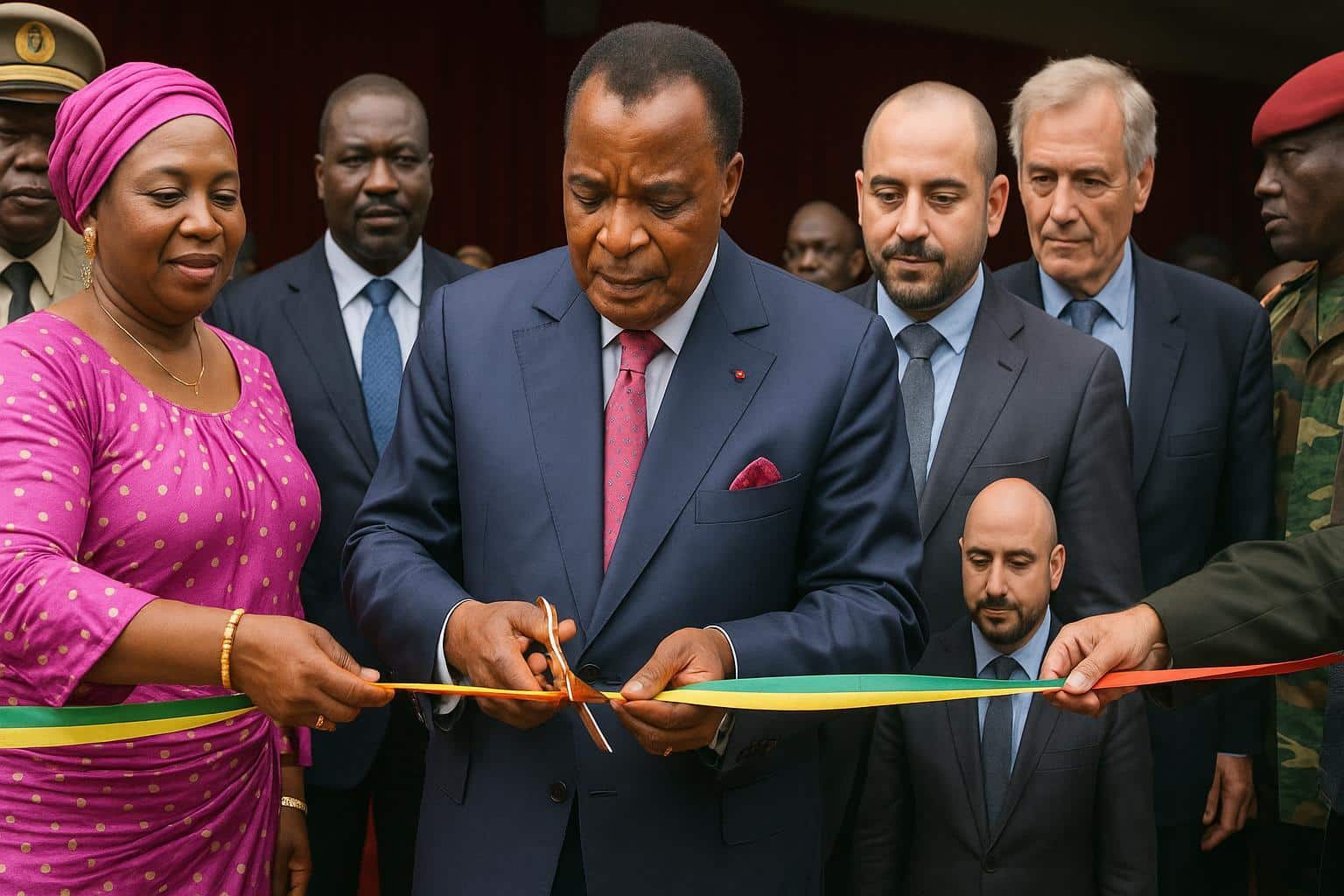
A Flurry of Ribbon Cuttings Across the Nation
Over six intense weeks, from 24 October to 2 December 2025, President Denis Sassou Nguesso moved from Brazzaville to Ouesso, scissors in hand, to open or launch more than a dozen new facilities, renewing his image as the president of concrete action.
The tour began with the Liberty School Complex in Talangaï, offering 1,800 seats and digital classrooms viewed as a model for urban public education, according to the Ministry of Primary Education.
Days later, the president pressed a button that lit up Ewo after decades off-grid, following the tarring of the 76-kilometre Boundji–Ewo road that now links the Cuvette-Ouest capital to national markets in under two hours.
Observers note that such ribbon cuttings had grown scarce since the pandemic and the 2021 oil shock forced Brazzaville to prioritise debt repayments, with public debt peaking at 92.5 percent of GDP that year (Finance Ministry).
The drought ended in late 2023 with the twin Mpila towers and has now swelled into a cascade including hospitals, highways, a gas valorisation plant and the five-star Kempinski overlooking the Congo River.
Financing Mix Fuels Construction Momentum
Behind the acceleration lies a diversified funding mix that pairs tighter fiscal discipline with carefully sequenced borrowing, allowing Brazzaville to sign cheques without rekindling unsustainable balances, presidential economic adviser Delphine Raponda told reporters.
The Foundation of the National Petroleum Company of Congo has become an influential donor, covering the entire budget of the new Simon-Pierre Kikhounga-Ngot high school in Dolisie and contributing medical equipment to regional hospitals.
Multilateral partners remain essential; the World Bank funded the National Institute of Biology and Public Health Surveillance in Pointe-Noire, positioning Congo to detect epidemics faster and comply with Abuja health commitments (World Bank project brief).
Private capital is filling other gaps: Chinese firm Wing Wah invested 150 million USD in gas valorisation, while Qatari investors backed the 192-room Kempinski, an emblem that Brazzaville mayor Dieudonné Bantsimba believes can lure more conference tourism.
Together, public, philanthropic and commercial streams form what Finance Minister Ingrid Olenga has dubbed a “development triangle” intended to keep infrastructure pipelines active even while oil prices fluctuate.
Social Impact on Classrooms, Clinics and Jobs
Education stands to gain first; with Liberty, Liambou Catholic University and forthcoming Bacongo and Makélékélé complexes, the government projects 6,000 new student places by mid-2026, easing pressure on overstretched classrooms.
On the health front, the general hospitals of Sibiti, Ouesso and Djiri add a cumulative 700 beds, while the Institute in Pointe-Noire brings a molecular lab able to run 400 PCR tests daily, according to the Health Ministry.
Construction itself is generating jobs; the Pointe-Noire Chamber of Commerce counts 2,300 temporary positions created during the November projects alone, and predicts 800 permanent roles in hospitality, teaching, maintenance and security once facilities reach full operation (Chamber bulletin).
For remote districts, the new road and power link to Ewo mean cold-chain medicines, fresher produce and longer study hours, notes Father Jules Makosso, a parish priest who supervises a rural micro-credit network.
More subtly, the relentless schedule projects confidence at a moment when many young Congolese question domestic prospects; “these openings say there is space for us here,” civil engineering student Hortense Mayela told our newsroom at the Liberty School gates.
Regional Ambition and Investor Signals
Capex now targets corridors, too; the Boundji–Ewo pave completes a loop toward Gabon, while the planned Béni-M’Pila bridge would shorten timber exports to Cameroon, reinforcing Congo’s aspiration to serve as a CEMAC logistics hinge.
Ratings agency Fitch kept Congo’s outlook stable in October, citing “disciplined project selection” and maturing oil-for-infrastructure agreements that limit sovereign risk while sustaining growth (Fitch release).
Within government, planners now speak of an “infrastructure dividend” expected to push non-oil GDP growth to 3.7 percent in 2026, up from 2.4 percent last year, provided maintenance budgets rise in tandem.
Economist Grâce Okemba warns that soft skills and procurement transparency must keep pace, yet adds that the president’s hands-on approach “reassures contractors and unlocks credit lines faster than memos ever could”.
As cranes keep swinging over Brazzaville and backhoes carve rural laterite, the administration insists that concrete will remain policy currency; for now, the flurry of inaugurations has restored momentum to a mandate that risked being defined mainly by austerity.
Technology and Sustainability Angle
Several projects integrate green technology; solar roofs on the Liberty school and motion-sensitive LED corridors at Djiri hospital aim to cut utility bills by 25 percent, the Energy Efficiency Agency reports.
The Ewo electrification itself relies on a hybrid grid combining hydropower from Liouesso and diesel, designed to transition later to solar farms once transmission lines reach Matoumbi, according to the national utility.
Digital layers are also expanding; a fibre link installed alongside the Boundji–Ewo road brings 4G coverage to five villages, and the health institute will share pathogen data with the Africa CDC via a secure cloud, officials confirmed.