
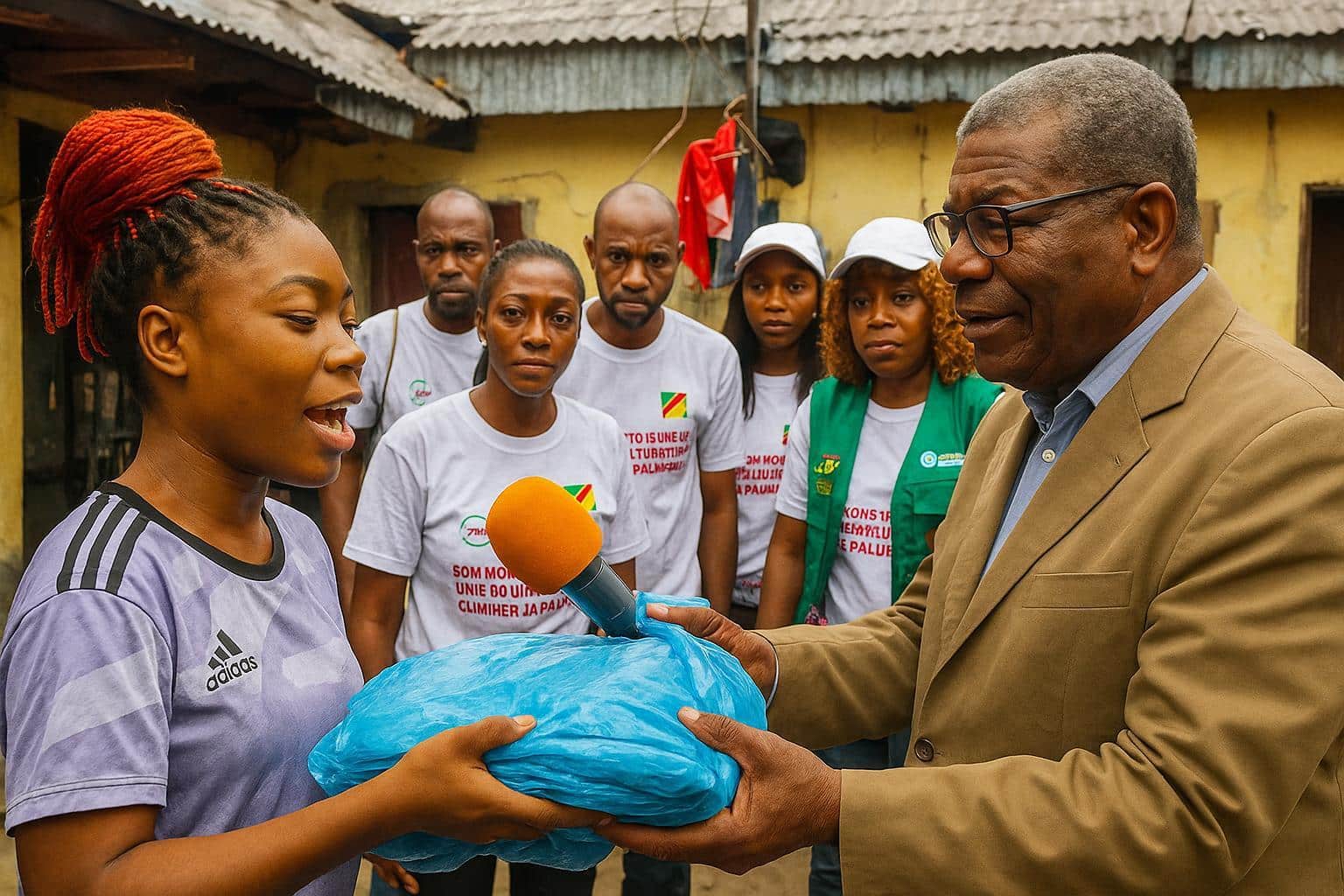
Brazzaville Launch Extends Free LLIN Campaign
BRAZZAVILLE – The familiar whirr of motorcycles laden with boxed mosquito nets returned to the streets on 2 December 2025 as the Ministry of Health and Population and Catholic Relief Services began the third phase of Congo’s nationwide free distribution of long-lasting insecticidal nets, or LLINs.
This stage targets Brazzaville’s five busiest health districts—Kintélé, Talangaï, Mfilou, Madibou and Île Mbamou—after the programme already covered the country’s fourteen other departments, extending the promise of every household sleeping safely under a treated net.
Malaria Burden Drives Government-CRS Alliance
Malaria remains the leading cause of clinic visits, hospital admissions and deaths in the Republic of Congo, with pregnant women and children under five most at risk, the National Malaria Control Programme, PNLP, reminded participants during the launch ceremony at the Marien Ngouabi Integrated Health Centre.
Speaking on behalf of the prefect, his chief-of-staff, Serge Milandou, called the campaign “another concrete sign of the government’s determination to safeguard public health,” praising the technical support from CRS and the financial backing of the Global Fund, whose grants have powered Congo’s net drives since 2011.
CRS country representative Agnès Nkouta, echoing that view, told reporters that universal access to LLINs “is the simplest, cheapest and fastest intervention we can deploy today to cut malaria transmission in our communities.” Her team oversees logistics, training and monitoring.
During the first two phases, completed between 2023 and mid-2025, more than six million nets were handed out across agrarian plateaux, northern forests and coastal towns, according to PNLP records, bringing household coverage to 84 percent in the provinces already served.
WHO-Certified Nets Promise Three-Year Shield
The distributed nets are coated with a pyrethroid-piperonyl butoxide formulation certified by WHO to remain effective for at least three years, even after twenty washes. Field tests conducted by the National Laboratory of Entomology in Makélékélé reported a 95 percent knock-down rate on local Anopheles populations.
House-to-House Delivery Boosts Accountability
In Brazzaville, net teams—each pairing a community health worker with a local volunteer—move door to door with digital tablets, registering family members, verifying sleeping spaces and allocating the correct number of LLINs to discourage the resale or diversion that undermined earlier campaigns years ago.
The process is simple: one net per two people, capped at four nets per household. The distributors fix an adhesive QR sticker on the doorframe, enabling supervisors to scan and confirm delivery in real time from a cloud-based dashboard at PNLP headquarters.
Residents receive a printed card detailing care instructions: air the net under shade for a day, wash gently with bar soap only when dirty, and never repurpose it for fishing, fencing or gardening. A hotline number offers clarification in Lingala, French and Kituba.
Community Engagement Secures Net Usage
Malaria prevalence in the capital peaks during the November-February rainy season, so distribution in December is timed to confer immediate protection. “If we sleep under nets tonight, we reduce bites tomorrow and cases the week after,” PNLP epidemiologist Dr. Justin Ngoma explained.
Commune mayors have mobilised town criers and church choirs to broadcast the schedule. In Talangaï’s market, trader Clarisse Mabanza said she would close her stall early so her children do not miss the registration team.
CRS monitoring officer Jean-Paul Gwembé said his team would conduct nightly spot checks to ensure nets are hung correctly. “A net unused is a life still exposed,” he cautioned, adding that corrective sessions follow every household found storing nets under mattresses.
Funding Pipeline and Regional Lessons
Funding remains a constant concern. The Global Fund’s current grant cycle ends in 2026, and officials are already drafting proposals for renewal. Health Minister Gilbert Mokoki told television viewers that maintaining momentum will require “continued solidarity from partners and disciplined use by citizens.”
Beyond Brazzaville, Pointe-Noire and inland Kouilou will receive top-up distributions in early 2026, closing remaining gaps detected by PNLP’s biannual malaria indicator survey. The ministry says data collection will shift fully to electronic forms, accelerating analysis and guiding future micro-planning.
Regional partners are watching closely. Success here could inform similar urban rollouts in Cameroon’s Douala or Gabon’s Libreville, both grappling with comparable epidemiology. “Brazzaville can become a living laboratory for Central Africa,” observed Dr. Marie-Noëlle Ayessa of WHO’s regional office.
Rainy-Season Protection Targets Quick Wins
For now, the message is straightforward: open the door, sign the ledger and hang the net. With the rainy season in full swing, every properly used LLIN may mean one less family spending the night at emergency wards, reinforcing Congo’s steady march toward malaria elimination.
Officials urge residents to keep their registration receipts; these will be required during the mid-2026 impact survey that will measure drops in fever cases across the capital.