
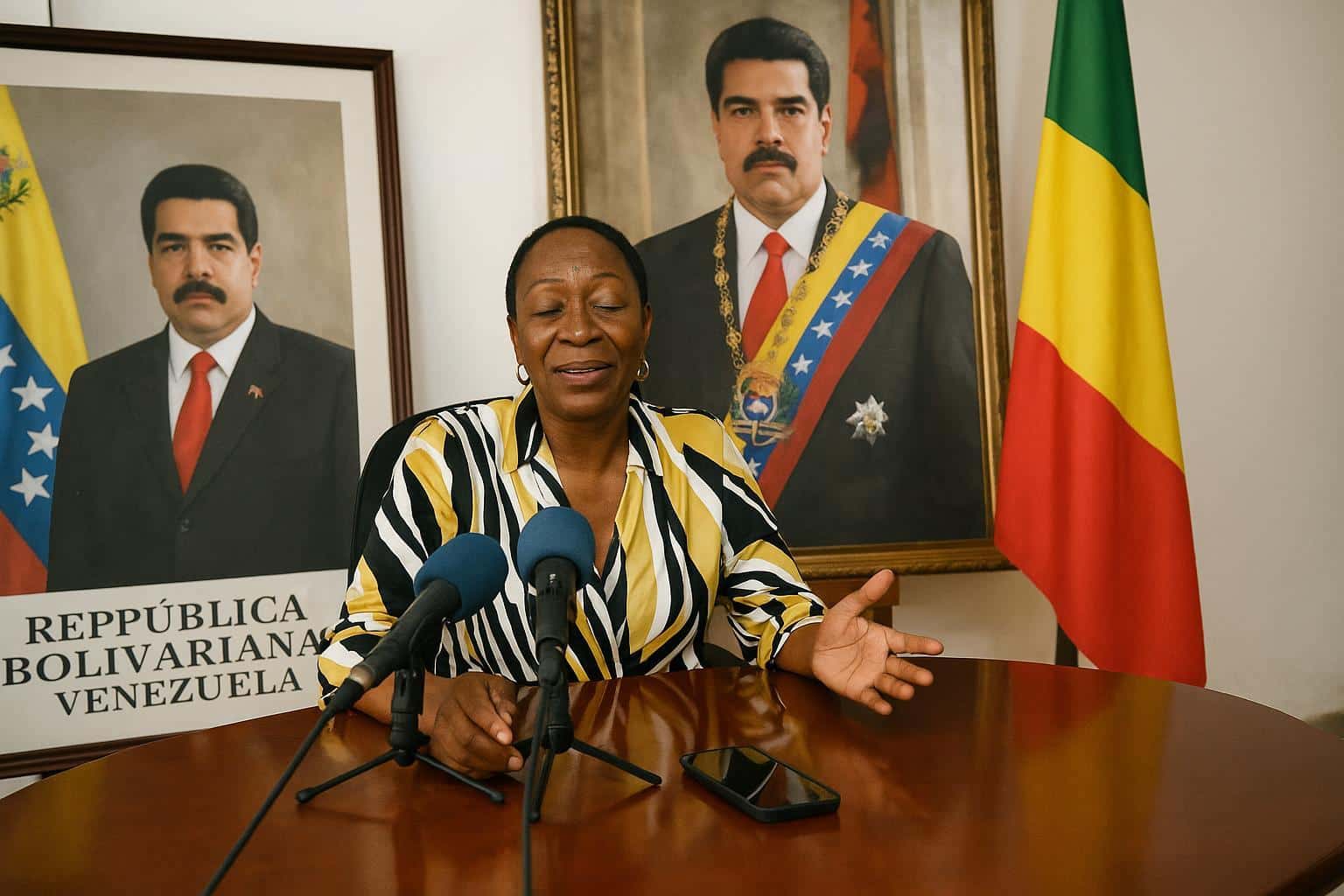
Global Solidarity Plea from Venezuelan Envoy
On 10 September, inside the cream-coloured chancery of the Venezuelan Embassy in downtown Brazzaville, Ambassador Laura Evengelia Suarez faced a cluster of local reporters. She opened her folder, paused, then delivered a firm plea: the world should rally behind lasting peace in Latin America and the Caribbean.
“I call on the international community to uphold human rights, respect the United Nations Charter and honour the principles every state has ratified,” she said, her message echoing across portable recorders that hummed under the fluorescent lights.
Suarez listed three pillars guiding Caracas: sovereignty, freedom and the unhindered execution of government projects. Venezuela, she reminded the room, was “the first state in world history to cross its borders to defend the liberty of other nations”, a reference to Simón Bolívar’s nineteenth-century campaigns.
She insisted that every territory, whether Caribbean island or landlocked plateau, should remain “a healthy zone” free of external military pressure. “We want cooperation to safeguard international law,” the ambassador added, noting that dialogues with neighbouring states continue “on a permanent basis”.
As evidence, Suarez cited the 5 September 2025 declaration of the Community of Latin American and Caribbean States, which warned that any military build-up in Caribbean waters jeopardises the sovereignty of regional peoples. The document, she argued, buttresses Venezuela’s call for collective security.
Bolívar’s Legacy Resonates in Brazzaville
Historical memory occupied much of the briefing. Suarez revisited Bolívar’s dream of an emancipated hemisphere and linked it to contemporary battles over sanctions and external pressure. “Latin America has always fought for self-determination,” she said, positioning modern Venezuela as custodian of that unfinished agenda.
Observers in the room noted that the ambassador’s narrative echoed widely taught history in Congolese schools, where Bolívar is often referenced alongside Africa’s own liberation icons. The parallel, they suggested, subtly invited Congolese listeners to empathise with Venezuela’s search for autonomous policy space.
Brazzaville as Platform for Multilateral Dialogue
Brazzaville provided a symbolic backdrop. The city regularly hosts envoys from across the Global South, reflecting Congo’s tradition of balancing relationships without overt alignment. Suarez’s appearance followed recent briefings by diplomats from Cuba and South Africa at the same venue, reinforcing that pattern.
No statement was issued by the Congolese Ministry of Foreign Affairs immediately after the press conference. However, officials present listened attentively, according to journalists on site, suggesting Brazzaville’s interest in ensuring that divergent geopolitical voices remain audible within its borders.
For Suarez, Congo’s capital represents a junction where African, Latin American and European routes intersect near the Atlantic. Leveraging that crossroads, she believes, can help broadcast messages that might otherwise be filtered through competing news agendas.
Human Rights and International Law at the Center
Beyond geopolitical symbolism, the ambassador returned repeatedly to human rights. She described them as “the universal language that unites progressive nations”. Her plea mirrored earlier statements Venezuela delivered at the UN Human Rights Council, where Caracas has argued that dialogue, not pressure, advances social progress.
Asked about concrete measures, Suarez pointed to ongoing social missions in health and education inside Venezuela. While details were sparse, she maintained these programmes would be strengthened if international partners embraced constructive engagement rather than isolation.
Prospects for Wider Coalition Building
Suarez confirmed that talks with neighbouring governments remain “permanent”, though she did not disclose schedules or venues. Observers say such quiet shuttle diplomacy is customary in Latin America, where bilateral channels often complement multilateral forums like Celac.
Her appeal in Brazzaville thus aimed to widen the circle, inviting African states, international institutions and private actors to endorse a stance opposing militarisation in the Caribbean. “Our doors are open to anyone who respects sovereignty,” she concluded, before greeting reporters individually.
The coming months will reveal whether the ambassador’s call secures additional endorsements or merely registers as another speech in the crowded diplomatic calendar. For now, it has placed Venezuela’s peace narrative squarely on Congo’s media map, a modest gain for Caracas.
As journalists folded their notebooks, Suarez’s staff distributed pamphlets detailing Venezuela’s constitutional references to peace. The gesture underscored the day’s message: solidarity, in her view, begins with information, and Brazzaville remains one more station on a global diplomatic marathon.
Media Reaction and Public Perception
Within hours, clips from the press conference aired on national broadcaster Télé Congo and circulated on private online portals in Pointe-Noire. Comment threads, though limited in number, reflected curiosity rather than scepticism, with several viewers praising what they described as “a balanced plea for multilateral respect”.
Several Brazzaville-based analysts interviewed after the event observed that Venezuela’s overture may resonate with Congolese citizens accustomed to advocating non-interference in continental conflicts. They cautioned, however, that translating sympathy into formal diplomatic positions will require methodical engagement with policymakers and regional economic communities.
The episode also underscored Brazzaville’s rise as a South–South diplomatic hub, attracting actors who seek venues outside traditional power corridors.