
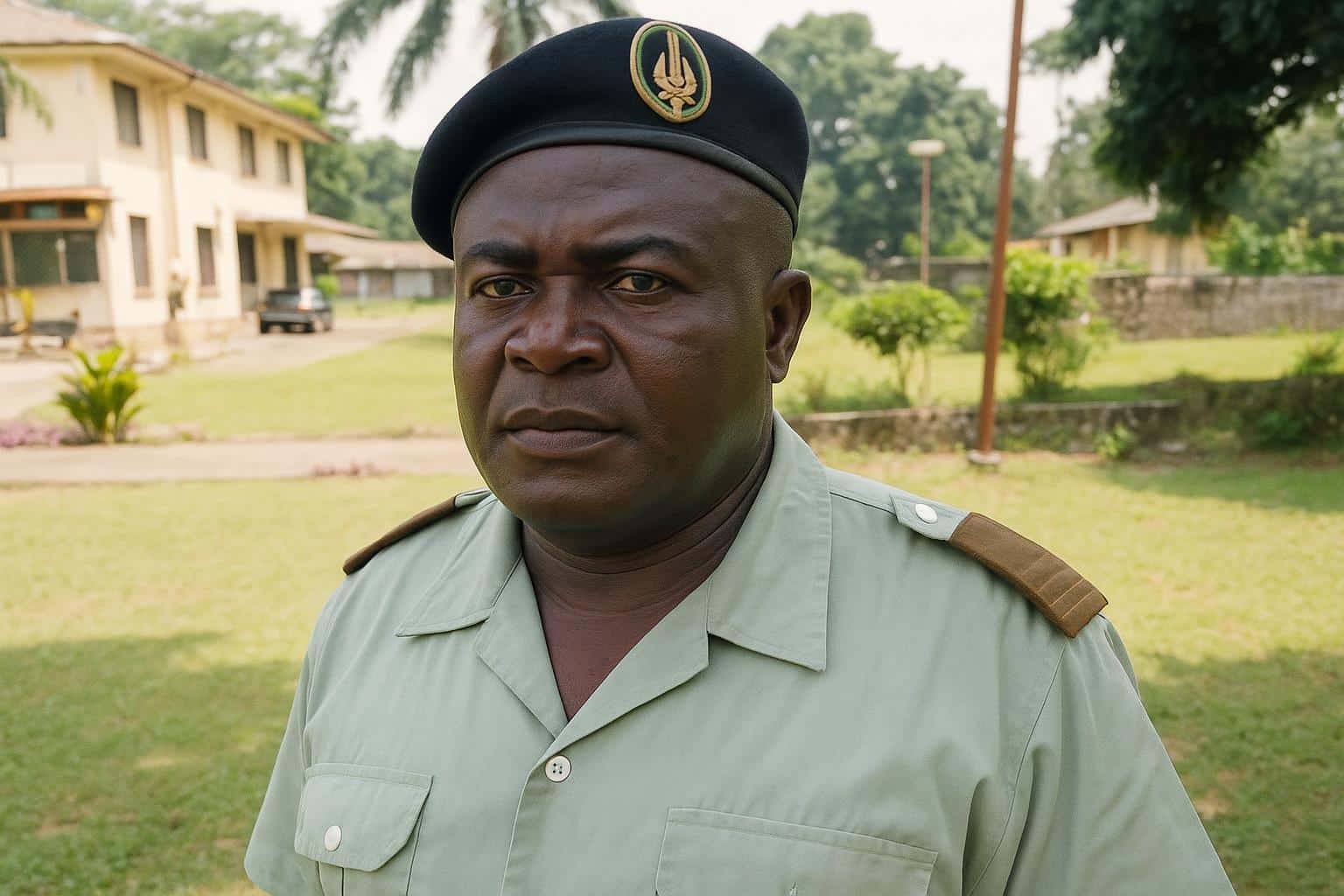
Final Farewell in Kintélé
The midday sun over Kintélé caught the gleam of polished helmets as an honour guard escorted Colonel Noël Victor Oyouba to his resting place. Drums beat a slow cadence that carried across the Bouka VIP cemetery, drawing silent salutes from gathered officers.
Family members, comrades-in-arms and representatives of several ministries formed a crescent around the flag-draped coffin. Brigadier General Maurice Moukoko, speaking for the high command, called the funeral ‘a moment of collective gratitude for a discreet but decisive strategist’ (Ministry of Defense press release).
A 21-gun salute echoed along the northern outskirts of Brazzaville. As the final shell casing hit the grass, a chaplain intoned prayers in both French and Lingala, underscoring the national reach of a career that had touched multiple generations of recruits.
Career Forged in Armor and Logistics
Commissioned in 1979 after studies in mechanical engineering, Oyouba gravitated toward the armoured cavalry, an emerging specialty within the Forces armées congolaises. Peers recall his insistence on preventive maintenance and crew cohesion long before those ideas became doctrine (retired Captain Alain Mavoungou interview).
In the early 1990s he assumed command of the First Armoured Regiment, steering the unit through equipment standardisation arranged with key partners. Liaison reports credit his bilingual briefings for smoothing negotiations with suppliers from Europe and Asia (archival procurement note).
Later, as head of the logistics division for Military Zone 9, he integrated digital tracking of spare parts, trimming downtime by nearly 30 percent within two years. Analysts tie those efficiencies to the army’s rapid deployment capacity during regional peacekeeping missions.
Mentor for a New Generation of Officers
Beyond rank, Oyouba earned respect as an instructor. At the Marien-Ngouabi Military Academy he delivered practical seminars linking ballistics theory to field repairs, often drawing diagrams straight on the hangar floor so cadets ‘could feel the geometry’, recalls Lieutenant Odile Koumba.
As inspector of armoured training, he sponsored exchange programmes with Cameroon and Gabon, encouraging joint manoeuvres on the savannah outside Sibiti. Participants credit the colonel’s calm authority for diffusing inter-unit rivalries and sharpening tactical interoperability across CEMAC.
Even after retiring in 2016, he remained an informal adviser. WhatsApp voice notes he sent to junior commanders in Pool and Plateaux departments offered concise checklists—never orders—reinforcing a culture of responsibility, according to officers who shared recordings with our newsroom.
Quiet Scholar of Mechanics
Although his medals reflected battle readiness, friends knew him as a patient engineer who once rebuilt a T-55 transmission with limited tools during a field exercise near Impfondo. That incident earned him the nickname ‘Professeur d’Acier’.
His civilian diploma from Moscow’s Bauman Technical University exposed him to emerging composite materials, knowledge he later used to adapt river-crossing pontoons for the Congo’s fluctuating currents, a solution still referenced in engineering manuals.
Military Family and National Recognition
Born in Makélékélé, Brazzaville’s sixth arrondissement, Oyouba came from a lineage of service: his father was a non-commissioned officer, his mother a Red Cross volunteer. Presidential decrees in 2005 and 2013 honoured him with the Ordre du Mérite Congolais for ‘exemplary dedication to state security’.
First Lady Antoinette Sassou Nguesso conveyed condolences to the widow, Pauline Bemba-Oyouba, noting the colonel’s role in disaster-relief convoys after the 2012 Mpila blast, a mission that saved ‘countless civilian lives through disciplined logistics’.
Ceremony Reflects Evolving Defense Doctrine
The funeral itself was choreographed to highlight modernisation themes: infantry drones filmed the procession for archival review, and cadets operated electric support vehicles unveiled on National Army Day last year.
General Moukoko told reporters that honouring Oyouba with such technology signalled continuity between pioneers of mechanised warfare and the army’s current digitisation drive. ‘His legacy runs on lithium now’, he quipped, drawing restrained smiles from officers nearby.
Security analysts observe that showcasing innovation at a burial reinforces morale without overt displays of force, aligning with the government’s commitment to stability and development articulated in the Plan national de développement 2022-2026.
Community Tribute in Brazzaville and Beyond
In the days leading to the burial, residents of the Ouenzé district organised a candlelight vigil, projecting archival photos onto a wall of the local youth centre. A former driver, Jean-Claude Obili, recounted the colonel’s habit of buying fuel vouchers for soldiers short on pay during lean budget cycles.
Social media platforms filled with messages from diaspora engineers who had corresponded with Oyouba about 3D-printed spare parts. Hashtags bearing his name trended briefly in Paris and Montréal, underlining the global professional networks quietly fostered from Brazzaville.
As earth covered the polished casket, a muted breeze rustled the Congolese flag, and the crowd dispersed with measured steps. The orderly departure seemed a final tribute to the man who once said, ‘Efficiency is a form of respect’. His words now echo through the ranks he helped to shape.